Working ‘in series’ came as a big breakthrough

One of the artistic ideals in my life originated in the fantastic illustrations by Inuit craftsmen as they expressed the world they inhabit. Perhaps you’ve seen some of their calendars exhibiting owls, seals, the sun itself, and the like.

As I was told by the couple who introduced me to the Inuit works, an artist in the tradition does a subject just once, at least in the position or perspective that results. A bear, for instance, might be shown standing, but only once. If a bruin shows up again, it would be fishing or lumbering along or maybe paired. Each appearance, though, must be unique. There were still plenty of ducks, geese, walruses, whales, and other Inuit – hunters, mothers, and children – remaining for close examination, even in their Arctic environment.

The husband who told me this, let me add, was a coauthor of the Alaska constitution who had some acquaintance with the ecosystem. He had grown up at its southern edge, northern Washington state.

After more than two decades with that as a guideline, I faced a conundrum as I tried to assemble my own poems for submission as a competition for a chapbook – a booklet, essentially. A book needs to flow from start and middle to an end with some sense of continuity. My one offering that had that, American Olympus, had a received a provisional acceptance from a prominent press that later rescinded, claiming a cut in their grant funding. And my other pieces hopped, skipped, and jumped from one setting to another – if only I had been able to remain in one setting long enough for continuity in their completion.

Beyond that, my own life had moved on, providing me a lode of new material to draw upon. That’s when I turned to the idea of theme and variations, a major element of the classical music I so love and also big in jazz as improvisation. What hit me, especially, was Ted Brautigan’s sonnets from the ‘60s. They were essentially three poems, reworked over and over, into a full and very stunning collection.

I took that as my springboard into two intense weeks – while working fulltime as a newspaper editor – of reworking raw notes of loved desire that had incinerated into what you can read as Braided Double-Cross – a set that was rejected by the jurors in a competition based in its principal subject’s hometown. Maybe it was too intense. The poems are searing.
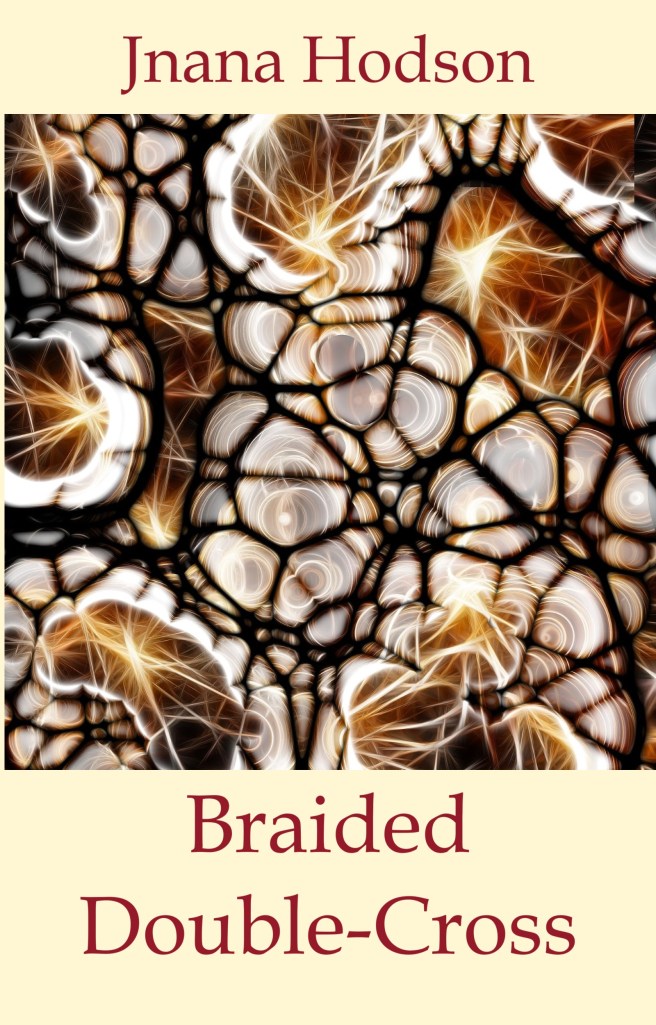
The night I finished drafting the 60 poems, I should note, I went out to dinner and have no idea how much I tipped the server. I was thoroughly exhausted, not just emotionally. Not that I remember of the meal I devoured.

Love really can be such a bitch. At least it still is with me, no matter how much she wonders why I still worship the one who continues in my life.

~*~

For now, let’s turn to the question of what makes a poetry collection “hang together”? In contrast to an assembly from my “best work,” however sporadic.

For perspective, also consider my aversion to series in fiction, where I’ve seen too many series as the same book done over and over with a few tweaks, even if that has led to way too many bestsellers. Yet I’ve gone back to my novels and reworked them to create linkage from one to the next, at least in two separate series. What I think now separates mine from most series is that none of my novels is a carbon copy of any of the others. Mine do, in contrast, represent a sequencing of growth from one to the other. In that way, they create one longer epic rather than imitative episodes like a TV sitcom.

Still, what is it that draws you back to a particular author, book after book?

~*~

I think now of the observation that an author’s next book springs from what was left unsaid in the volume published just before it. That point resonates and returns us to the question of how does an author know when a work’s finished.

Regardless, I’ve definitely done much more in the vein of “series” since completing the first.

~*~

You can find Braided Double-Cross and more in the digital platform of your choice at Smashwords, the Apple Store, Barnes & Noble’s Nook, Scribd, Sony’s Kobo, and other fine ebook retailers. You can also ask your public library to obtain it.
Highest with lows

What was the best year of your life and how did it look?

Pondering the possibilities for my most perfect year, I see how much even the best was tainted.

’72, I had the high of the ashram but it involved going through a lot of psychological muck and growth to get there. See Yoga Bootcamp for the parallels.

’73 was the whirlwind with my future wife, but I was laboring at subsistence pay, at best. See Nearly Canaan for the parallels.

’83 encompassed both my divorce and an exhilarating engagement with the young cellist who promised to be The One. It was also crushed in long workdays as a shirtsleeves manager in a newsroom, no matter how engaging I found the challenge professionally.

’86, I was deeply ensconced in a self-awarded sabbatical, but generally loveless. The core of my fiction was drafted in this period, and my circle of friends included Mennonites and my introduction to part-singing.

’99, the excitement of the ultimate woman in my life, as well as our frustrations in trying to find a home we could afford along with some emotional upheavals at the office.

2021, my exile to Eastport in what became a heavenly writer’s retreat, resulting in the publication of Quaking Dover the next year. It did mean being apart from my family and friends back in Dover for much of the time, but included exploring the fantastic outdoors of the waters and woodlands around me as well as the artistic stimulation of my new community.

So here I am now, with what’s turning into the home of my dreams in the sunset of this life.

Add to my once idealistic expectations, there was this

My goal of having our family operating on a Quaker Meeting decision-making process.

Yes, trying to find concesus with young children in the house. We’re all on board, right?

Let’s just say I failed here. My, was a naïve when I jumped in as a stepdad in my mid-50s!

Not just because of a rebellious younger member, whom I deeply adore. But also because of the parent/adult dynamics and tensions.

No doubt, I pictured myself as the clerk, that is moderator. The mother, however, is what the one in the movie My Fat Greek Wedding Declared, the throat, ultimately rules.

Saint Paul should stand fully corrected regarding the head of the household. The mother’s is great theology.

Just how are decisions really made in families? I’d love to listen in on the discussions.

First Lady Dolley Madison cut quite a character

Dolley Payne (1768-1849) was the widow of prominent Philadelphia lawyer John Todd when she married the future fourth president of the United States, James Madison from Virginia. She was a colorful character, even apart from her extravagant fashion sense (which I see as a rebellion against the Quaker Plain constraints of her youth), a charming hostess who can be viewed as a founder of bipartisanship in American politics thanks to her dinners. Pleasurable food does enhance conversation, no? Dolley’s legendary social gatherings, known as “squeezes,” were attended by influential figures such as politicians, foreign dignitaries, and intellectuals, making her a central figure in American society.

Or, as a North Carolina Quaker minute book wistfully records her, “Formerly of our society,” meaning the Society of Friends. She was also the first president’s wife to be called First Lady.

Today, we have a Double Tendrils. The first set of quotes reflects her time in the White House and her flight during the War of 1812 when she saved the iconic portrait of George Washington in the throes of the attack that burned the new White House, which she had furnished and decorated.

First, things she said as First Lady.

  1. Two messengers covered with dust come to bid me fly, but I wait for him. … I am accordingly ready; I have pressed as many Cabinet papers into trunks as to fill one carriage; our private property must be sacrificed, as it is impossible to procure wagons for its transportation. … It is done… the precious portrait placed in the hands of the gentlemen for safe keeping. … And now, dear sister, I must leave this house or the retreating army will make me a prisoner in it by filling up the road I am directed to take.
  2. I have always considered my husband my partner and equal, and have valued his opinions and ideas greatly.
  3. In times of crisis, it is important to remain calm and focused, and to make decisions based on reason rather than emotion.
  4. Leadership is not about wielding power, but about serving others with humility and compassion.
  5. You may imagine me the very shadow of my husband.
  6. A good leader listens to the voices of those they serve, and seeks to understand and address their needs.
  7. History is shaped by the actions of individuals, and we all have the power to make a difference.
  8. I believe in the importance of standing up for what is right, even if it means going against popular opinion.
  9. I have never been afraid to speak my mind and advocate for causes that I believe in.
  10. I believe in the power of collaboration and teamwork, and the strength that comes from working together towards a common goal.

The second set of quotes frame a larger perspective.

  1. It is one of my sources of happiness never to desire a knowledge of other people’s business.
  2. I believe in the power of education and the importance of women’s access to knowledge.
  3. I believe in the importance of preserving and protecting our natural environment for future generations.
  4. True strength lies in the ability to admit mistakes and learn from them. … Honesty and integrity are the foundations of a strong and lasting legacy.
  5. A strong woman is one who can support and lift others up, even in the face of adversity. … Women have the capacity to be leaders and agents of change, and should be given equal opportunities in all areas of society.
  6. Life is too short to hold grudges or dwell on the past.
  7. Excellence should be pursued in all aspects of life, whether it be in relationships, work, or personal growth.
  8. Everyone deserves to be treated with respect and dignity, regardless of their background or social status. … The true measure of a person’s character is how they treat others, especially those who are less fortunate.
  9. Kindness is not a sign of weakness, but a reflection of strength and compassion. … I believe in the power of forgiveness and the strength that comes from letting go of anger and resentment.
  10. I would rather fight with my hands than my tongue.

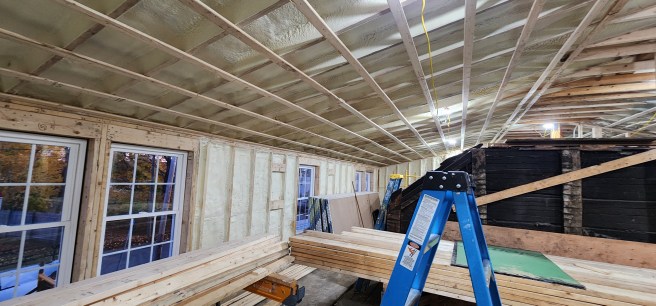
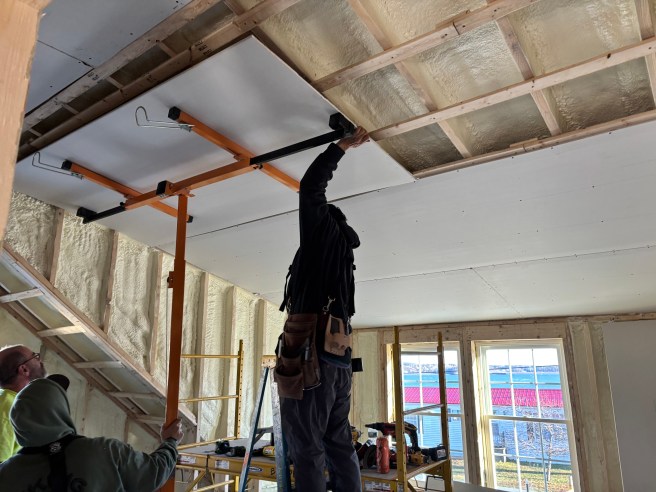
Watching the rooms take shape was especially exciting

There were moments when we wondered about leaving all of that space open – just one big room. Maybe something like an artsy loft apartment. But then we returned to our projected needs and the plan at hand.

As the framing and wiring and flooring moved along, as well as the drywall itself, our hopes of painting the interior in the weeks between Thanksgiving and Christmas got pushed back till after New Year’s. Still, we were able to sleep some of our visiting family up there in primitive conditions as the drywall taping and mudding dried, thanks to a flurry of action just before Christmas.

The two front bedrooms are nearly twice as large as ones in the back. No surprise there, since the back half also has a small hallway and the bathroom and the laundry room.

Altogether, we have twice as many electrical outlets up there than we do on the first floor. And twice as much natural light.

As for the views? Sometimes breathtaking.

The good news is that the upper level, which prompted all of this work and expense to date, is largely complete.

Yay! Yes, Phase One is in place. The part that demanded we do something, or at least have it done.

~*~

Not surprisingly, this first phase cost about three times what we budgeted and took at least three times as long as we planned. Sadly, it is a rule of thumb in these undertakings. We have arranged refinancing to assure the work will be finished in the months ahead while we have our beloved contractor, rather than trying to reschedule later, but other projects we intended were reconsidered.

Working solo, as many of the carpenters do around here, meant our contractor was moving along at a slower pace. The good news came in the appearance of an enthusiastic apprentice two or three days a week, along with a helper as needed.

Immediately ahead of us was painting the ceiling, walls, and floors and then moving our stuff out of storage and up from downstairs.

In the coming weeks, we’ll be looking at specific areas of the work inside.

At this point, we did take time to review our budget and resources, and consider modifying our direction as needed. Just getting the upstairs under control was a huge relief and accomplishment, one much larger than I had anticipated.

~*~

The most maddening item involved moving the wood-burning stove from one corner of the front parlor (aka living room) to another. It made sense for several reasons, safety for one, but also straightening out the stainless-steel chimney pipe to allow for more room in the kitchen and bedrooms above. Getting a subcontractor back to finish the job was another matter, one not uncommon problem around here, as we’re finding.

That stove is an important factor for us when it comes to the frequent electrical outages in Maine, at least in all but the summer months. And it is a major improvement in heating the house through our cold winters.

Maybe if we had decided on the emergency generator back when?

There are tradeoffs, after all.

As for the placement of electrical light switches or which way the doors opened?

Right-handed or left? Have you ever considered that? You just reach and hope, right?

~*~

We were far from finished, of course. The kitchen remained a priority, along with the adjoining mudroom. And the downstairs windows, with all of their rotting, did need to be replaced. The small downstairs bathroom and tweaks to the other rooms could, if necessary, be put on hold. Not that we’d prefer.

In the bigger picture, we’re hoping the extensive renovation of our old house assures its continuance for another 200 years or more.

Shakespeare as the dreaded elephant in the room

In being held aloft as the epitome of English language and arguably world theater, too, the Bard of Stratford on Avon stands as an overbearing, even oppressive, figure.

Any writer since has faced the reality that by definition no one else can measure up, period. The fact that others have managed to carve out niches in the field in the centuries since is remarkable, considering.

Still, William’s presence was the reason I didn’t major in English when I transferred to Indiana University in mid-sophomore year. The department required a Shakespeare course predicated on memorization, something that’s not high in my skillset.

Beyond that, my focus has been on contemporary literature, at the time fiction and non-fiction but soon turning to poetry as well.

As a contrarian, I see no value in iambic pentameter, which we don’t speak, OK, and when I wrote in the form, the lines were always needlessly wordy. I like tight, direct, distilled, edgy. Later, the more flexible lines on Japanese poetry fit my ear as more reflective of American speech, at least as it was being applied by some West Coast poets. Count me in.

Not to deflate the Great Bard myth, but long ago I came independently to debunk William Shakespeare’s authorship of the plays. Nobody could have such an acclaimed vocabulary, for one thing, especially in the days before a thesaurus or dictionary. As for such a wide panorama of human values and foibles? Maybe it was a committee or at least a collaboration of greats – you know, a circle of improvisers whose takes were dutifully taken down as dictation – I was willing to accept that much. Sir Walter Raleigh has his backers as the likely author, and his poetry is more vernacular than his contemporaries, more akin to what we were doing in America in the 20th century.

Emelia Bassano

Remember, though, having to memorize his plays, or at least the great moments, was the swing factor in why I majored in political science instead. Otherwise, I would have continually been trying to rewrite it. Instead, avoiding the Bard, I was still able to minor in English abetted by the Comparative Literature department.

More recently I’ve embraced the argument that Emelia Bassano Lanier was the actual playwright. From the existing evidence, she was better read and had a wider command of foreign languages. She likely had more time for composition, considering all the time Billy Boy would have been tied up as a theater manager, director, and actor. To pursue the fuller case, you can start by looking her up online.

~*~

For my own quirky entry here, I’ll remind you of my own Hamlet, a collection of poems spread over five two-scene acts with intermissions and intermezzos.

You might say it has more in common with Chaucer, though, with a rock ‘em, shock ‘em beat.

You can find it and more in the digital platform of your choice at Smashwords, the Apple Store, Barnes & Noble’s Nook, Scribd, Sony’s Kobo, and other fine ebook retailers. You can also ask your public library to obtain it.