Defense Mapping Agency
“luck favors the trained mind”
You never know what we'll churn up in cleaning a stall
Defense Mapping Agency
“luck favors the trained mind”
Might as well start by eliminating the word “meaning” from the question.
That leaves the core mystery to savor before expressing its wonder in mere, pale words.
Life itself is unfathomable. Why me, you, us? As is our very awareness. It’s more than a neurochemical reaction or the like.
Descartes, for me, fails the mystery altogether. Thinking, which can wander all over the place, is secondary. Feeling is more primal, closer to what the Bible calls heart.
I prefer recasting it as “I breathe, therefore I am,” as more embodied. You know, inspiration, expiration. Inhale, exhale. It’s more Zen, and the Hebrew word for breath is the same word for soul, so I’ve been told. (And soul equals heart there.)
Action, then, perchance, as a way forward? Even one breath at a time?
Explain any of that, if you can.
Without raising too many more questions.
Now, have a great day.
I’d love for you to join me on Cape Cod on Sunday, July 9, for a Zoom examination of ways a faith community can sustain a unique witness in the face of strong resistance. I do expect some lively discussion, based on my book, Quaking Dover, but you don’t need to be a Quaker to participate.
Do note that preregistration for the free event is required (https://bit.ly/QuakingDover).

Hey, it’s a great place to be on a day in July!
Dover’s second minister, the Rev. George Burdet, made a quick exit from town amid scandals, quickly followed by more in York, Maine. He had even briefly been “governor,” or the agent in charge of the New Hampshire province, making him in charge of both its religion and politics. Or, as historian George Wadleigh quipped, a wannabe pope.
Beyond that, as I observed in Quaking Dover, Burdet “was obviously on a downward spiral, as Thomas Gorges wrote to John Winthrop in 1641, noting that Burdet was at Pemaquid and ‘is grown to that height of sin that it is to [be] feared he is given over. His time he spends in drinking, dancing, singing scurrilous songs, and for his companions he selects the wretchedest people of the country. At the spring I hear he is for England.’ Later that year, the younger Gorges added of Burdet, ‘the dishonor of his profession and monster of nature, is now gone for England by way of Spain.’ That description of drinking, dancing, and singing rather seals the Robert Dover connection for me, even if Merrymount’s Thomas Morton, the more obvious reveling partner, wouldn’t return to Maine for another year or two.”

So here’s where he spent that wild binge – 110 miles or so from Dover, or a two-hour drive away today.

As for Robert Dover, who gave Burdet the inspiration for naming the New Hampshire settlement? He was an anti-Puritan wit and attorney. That, in contrast to the South English port famed for its white cliffs.
Reports of the cleric’s subsequent movements vary, possibly ending in Ireland, “where he was named chancellor and dean of a diocese. He died in Ireland in 1671, ‘after founding a much respected county family.’ Had he reunited with the wife and children he’d left behind?” As I say in my book, “Or was he, in fact, a bigamist? Also, there’s no mention of prison.”
Turn to Quaking Dover for the details.
What my Pemaquid visit made me realize is how little history of early Maine I had encountered in drafting my book, and how tenuous so much of it I’ve found since remains. Yes, the early settlements, including Pemaquid, were obliterated and abandoned during the decades of warfare with the French and their Native allies, but there had been significant settlement before that, something that kept getting swept away.
Binge watching the episodes of the runway project, I’ve been struck by how many times his sage advice included basic English words the younger generation totally missed.
Well, words that seem basic in our household.
Look, kids: A big vocabulary takes you from black-and-white to full, vivid color. And then beyond. It’s full of nuance and possibility. A spice of life, even.
It’s kinda like that fabric store you raid. And one more reason your mentor on the show is as remarkable as he is.
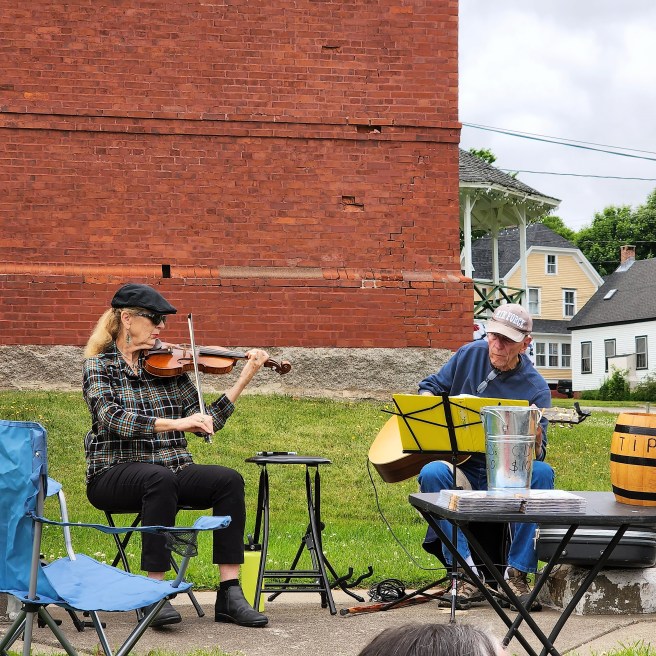
And I’ve danced to many of those tunes.
If you’re a musician or writer or some other kind of performance-potential artist, you probably find being part of an open mic event invigorating. Not just because you get to air your own work and see how it fares on exposure, but also because you’re amid so many kindred spirits.
Tonight has a kind of hybrid version — six featured published writers at the wine bar downtown — and it is creating a buzz in our small community. Each of us gets about 15 minutes in the spotlight, as well as a book-signing and chat time afterward.
I’ll be reading a chapter from my new book, Quaking Dover, one that details a remarkable but often overlooked outburst in early New England, the bohemian colony called Merrymount. I had settled on that excerpt, a side I hadn’t yet presented in my presentations, before realizing how appropriate it is for this weekend’s ArtWalk festivities, many of them reflecting Pride awareness.
So, here we go … just as the summer season is beginning in our oceanside setting.
STAYING IN A VERY POSH HOTEL in Washington, D.C., where one exterior was angled so the rooms opened out on a large waterslide! I’m torn in making a decision between going to the National Gallery, a block down the street, or playing in the water instead.
The deal also includes a helicopter ride over downtown Dayton, just a few blocks away.
Obligations/seriousness versus fun/irresponsibility.
IN COASTAL FRANCE, RIDING IN a horse-drawn carriage, our guide leaves and I’m expected to pay the driver but I haven’t converted my currency. At last, I say MO-NAY and point to the dollars in my wallet. He laughs and points to a shoreside bank. We enter together, take an elevator down from street level, toward the water, I presume.
DRIVING WITH JAMES DOBSON THROUGH rich, plowed farmland – gently rolling, like southern Indiana – but also about to be turned into housing tracts.
We need to take a leak, so we park and climb a small green rise, and at the fence line while taking our pee, I gaze out on a sunny morning pond and see what I think’s an otter. “Look!” As we focus, we realize it’s a brown bear and its companion.
THIS TIME, WITH BLONDIE, BEGINS roadside Bucks Co. PA scene from an earlier HODGSON roots quest dream. Soon, however, we are interior, getting intimate – walls, ceiling painted black. We’re interrupted by “Annie,” who has me tied up, ready to be shipped out with burlap bags (of pot?) and recipes for its use. My head is against strange paperback drawings of couples with bizarre tats and piercings. At last Blondie senses Annie, having spaced off somewhere else, has forgotten, for now, unties me. “You’ve got to go, now,” coins falling from my pockets all over the dark place. Me, in overalls! No time to chase the coins. “You’ve got to go. NOW!” Expelling me out onto a downtown, then my high school, Watervliet, daylight, all from other recent nights. She cannot come along. Held hostage, by her kids.
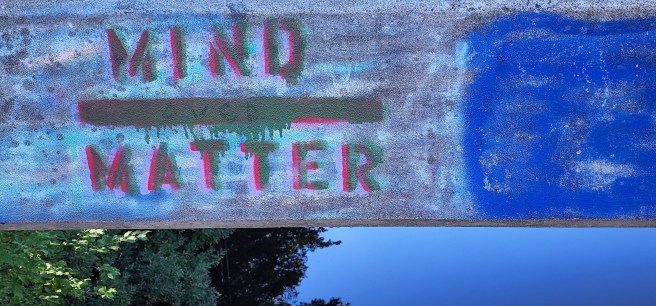
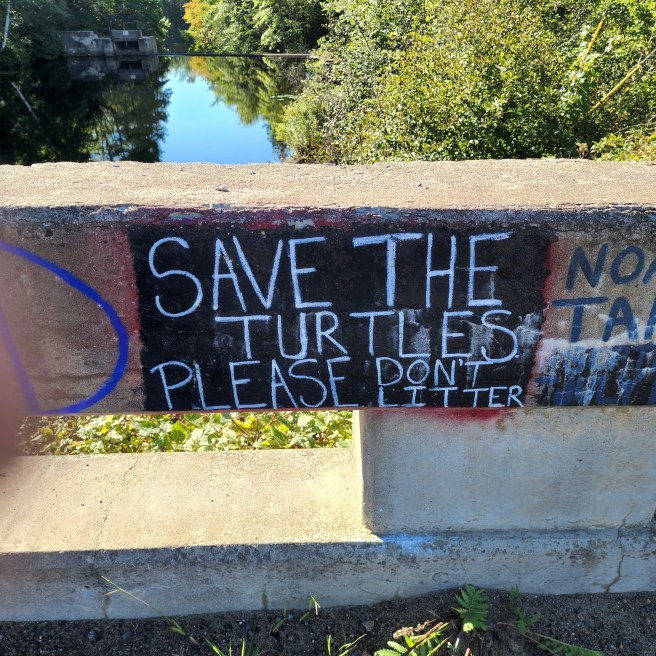
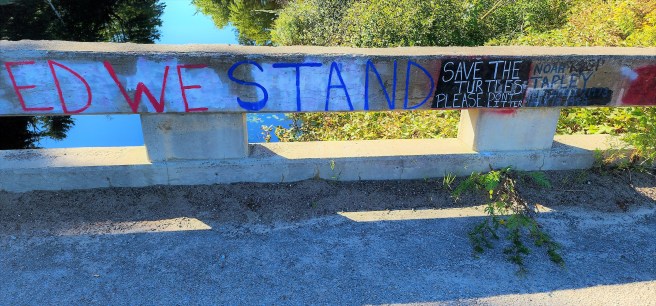
Among the bits of wisdom and advice found as graffiti on a rural bridge in Pembroke.

Recognizing the Indigenous People of this place.

