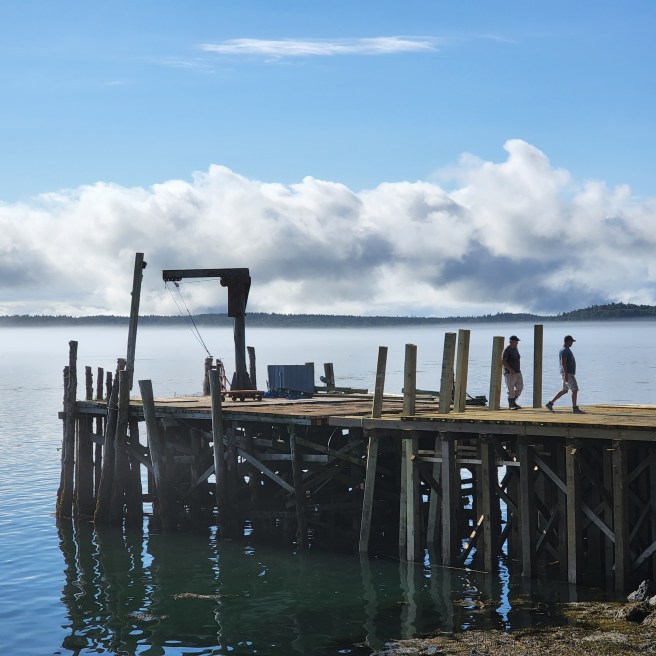
Only a block from our house.
You never know what we'll churn up in cleaning a stall
Only a block from our house.
Sailors who visited Eastport for the Fourth of July voiced their amazement at the pilot who guided their U.S. Navy destroyer vessel at the Breakwater pier in some very dense fog.
They could hear the conversational voices of humans on the pier and shoreline but couldn’t see a thing. We could hear them but not see them, too.
And then they were landed, gently and safely.
They told us he was a magician, and from my angle of observation, it was true. Even the commanding officer was most amazed, in what became a memorable experience.
“I’VE NEVER BEEN TOUCHED,” meaning love.
“My sisters have. They all have husbands and family, but I’ve never been touched.”
TRAVELING IN A TERRAIN LIKE the orchard country of Washington state – Naches or Cowiche, especially – in the car, we come across the top of a hill and find ourselves facing a band of four tornadoes, which we manage to drive past, after great fear and trepidation.
She’s no longer a goddess, but a traveling companion. Do the tornadoes reflect engulfing, destructive, and self-destructive figures of love?
ON A BOAT, THE RUDDER WORKS in the opposite direction of what feels right. Often seemed to have no effect, whatsoever.
In both cases, a sense of something important remaining unfinished.
The 350 U.S. Navy sailors who descended on Eastport for our extended Independence Day festivities were the first to uphold the longstanding tradition since before the Covid pandemic.
They were a welcome contingent in our small community, often appearing in their pristinely ironed white uniforms, which do look impressive even though, as I was told, they can be a challenge to keep clean. You have to lean way over while eating, for instance, to keep from spilling anything on yours. Not that we noticed any dirt when they marched as a big bloc in the grand parade Tuesday afternoon. At least the sailors and officers who fielded teams in the very messy cod relay contest the previous day were more practical in their dress.
What they got was a six-day taste of small-town America having summer fun.
As the police chief reported, “the Fourth of July was relatively quiet, aside from a couple of fights involving sailors … which were handled by the crew from the Navy ship.”
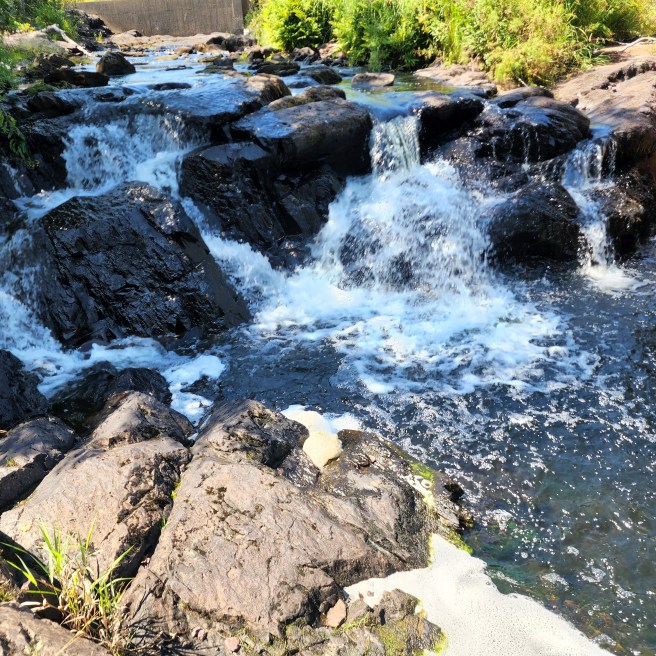
Creatively, I’m feeling a lull or perhaps more accurately adrift.
After my Cape Cod presentation via Zoom earlier this month, I have no other Quaking Dover events on the horizon. Nor do I feel compelled to undertake another big writing venture.
Authors these days are often saddled with the promotional end of any publication, and I’m coming up on a year of launching the marketing push on my latest book. Admittedly, I am proud of my public appearances on its behalf – each one unique, reflecting what another writer declared a “rich feast of a book” – but it’s also exhausting, especially, as I hate to confess, at my age.
Do I cut the ties and say it’s time for the book to sink or swim on its own, or do I find new ways to try to generate a buzz? It is the one book that seems to speak to a wider audience, especially, say, than poetry or my hippie novels.
The blogging hits have slowed down, perhaps as many viewers have shifted to other platforms. Social media and mass media both appear to be hemorrhaging there, so I can’t say I’m alone.
I’m certainly out of touch with youth and often can’t understand their conversations. That really hurts. I believe there’s so much knowledge that needs to be handed down but don’t know where to begin. Besides, I’ve often found them a source of great energy in my own outlook.
In short, I don’t have a big project calling for my attention and devotion. That part feels really weird.
I do have a big backlog of periodicals and books to finally tackle as well as a shelf of personal journals that deserve visiting, so that points to an overdue reading orgy.
There’s plenty of outdoors around here to indulge in, too.
I may even have to look at my remaining possessions and reorganize and cull them.
As I’m saying, I’m feeling a bit strange.
Ours are smaller than the glorious Dungeness of the Pacific Northwest or Chesapeake Bay’s popular Blue delicacy, named for the color of their tips.
But that’s not to say Maine doesn’t have crabmeat that’s as sweet. Ours comes from two species.
Here’s some perspective.
Me? I haven’t yet had to complain of having too much. Now, please pass the Old Bay.

I‘m feeling defeated. Both the New York Times and the Washington Post, as I’m seeing, have capitulated. As a copy editor who spent a career trying to preserve the language from utter erosion, this hurts.
Quite simply, it was two words, not one.
Oh, the enormity here! Where do we draw the line anymore? Or is that any more?
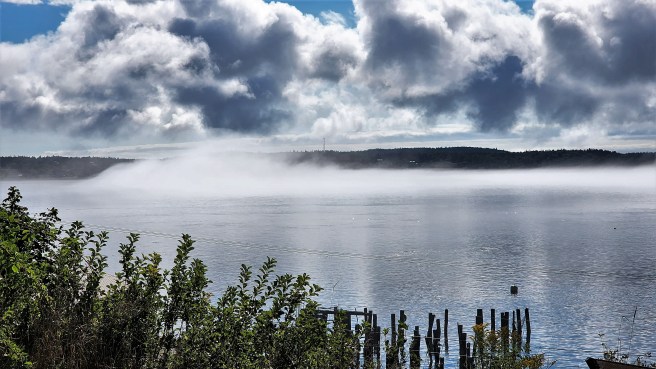

San Francisco has no monopoly. We are, after all, the City in the Bay.
expanse of granite
mirrors
blaze in blue
water

