A few more candid reader reactions

Despite nearly 60 years of writing, I’m still not accustomed to having readers come up to me in public with enthusiastic reactions.

My book Quaking Dover just may change that.

Here are two recent examples.

“It’s like you’re speaking right to me! It’s not like a history at all!”

That’s from a city councilor far from Dover.

I do hope that doesn’t put off history book addicts, though.

On the other hand, a Dover history buff said this:

“The clearest presentation of George Burdet I’ve read. Usually the histories of him are convoluted and hard to follow.”

When she first mentioned him, I felt some trepidation. Burdet wasn’t a Quaker and in fact predated them. He was one of those side details that could trip up the central argument if I had misread something.

More important than any praise is the confirmation. Or correction, too, for moving forward.

The next steps

Filling the new beds with clean soil atop a landscape fabric and cardboard barrier against weeds and the tainted ground below takes shape. Our planting season here naturally runs late – early June still had overnight low temperatures in the 40s. So transplanting seedlings is running on schedule.

The plastic is to help warm the soil.

The upright frames are for peas, which will probably continue to produce through the summer, thanks to the cooler temperatures. Tomatoes, though, will be tricky.

The biggest challenge will be deer, as you’ll see.

The shipwreck of Angel Gabriel had a Dover angle

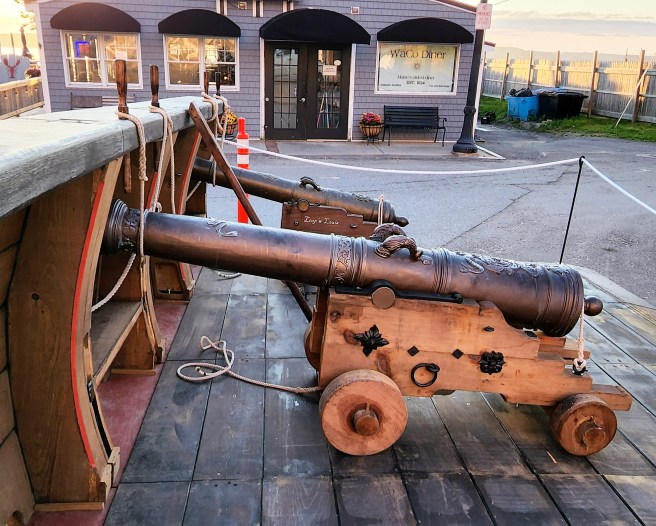
A monument at Colonial Pemaquid acknowledging to the 1635 tragic sinking of a ship caught me up short. I had forgotten the vessel’s impact on Dover.

As background, the ship had been commissioned for Sir Walter Raleigh’s last expedition to America in 1617 and in several subsequent incarnations been involved in some high seas adventures, staving off repeated boarding by pirates and beating off three Spanish ships. Not that I knew that in my initial research.

As the monument at the Maine historical site proclaims, the Angel Gabriel was a 250-ton galleon carrying settlers to new lives in New England in August 1635 when it anchored at the village of Pemaquid. Most of the passengers and crew got off the ship before nightfall to rest on land as guests of the villagers. That night, August 14-15, a storm later known as “The Great Colonial Hurricane” struck the area and the Angel Gabriel was torn from her anchors and destroyed.

Or maybe it had happened earlier and the ship had limped into harbor. Still, I’m quoting there, from an account that continues: “In the mid 1970s, efforts were made to locate the wreck in Pemaquid Harbor with divers and a magnatometer and sideccan sonar but no artifacts form the ship were ever located.”

For context, “The Angel Gabriel was very similar to the Mayflower but 18 feet longer and bearing four more gun ports per side.”

I am now curious to see whether the small museum displays a trunk that went down with the ship and was found floating the next day. It belonged to a passenger named John Cogswell and his descendant of the same name agreed to lend the trunk for display.

This marker, though, stirred up some memories of a section that got cut from the final version of my book Quaking Dover.

Here’s what I had:

Three Dover Combination signers shared a tragic introduction to the New World when their ship, the Angel Gabriel, broke up in the August 14 “Great Colonial Hurricane of 1635,” either in the harbor at Pemaquid, Maine, or at the Isles of Shoals.

[Note the clarification in the site of the disaster in the bronze monument.]

Twenty-one-year-old William Furber settled next to his brother-in-law, John Bickford, at Oyster River and later relocated to Bloody Point, opposite Hilton Point on Great Bay. He married Elizabeth Clarke, daughter of William Clarke and Elizabeth Quick, in 1642 in Dover.

(The Bickford family, meanwhile, has John landing at Dover in 1623 and marrying Temperance Furber in 1624 in New Hampshire. If these dates and locations can be supported, they would significantly change the early history of the Piscataqua settlement. Their son, John, though, was born in 1625 in Devon, England.)

Samuel Haines was an indentured servant or apprentice to John Cogswell, who was also aboard and survived. They were bound for Ipswich  [Massachusetts], where Haines finished his obligations the following year and may have moved at that time to Northam, as Dover was also called.

He did, however, return to England in 1638 and married Ellenor Neate within a few weeks after his arrival, suggesting they were engaged before his coming to America.

After a year-and-a-half, they set sail and established their home in Northam/Dover, where he had ten acres of land near the meetinghouse. Later, he had twenty acres on the Back River, where his neighbors were fellow Angel Gabriel survivors William Furber and John Tuttle.

He was taxed in Dover in 1648 and 1649.

In 1650 he leased Captain Francis Champernown’s Green Land farm for two years, and then secured ninety-one acres adjoining it, where he built a permanent home, and another ten acres where he eventually owned a mill. In 1653 he was one of the petitioners successfully asking the Massachusetts General Court to change the town name from Strawbery Banke to Portsmouth. That year he began the first of ten successive years as a town selectman. In 1666 he helped run the town line between Portsmouth and Hampton.

He was also the first deacon at the formal organization of the first church in Portsmouth in 1671.

At much of this time, the population of what now constitutes New Castle, Portsmouth, Greenland, and Newington was only fifty to sixty families.

Much less is known about survivor John Tuttle, who was about seventeen years old at the time of the disaster. After their rescue, he arrived in Chebasco (in Essex or Ispwich, Massachusetts). His age and destination suggest his situation may have been similar to Haines’. By 1638 Tuttle settled in Dover, where he was known as Shipwreck John and had a farm on today’s Bellamy River – one that grew into what was long known as America’s oldest family-owned and operated enterprise. (Never mind that Thomas Roberts’ heirs nearby would have a longer claim.) Tuttle’s son Thomas was killed by a falling tree while still a young teenager, leaving John Jr. to continue the family name.

~*~

Successive Tuttles became prominent Quakers. And, as I inserted, the monument is more specific about the scene of the disaster than I’d previously found.

Time for the countercharge

Given a former resident of the White House’s insistence an election was stolen, let me argue that he’s upset because he couldn’t steal it a second time.

You know, the cheater who justifies his actions by claiming that everybody’s doing it. Except that they aren’t.

That sort of thing.

So for proof on the election, I’ll hold back until he offers evidence for his case regarding 2020. Pipe up or shut up, please. Or, as we might also insist, get off the toilet.

Please remember, he never won the popular vote in either run. It was all up to the Electoral College.

Or, in an earlier questionable presidential election case, the Supreme Court, which is no longer impeccable as a result.

Just sayin’ …


Our feisty orchestra has played its last concert

Last weekend the Passamaquoddy Bay Symphony Orchestra ended its run on a wild note. Our 30-some member ensemble tackled Hector Berlioz’ sprawling, opium-inspired Symphonie Fantastique in a program that also included a world premiere and a Mozart piano concerto.

It was, as usual, a daring combination.

Our sprawling county has a tad over 30,000 residents, many of them seniors, mirrored by a similar demographic in neighboring Canada. And you’re going to draw sufficient skilled musicians from that as well as a supportive audience?

Yet that’s basically what happened.

The amateur band, augmented by professional freelance “ringers,” has largely been an extension of Norwegian virtuoso violinist Trond Saevurud, its highly-charged conductor. What we’ve enjoyed are bracingly refreshing performances where impulsiveness and driving passion overcome any shortcomings in perfection or “the” definitive interpretation. It’s vibrant music-making and thrilling.

But now, after a dozen years at the helm and as the orchestra’s godfather, he’s stepping down to spend more time back home in Scandinavia.

Add to that the lingering impact of Covid, which has impaired all the performing arts. Here, the border closing cut off players and supporters on the Canadian side of the line. So much for the slogan “two countries, one orchestra.” Some musicians refused to be vaccinated and instead declined rehearsals and performances. Some concertgoers avoided live events in the intimate spaces the ensemble called home. It hurt.

A resurgence of local virus outbreaks canceled two of the three performances of a recent set of concerts, and that undoubtedly hit the finances hard. (I really was looking forward to Tchaikovsky’s first symphony, which I’ve never heard live, unlike a dozen or so renditions of his last, but I couldn’t make the remaining slot.)

That leads the PBSO to a crisis. Officially, the full ensemble is going into hiatus. Perhaps the organization can regroup, rebuild, attract a new music director, perhaps redefine itself and its mission. More likely, it will dissolve.

Locally, it’s also emblematic of how fragile our communities are. Sunrise County has high poverty levels. We’re don’t have deep pockets, either, the kind based on global conglomerate headquarters or old money. Fewer people are available for public service, especially as volunteers on city councils, school committees, town select boards, or the like.

Churches, too, are stretched thin.

You can no doubt think of many other civic interactions where you live, too.

So that’s the score for now.

With some wild water scenes

SWIMMING IN AN ALKALI, ROCKY, heavy current river with Princess Di, a dead seal or otter on a sunny rock turns out to be Prince Charles.

Later, swimming downstream with her, toward a dam, a cry to get out of the current, come ashore on a sandy beach.

Snapping turtle sitting at the water sluice where the beaver had been in eerie, inviting, green river.


WHAT STARTS IN A 19TH CENTURY asylum atop Amoskeag Falls as part of an open house, except they’re trying to retain us, turns into escape as I go DOWN to the rushing water and somehow step out around the powerful whirlpool and cascades.

Aha! The unconscious: emotions!


EVERYTHING CRYSTALLINE. shoreline flowers in many shades and the greenest grass, the only clouds distant and low hugging the inland horizon.

Two halves of a partly open mussel rattle enclosing a pebble.


CLIMBING IN TROPICAL MOUNTAINS. Much water in pools and cascades. Other people. Flowers, too. An old mill or two. Quarries? Very beautiful, youthful – cool and sunny.


SWIMMING IN DEEP BLUE WATER, I suddenly panic before resigning myself. A strange kind of calm. Accepting survival as a gift, something inevitable for those who keep their wits first and let the shark decide.


I MOVE, LEAVE NO FORWARDING ADDRESS. There’s much water imagery.


I OVERFILL THE BATHTUB on Oakdale, 2 inches of water on the floor and Dad keeps getting in the way, trying to help … for some reason, he’s not angry. Hmm.


SWIMMING IN MOUNTAIN PONDS, looking down, even spying on other swimmers in ponds below surrounded by green forest, then, walking up from or even to those same pools and looking further up to where we had been which no longer appeared so lofty, again leaving me with a very warm feeling.

To those who say God wrote the Bible, let me reply as a writer

If He’s so perfect, why didn’t He do a better job of it? (See any masculine references here as traditional and object to them as you wish.)

Even in Hebrew, so I’m told, many key passages are unintelligible. As for the King James English, which many Protestant fundamentalists hold as inerrant (meaning flawless, perfect, unblemished), let me object. There’s a lot of clumsy translation – and outright mistranslation. Add to that the ways our own language has shifted in the centuries since. (To wit: I find myself having to retranslate many key Quaker writings from the mid-1600s on for modern readers, even those with PhD credentials. Those early Friends were conversant with the KJV lingo. Does thee understand?)

For perspective. When’s the last time you read Shakespeare? Without relying on footnotes?

More to the point. He (yes, He, in the current argument) certainly could have used a better editor, in any language. As for revisions? Let me contend that no work of language is ever perfect, it is ultimately a human artifact. Including the arcane collection known as The Bible.

For me, the best we have in those pages is all the more exalted because of that edge of imperfection and decay. It allows humanity to creep in. I’m thinking of some very cutting-edge contemporary poets, actually.

My fascination with that divine text has turned to the struggle to accurately record our own, very personal, experiences of the Holy One. Name it as best you can. And, from the other direction, the ways our own lives have reacted to the struggle from our own first-hand encounters with those haunting great mysteries.

I’ve come to see – and treasure – what we have in that book more as a set of deeply personal journals of individual and group experiences, including their failures, than as any set of how-to steps to eternity.

Blogging isn’t your only life, is it?

Are any of you amused by fellow bloggers who apologize for not posting during a hiatus in their otherwise self-imposed publishing schedule?

I am. And remember, my career as a journalist was filled with pressing newspaper deadlines where missing by a few minutes could be costly.

Blogging, in contrast, has none of those pressures, at least for most of us. I doubt that any of our followers is drooling in anticipation while awaiting our next post on whatever schedule we follow. Like every Wednesday or Friday, who’s counting? The important thing is to have something to say, usually gleaned from real life.

That’s assuming you have a routine. You do, don’t you?

In the bigger picture, I can think of some voices I miss, unfortunately long gone from the scene. Ones who even erased their contributions when they closed up shop. But they always appeared when they had something to relate, and it didn’t matter what day or week we were in.

Still, we post and/or schedule as best we can. We’re our own boss here, right?

And for the more inquisitive of us, when we fall behind your postings, we’ll catch up when you show up next round.

This is, after all, ultimately about sharing the joy and wonder or challenges of life where we encounter it.

And yes, even that “do wish you were here.”

For the record, I still regard many of you as pen pals. Remember what that was?

Now, to try to catch up with all that’s been happening on this end. That’s one thing I’ll admit can be frustrating.