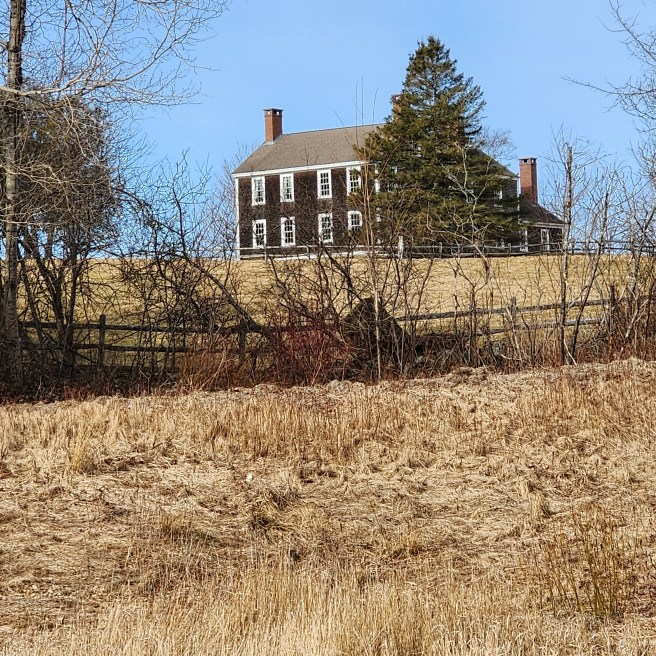
The Dr. Albert Lincoln homestead along U.S. 1 in Dennysville presents an iconic image from the Civil War era, if you catch a view while driving past. Today the well-maintained second home is also a working cattle farm.
You never know what we'll churn up in cleaning a stall
The Dr. Albert Lincoln homestead along U.S. 1 in Dennysville presents an iconic image from the Civil War era, if you catch a view while driving past. Today the well-maintained second home is also a working cattle farm.
She does show up in my sets of art gallery poems, accompanied by Norman Rockwell, for good reason, if only a fictional role.
Here are ten things she really said.
For the art gallery poems, go to my blog Thistle Finch editions.
You know, that chinaware under coffee and tea cups.
Maybe they went the way of the cups, too, when mugs took over.
Is it something we can’t blame on changing technology, unless microwave safe is a consideration?
Or maybe it goes along with all of those paper cups we get for our takeout brew.
impoverished
by an ingrained sense
of impoverishment

When you think of a tall-masted sailing ship, it’s probably like this, one with squared masts and rectangular sails. This one does have a gaff aft sail, resembling the sails on a schooner.
Square-rigged ships did require larger crews than did schooners and sloops, and they weren’t as agile in the wind, but they could carry more cargo.
As for the bird in the nest atop the rock outcropping? I think it’s an osprey.
Welcome to Rockland Harbor.
Mine is a family of booklovers, which means we need bookshelves everywhere in our renovated home. Make that two homes, considering the younger daughter and son-in-law, too, in their new purchase in suburban Boston. To that let me add one friend, a famed author, who had so many volumes stored in his Maine barn that one corner collapsed, according to the New York Times Sunday magazine. I’m not prepared for that possibility here in our historic house.
Still, this gets painful as we prepare for triage. What volumes must each of us keep, which ones become optional, and where will all of the remainder go?
On my end, after much culling, I’m finding my eyeballs no longer support the small type in many paperbacks, many of them with binding that is crumbling.
Gee, I’d never thought it would come to this. Take a deep sigh before they are trashed.
The other partners in this move will have to explain for themselves.
Here’s more from my working paper ”Thinking Thru the Future of Publishing” from 50 years ago. Your may want to substitute “email” or the like for “photocopy.”
~*~
As I wrote at the time:
Good Soviet writers, boxed out of publication at home by the official writers’ union, produce Samizdat or “self-published” editions that are hand-copied or mimeographed and passed under the table, sometimes as novels & volumes of poetry that sell for $50 or so a copy & are surreptitiously sold on street corners, often at personal risk from hand to hand.
Cheap photocopying opens an easier means of doing the same thing.
~*~
A turning point: How do we turn these obstacles to our advantage? How do we plan our strategies around the status quo?
~*~
As hinted earlier, the adventurous writer is often boxed out of circulation, as commercial and even university presses contend there is no money for poetry or fiction when they make no deep effort to nurture what they have. There is also a problem that there are generally few bookstores, & that more than 25 percent of all trade books sold in the nation are sold in the NYC area, where about 5 percent of the national population lives. It should also be noted that throughout much of the rest of the country, the bookstores that do exist are generally of a general sort, with very few stores devoted to special interests. Thus, it should be no surprise that San Francisco should be a major center of poetry, since there are a number of bookstores specializing in poetry there & PUBLISHING THEIR OWN SMALL editions.
In political science we face the same problem: It is very difficult to circulate to potential audiences. The high cost of most publication excludes small-circulation working papers, in most situations, altho Workshop is an exception. (And even here, the case is limited.)
To get into the professional journals requires time (delays of six months to a year being not uncommon), often followed by rejection. In addition, there are often the high costs (again) of typing & mailing, & the common need to revise to fit the particular styles & needs of specific journals.
~*~
Unlike many of the little magazines publishing poetry & fiction, which are often a personal thing carried out by an individual editor at his own expense for several issues, until the venture collapses under continued losses, the social science field appears to be frequently supported by professional associations or the prestige of particular schools. (Altho PG informs me this is not always the case; cf, Policy Studies Journal.)
Given the increasing appearance of photocopy “rip-offs,” will subsidy of artists/researchers become increasingly necessary?
In recent years federal money has helped to underwrite a number of little mags. Given the increasing use of photocopy subsidy of artists become increasingly necessary?
~*~
NN has mentioned that in chemistry, at least, a number of highly specialized journals are now being circulated & stored on microfiche. The approximate cost is 25 cents, altho the user must have access to a $200 reader. However, as NN points out, this should not be a problem for scientists willing to pay $600 for a calculator.
While scientists may possibilities of progress such as this, microfiche does have the disadvantage that it must be read at the reader: one cannot curl up in a cozy chair to read it by the fireside.
Also, because of its small size, the ability to steal such units becomes increasingly easy, unless libraries install elaborate request & check-out procedures for its use. (Use of the Lilly Library, with its padded doors, electronic locks, page users cards left in the stacks wherever books are removed, may be a good indication of the type of system necessary to sharply prevent theft.)
~*~
In poetry at least, for those few interested “in the feel of typescript,” one alternative is to issue single poems in broadside form, on large sheets carefully printed, using fine art paper & limited editions. Such versions, suitable for framing signed by the poet, often cost between one and 10 dollars.
Special editions of books can be arranged the same way, as collect items. be enthusiastic over the systems & group can be arranged the same way, as rich collector’s items.
~*~
On another hand, limited experiments have been performed in which groups of poets or novelists have banded together to get works into print. By forming a cooperative, in which a number of participant/patrons each contributes $200 or so to a common kitty, which is used to ensure the publication costs, the underwrite the costs of production until sales have replenished the kitty. A set of common pool rules is established, in which any one member can recoup his share of the fund at the time he decides to withdraw from the effort. A common committee is established to determine which works should be published.
In one case, a group of fiction writers in NYC have operated this way to produce a series of novels that have been distributed by one of the publishing houses (Dial?). So far, all of their volumes have sold out in the first edition, somewhere in the range of 8,000 to 10,000 copies.
In the other case, a group of poets in Minnesota, headed by Robert Bly, a widely respected & published poet, have banded together to issue a series of low-cost Minnesota-area poets, many of whom generally unknown. Because many of these writers do not yet have enough solid material to fill an entire volume on their own, the volumes have often been split between two or more poets. are young & generally unknown.
The circle has found enough of a market, including cultivation of high school libraries in the state, to make ends meet in their project.
~*~
The potential exists for such a method among the Public Choice circles. I do not know what the legal situation concerning such an arrangement would be, but we can discuss that. I would assume that we would have to set up some sorts of arrangements outside of the university structure if we were to operate in this manner. I don’t know.
~*~
Stay tuned for next week to see where this thinking leads.
You can find my works in the digital platform of your choice at Smashwords, the Apple Store, Barnes & Noble’s Nook, Scribd, Sony’s Kobo, and other fine ebook retailers. You can also ask your public library to obtain them.
Another gleaning from my files, one that had me thinking of the influence of Chinese and Japanese writing on my own.
~*~
Nearly a fairy-tale in its beauty and precision, the first two-thirds concerns Genji and his many affairs.
He’s the most shining, the best musician, becomes ever more attractive as he ages, et cetera.
And even while fooling around, still, in his own way, is devoted and faithful. But just as I’m forming a deep aversion for the bastard who’s little more than another spoiled, beautiful Rich Kid, etc. – I notice the real protagonist turns out to be his favorite wife, Murasaki, whom he raised as a child and trained to his tastes. She’s one of the rare Truly Good People in Literature who’s also interesting.
Indeed, the way she welcomes her rivals into Genji’s home compound, and so on, while overcoming her own hurt and transforming her own jealousy is wonderfully shaded. All the same, the reader makes much use of the list of characters in the end pages, a wise editor was at work there! Especially, when, in the final third, Murasaki and then Genji die the story focuses on two of his grandsons.
And there, the work turns dark, brooding, contemporary in its psychological depth – including the hanging ending.
And then My Lady of Hyde Park winter informed me of more, which I’ve unfortunately since lost.
~*~
More recently, a Chinese exchange student who spent a month with us in Dover gifted me with a pencil cup that was inscribed with the works of four great poets. She included a paper where she copied their translations.

The Orange River in Whiting is becoming a prime wilderness water trail for canoeists and kayakers. The nature preserve, with holdings from several different organizations, is accessible principally by water.
Yes, for those of you writers who should be well past the halfway point of your new novel draft by this time this month. As well as any others, working at whatever.
 Jnana's Red Barn