Various lifestyles I’ve lived

Maybe it’s a good thing we didn’t have selfies through most of it. Most of those shots would have no doubt been embarrassing now.

So here’s how my life’s shaken out in terms of lifestyles.

  1. Straight ‘50s middle class: Growing up in the Midwest.
  2. Hippie: From college to Upstate New York and various moves thereafter, including my first marriage to an emerging visual artist. Well, this does fuel my novels Daffodil Uprising, Pit-a-Pat High Jinks, and Subway Visions.
  3. Monastic: The rogue yoga ashram in the Pocono mountains. See my novel Yoga Bootcamp.
  4. Ascetic: In many ways, this was still hippie as I lived in a loft in a small downtown in a place resembling what I’ve called Prairie Depot.
  5. And back-to-the earth: The next move was a return to my college, this time as a research associate position before leaping on to the interior Pacific Northwest, one with my personal life filled with growth as a published poet, a shift to Quaker spiritual practice, and immersion in backwoods and wilderness wonder. These inspire my novels Nearly Canaan and The Secret Side of Jaya.
  6. William Morris: Steel mill region in what one called the Near East, aka the Rust Belt. Included a divorce and rebound. Hometown News arises in that experience.
  7. Nearly Plain Quaker slash Muppie: The Mennonite Urban Professionals I was hanging out with in Baltimore were the less expensive version of Yuppies. Living in a federal-style brick rowhouse in the Bolton Hill neighborhood was the culmination of my big-city dreams. During the week, I was often on the road with a company car and expense account. This was a rich mix for me, a time of much personal growth, ending in a self-gifted sabbatical year hunkered down in a suburb in which I drafted early versions of much of my fiction.
  8. Yuppieville on the Hill: Relocating to New Hampshire, I wound up living in a complex where I rented a small townhouse. Back in the working ranks rather than management, I was freed from long unpaid overtime hours and the neckties and suits of my earlier professional situations. Contradancing, especially, steeped me in Boston, an hour to the south, while I immersed my personal writing in poetry circles. My love life had many ups and downs.
  9. City farmer: Remarriage prompted my move to the New Hampshire Seacoast, where we bought an old house within easy walking distance of downtown and the Quaker Meeting. That “farmer” label actually befits my spouse, the avid gardener. The property also had the small carriage house you know as my Red Barn. Retirement included serious choral singer and daily swimmer roles.
  10. Island author: We needed to downsize, which led to the remote fishing village with a lively arts scene you’ve been reading about here.
Here comes the sun, and then little planets, along a stretch of rolling highway

In my telling of our trip to The County, I omitted a delightful activity along the main road through potato country.

Our encounter started with a stop at the state university branch on the southern fringe of the county seat, Presque Isle.

We were looking for the sun on a cloudy day. It was harder than you’d think.

According to the brochure, it was supposed to be at the base of a flagpole. No luck there.

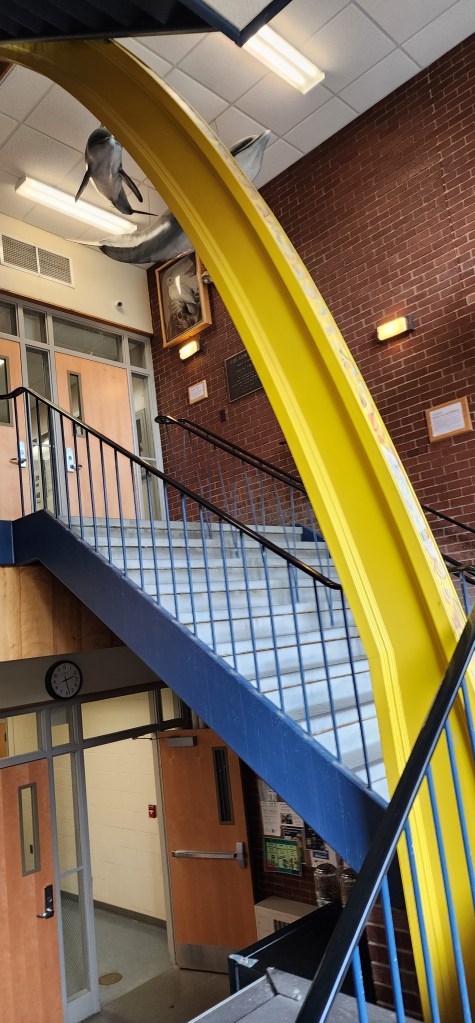
Finally, asking passers-by, “Where can we find the sun?” we were pointed to a science building and told with a laugh, “It’s inside, by the stairwell.”

The yellow arch represents the size of the sun in relation to the earth, set out by U.S. Route 1 a mile away. As you’ll see. I’m assuming this is an economy version, considering how big a fuller version placed in an atrium or outside would be.

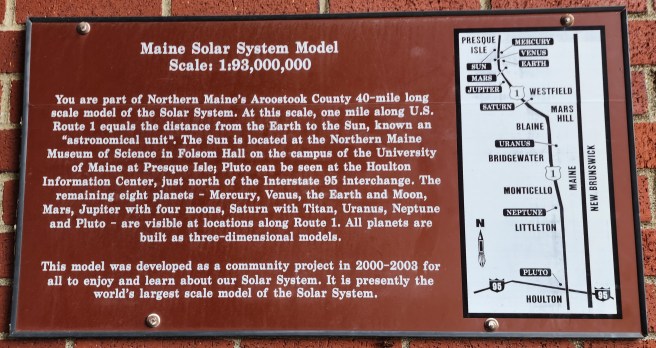
Welcome to a three-dimensional run through our solar system, one created by an imaginative science teacher abetted by enthusiastic students both at the college branch and the community college plus high school and tech center kids and interested adults (aka the space enthusiasts) in the county, the results were executed without big grant money et cetera. Amazing.

As a small correction: The model is now the second-largest, the biggest in the Western Hemisphere. Or so I read elsewhere.

To be continued, if you’re patient.

Fun on a spud run

I had been wanting to introduce my wife to Aroostook County, which borders ours to the north. If we timed it right, we’d make it a spud run, purchasing newly harvested potatoes from roadside stands. Who cares if the bags are culls offered at bargain prices, right? The skins on fresh are much more tender, and the texture inside is smoother, more buttery, because many of the sugars haven’t yet converted to starch. For many but not all recipes, those are tasty pluses.

I posted my experience of that introductory trip, Off to Aroostook County, September 25 last year. Take a peek, if you wish.

This time, the driving would be shared, meaning I could more freely view much of the passing scenery. In addition, she insisted on a game plan rather than my more casual trust of luck or fate for the unexpected.

After juggling schedules and moving the target date back a few weeks, we finally hit the road with a feeling of threading a needle – if not now, it would likely keep getting delayed until next year. Still, we left Eastport two hours later than anticipated. That part, missing a deadline, can drive me nuts. This time, though, I was pretty calm.

~*~

Maine’s largest county – often known simply as The County – is a sprawling wonder. To me, it often feels more like Pennsylvania than New England, and its potato farms and homesteads are generally tidier than the don’t-throw-anything-away grounds (or junkyards) seen throughout much of the remainder of the state.

This outing reminded me of the fact that the potato farms are buffered from our corner of the state by more than an hour of driving through forest, frequently miles between houses. The highway itself seemed to be all ours, without a vehicle in sight in front of us or behind and only the rare traffic in the opposite direction.

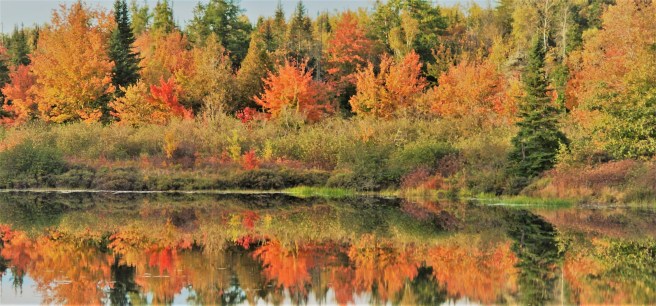
Our day began with thick fog that left the deciduous leaves glistening wet as the gray lifted. Low-angled sunlight illuminated the colors magnificently, intensely red trees prominent among them.

Shortly before Houlton, where the potato country begins, my wife’s route via Google Maps had us taking lefts and rights through farmland westward to Smyrna and its small colony of Amish – perhaps 20 families.

The quest was their general store and a farm market featuring doughnuts. The interiors of both buildings were darker than what we’re accustomed to in retail outlets, but you do get adapt to the realities of natural lighting augmented by a few compressed white-gas lamps (what we used to call Coleman camping lanterns).

The produce was gorgeous, but, as my wife noted, it wasn’t cheap. Quality carries a premium and perhaps some sharp marketing, humility aside.

The doughnuts, I should add, were heavenly, though heavy on the cholesterol. Cooked in lard, we presume.

Amish customs and regulations can vary from community to community, but this was the first time I’ve seen men wearing mustaches in addition to the beards. And this was the first time I’ve seen their homes painted anything but white – a café au lait was prominent but also common among the the non-Amish throughout The County. Not to be judgmental …

~*~

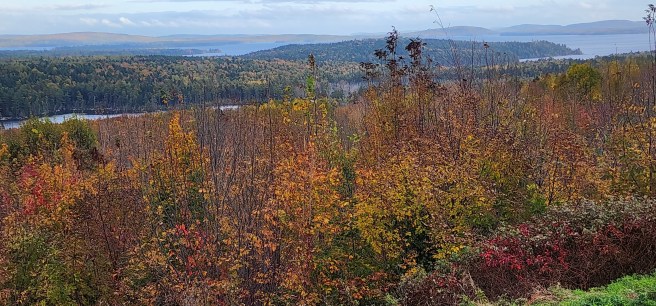
From there, my wife’s route headed northward to the west of U.S. 1, about 30 miles of largely unpopulated, corporately owned forest principally along State Route 11. The fall foliage was stunning and at its prime intensity.

We still weren’t in the distinctive potato country until we approached the outskirts of Presque Isle, the county seat.

We did stop at a roadside, honor-system potato stand – they’re prominent throughout the farming districts. We picked up a 50-pound bag of russets for $10, a steal, as we would see on later stops. Potatoes sold along the route are generally culls, sometimes damaged in harvesting. The ones in the bag, however, were mostly irregular sizes and shapes the supermarkets don’t want. No problem for us.

Over a leisurely lunch at a window table, we watched downtown traffic that included unique potato-hauling tractor trailers – one half of the top taller than the other, perhaps for pouring out the spuds at their destination. There were also the occasional Amish carriages, this time with men without mustaches – presumably from the other colonies in the county.

And then, after a perusal of a few shops, we were off on our return through the potato country itself.

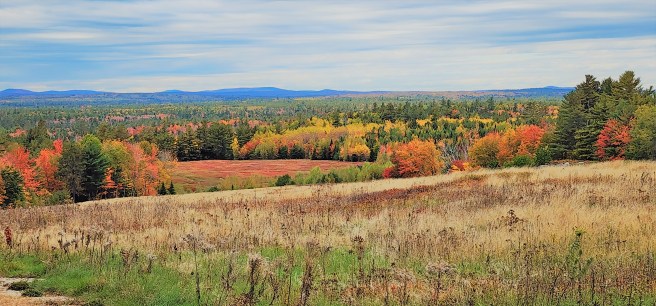
This time, our run included hazy, soft light on the panoramas of forests and distant blue mountains under varied clouds. The large, endless lakes, too. The air was too dense to see Mount Katahdin or the other tallest peaks, but we aren’t complaining. The views were still breathtaking.

The final legs home were in the early night.

The Maine image versus reality

“Life as it should be,” as the billboards proclaim in welcoming visitors aka tourists, is a slick slogan ignoring the economic realities most working adults in the state face.

The recent death of a new high school graduate in our county who was about to enter the prestigious Maine Maritime Academy is a harsh example.

He was out lobstering, solo, and got caught up in his gear and dragged overboard.

More common is the hobbling together of three or more jobs, mostly part-time and/or seasonal and lacking paid benefits.

~*~

Yes, the state’s landscape can be breathtaking, especially in summer. But much of winter is brutal, as are the black flies come late spring, and we do have more than our share of trash weasels.

Just want you to keep your impression in balance.

As if his Merrymount antics weren’t enough

Other than the broken wedding engagement, I’ve seen no hints at Thomas Morton’s sexual orientation, as if such distinctions were even worthy of notice back then in colonial New England. But, as far as I’ve found, he never did wed.

Beyond that, I’m left feeling the Puritans were afraid the Quakers would lead to something similar to Morton’s scandalous presence a few decades earlier.

His Merrymount settlement was, I’m convinced, a significant moment in early New England history that few people know about, one sharply at odds with the resulting Puritan image. It was, you know, a kind of hippie commune with friendly relationships with the Natives. Not that Friends would have engaged in dancing, much less doffing their clothes, around a maypole. As well as perhaps many of the other things that cause a lot of people to congregate on Salem, Massachusetts, this time of the year.

Let’s just say it heightened the tensions.

If you don’t know about Merrymount, my book Quaking Dover offers an introduction.


How many flights to Europe each night?

While watching a meteor shower last summer, probably two jets a minute overhead, I was surprised how big they still looked or the fact that we could hear them at all, considering they may well be five to seven miles above us, and then many miles away before disappearing.

How many passengers and how much freight a day? And then, how much coming the other way? And how many military?

Within the U.S. every day, there are 2.9 million passengers and 45,000 flights – not all of them commercial.

Think, too, of the number of diseases that could be carried from one continent to another or some other social upheaval.

It averages out to 46,500 passengers U.S. to Europe a day, or nearly 2,000 an hour. The United Kingdom and Germany are the leading destinations.

Surprisingly, U.S. to Central America flights predominate over the European traffic.

Altogether, 44 airports in the U.S. and Canada have nonstop flights to 41 European airports.

Each day has between 355 and 435 flights in one direction, up to 117,000 seats for sale – roughly 5,000 an hour.

So they’re rarely flying to compacity.