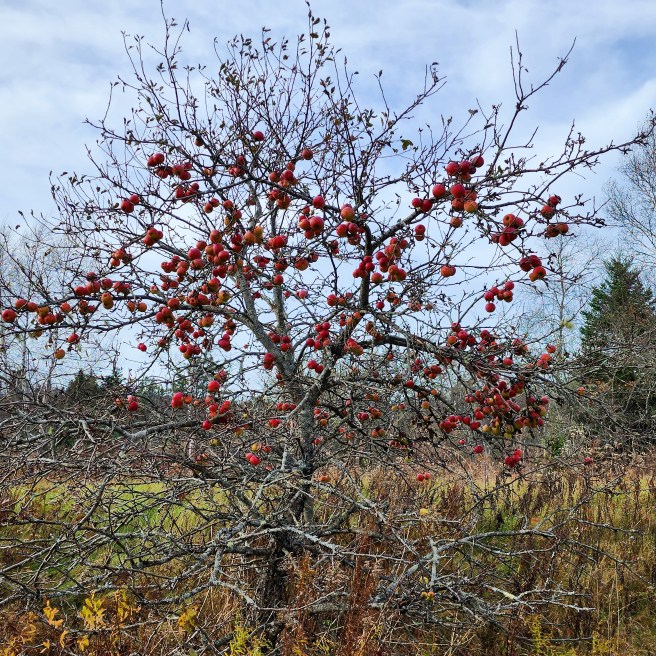

The trees are found everywhere around here. As are the deer that eat all the fruit they can reach.
You never know what we'll churn up in cleaning a stall
The trees are found everywhere around here. As are the deer that eat all the fruit they can reach.
At least we did it on a Friday, allowing for our being laid low over a weekend. It did involve a trip up to the Walmart in Calais, which was running way behind once we got there, but at least it’s one more thing we’ve crossed off our to-do list. These things add up as some kind of forward progress.
As for the condition of pharmacies in the USA? One more item ripe for a rant, from what I’m seeing. Fire away in the comments if you’re ready. At least we have a fine family version here in Eastport, except for getting that Covid booster or my insurance dealing with the flu vax. I’m not complaining. But they do refill prescriptions days faster than the Walgreens or Rite Aid another family member deals with down at the other end of the state.
I did plan for a “sick day” or two, perhaps reading if I was up for it. Don’t rule out the importance of such rebound days.
As it turned out, I did feel a whammy and slept through much of the next two days. Oh, home sweet home, even with a very sore arm. It was ultimately mild.
The break in my usual routine also gave me time to finally examine two movie distributors’ offerings and reflect on how they might apply to our local film society in its revival after Covid, now that I’m on the committee. Am guessing I’ll share those thoughts here at the Barn, too, for any of you so inclined.
We do have a lot of arcane material here at the Barn and in our lives, too, don’t we?
Onward, then!

The label does have a range of applications, from residents of the six-state New England region or Connecticut in particular to a Manhattan professional baseball team to anyone north of Dixie (often prefaced with “damn”) to anyone from the USA who lands in a foreign country.
Along with the shortened “Yank.” Or its many uses as an adjective.
The word’s origins, though, are contested.
None of these quite convince me, but I feel Scottish, Swedish, and even Persian roots are even less likely.
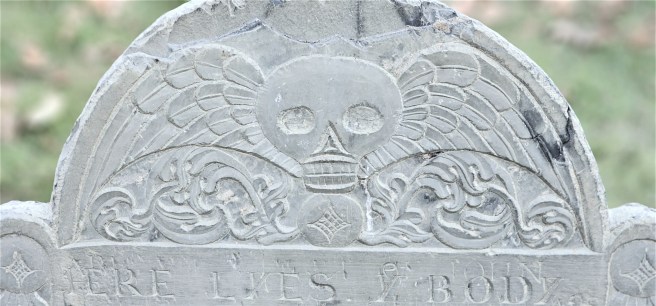

The thought crept upon me the other morning as I was pondering simplicity and frugality.
Yeah, look at the flip side.
I remembered reading a recent New York Times piece on a Long Island boutique that catered to billionaires and noted the owner’s insight that they spent differently. I shrugged it off then but come back to it now.
Suppose your after-tax income came to $3½ million a year? That would be nearly $10,000 a day. (I did miscalculate and put that at $100k a day, a more interesting figure. Still!)
For perspective, the median pay for S&P 500 chiefs was $14.5 million last year, in contrast to an average $56,000 earnings for American workers.
The No. 10 guy on the list, Tim Cook at Apple, came in at $99 million in salary, benefits, and bonuses. More than $240,000 a day. That is, $10,000 an hour.
Ahead of him were the CEOs of companies like Alphabet, Peloton, Live Nation, Sarepta Therapeutics, and CS Disco, plus four I recognized. Please, can somebody tell me what the head of Pinterest is doing to make him pocket $123 million for the year? A tad under $337,000 a day?
As one scion of affluence told me a half century ago, there isn’t much real difference between a $20,000 car (today’s prices) and a $200,000 vehicle, as far as everyday performance goes. Let me add, today’s median family car is far superior to the luxury vehicles back then. Air conditioning? Seat warmers? Cruise control?
As I played with the $100,000-a-day figure, nearly twice the yearly earnings of real workers, I realized how little of that was needed for everyday expenses, even at inflated expectations – how many houses does one need, anyway, or how many hotel suites while traveling? What came into focus was the vanity opportunities: collections of antique cars, paintings, sexual playthings, political hobnobbing. Just name it and claim it.
And that’s where it gets scary, even when you scale back to $10,000 a day.
Conservatives like to quote Lord Acton’s “Power tends to corrupt and absolute power corrupts absolutely,” while they pursue the maximization of their personal wealth, which intensifies their power and, thus, corruptedness. Per the logic.
Renting a luxury yacht – $100,000 a week plus expenses, last time I looked – is peanuts in comparison. As is a private jet. They might even be business expenses, paid by the company.
Well, F. Scott Fitzgerald did quip, “Let me tell you about the very rich. They are different from you and me.”
But I am wondering what he’d make of today’s mutations.
What would you do, given that much at hand?
A bicycle is useless indoors.
Moving to a new community three years ago meant meeting new neighbors, and Eastport, as we’ve found, can be a friendly place, even for us who are “from away.”
But one of our abutting neighbors was very-hard-of-hearing, as my wife discovered in attempting to talk to her, and ignored my attempts of waving in greeting. In many ways, she resembled my late asocial mother-in-law, not only physically but also in a heavy cigarette habit. Don’t know if she rolled her own, though. Still, she seemed to relish her independence and had a support system that included a few handymen I could approach with problems to address. Which they did.
We did worry about her occasional drives to the grocery or doctor or wherever. She could barely see over the steering wheel while puffing away, for one thing. And her backing out of the driveway did appear questionable. Still, she eventually returned home, apparently unscathed. I did see her one day in the IGA parking lot receiving a lot of help packing her trunk with her purchases.
I did wonder about her living in a big house all by herself, though that’s not uncommon in a town that’s largely elderly.
So flash forward to a day before what was left of Hurricane Lee was to hit town and I looked out the kitchen-sink window to see a police officer nosing about, checking her car, knocking on her door (and receiving no answer). No surprise there, her lawn-mowing and snow-removing crews got much the same.
Still, he was persistent, making repeated calls from his cruiser after trying all doors and walking around the house.
The next thing I knew, an hour or two later, was a white glove through her apple trees and the black SUV before the blanketed gurney came into focus.
Even before the obituary, an online search gleaned details that she had been born in Eastport to the manager of the local Newberry’s store and, when it closed, moved by stages to Upstate New York, and then, after college, to San Francisco before the Summer of Love and a career in banking.
And then, in retirement, she returned to her roots – from the City on the Bay, as we say, to the City in the Bay.
Her maternal side ran back to a family of Loyalists who fled to St. Andrews, a neighboring community in New Brunswick, before relocating to Eastport early on, while her paternal line was Pennsylvania Dutch by way of Virginia.
The family’s eventual obituary adds details.
~*~
In the aftermath, masked family and friends have been working steadily over two weeks to collect bags of trash and purge the house, including a colony or two of rats. (The rodents, it turns out, are well established in our end of town today – one more challenge to address.)
This also raises the question of just how much I leave to others after my own passing, and how much I need to clear out before then.
In the meantime, other questions loom, including the meaning of life for each of us.
We do wonder who will be living there next – hopefully not one more Airbnb but a real family with kids.
Onward! As I like to say.
Not that I wouldn’t love hearing the rest of her life story.
One of the first things the Puritan authorities examined for after arresting women preaching the Quaker message in America was physical proof of their being witches.
I have no idea about the specifics – and am not sure I want to know. Still, their obsession with the naked bodies strikes me as creepy, even pornographic.
After publishing my book Quaking Dover, the thought struck me that the Puritans must have seen Quaker worship as some kind of séance. Not that we were trying to communicate with the dead, but rather be open to the presence of the Holy Spirit, or Christ.
Of course, that Holy Spirit was translated at the time as Holy Ghost. Yipes! Sounds like Halloween, no?
From my perspective, Ghost is way too limiting for that Spirit, especially when Christ is seen along the lines of Logos in Greek philosophy.
It’s far more revolutionary and liberating than you’d think. One way builds religion as a kind of legal system with punishments and rewards. The other builds it as a set of relationships.
Now, to stock up for those little trick-or-treaters who will be knocking on our door. I promise not to put religious tracts in their bags, tempting as the opportunity might be.
Yes, the tiny one-inch ball with its moon Charon, at one-half inch, out on that branch.

We won’t get into the shock of the dwarf status revision within the lifetime of some of us, in part in consequence of the discovery of that moon.

As a further twist, the Aroostook system has two Plutos, one inside the Houlton tourism center, where it represents the orbs’ average distance from the sun (40 miles in the scaled version), and this one presenting its more current placement in its wildly elliptical orbit, a relative 33 miles from Presque Isle for the next 20 or so years.
 Jnana's Red Barn