The Metropolitan Opera broadcasts take on a new tone

One of the benefits of donating even a modest amount to the Metropolitan Opera’s broadcast fund is that you receive an annual schedule booklet, 36 colorful, glossy pages with the casts, broadcast times and estimated lengths, and summaries of the plots. The booklet arrives a month or two before the next season begins, and I keep mine as wonderful future references.

The upcoming Saturday matinee broadcasts, which start airing on Dec. 9, have already been controversial, due to the company’s shifting focus toward increased contemporary and sometimes realistically gritty works. The first presentation of the season, in fact, is Florencia en el Amazonas, inspired by the writings of Gabriel Garcia Marquez and only the third Spanish-language opera to be performed at the Met. (Carmen, after all, is in French and will be heard on Jan. 27.) Other works from our own era are Dead Man Walking (Jan. 20), X: The Life and Times of Malcolm X (Feb. 3), Fire Shut Up in My Bones (April 27), John Adams’ opera-oratorio El Nino (May 4), and The Hours (May 18).

That unprecedented string of operas by living composers doesn’t mean the usual masters aren’t on the menu. Mozart (3), Wagner, Verdi (4), Puccini (3), Bizet, Gounod, Donizetti, Johann Strauss Jr., and Gluck are all in the lineup, with two of the dates yet to be announced. Conspicuously absent is Richard Strauss.

Two of the archived presentations feature my favorite-ever conductor, Max Rudolf: Mozart’s Le Nozze di Figaro on Dec. 30, with Victoria de los Angeles and Cesare Siepi, and Donizetti’s L’Elisir d’Amore on April 6, with Luciano Pavarotti, Judith Blegen, and Ezio Flagello. As one conductor once told me, Rudolf could have been famous, if he had wanted that. At the Met, he worked largely behind the scenes as Rudolf Bing’s artistic administrator before going to Cincinnati and rebuilding that city’s great orchestra.

Also of note is that the long-running broadcast series has a new sponsor, the Robert K. Johnson Foundation, only the third in its history. The series was underwritten by Texaco from 1940 to 2003, followed by Toll Brothers luxury homebuilders (2005 to 2023).

Gee, have Texaco’s red-star gas stations been gone from the landscape 20 years already?

Even tradition changes.

How many books do you read a year?

These days, it seems that everyone I meet has written a book. As an author myself, I’d much rather for everyone to have read a book in the past week. Or, gee, even a newspaper.

Trying to get solid figures on how much is being published or read is trickier than you might suspect. But to get us started, let me offer some findings, albeit with a grain of salt. And, to further complicate matters, I’m not exactly sure how the researchers are defining “book.” I’m assuming textbooks, instruction manuals, catalogs, and the like are excluded. But cookbooks? They’re big in our household. That said, in the United States:

  1. Readership averages four books a year.
  2. A quarter to a half of adults admit to reading no books.
  3. A typical bookworm, on the other hand, devours 14 a year.
  4. Non-fiction dominates over fiction, three to two.
  5. History, biography, and memoir are major sellers.
  6. Two-thirds of book readers are women, but they comprise 80 percent of the fiction audience. Some surveys suggest that women age 18-24 are the most frequent fiction readers.
  7. On the other hand, half of American book readers are over age 55.
  8. Romance is the best-selling fiction genre, accounting for a third of the books sold. Mystery, fantasy, and sci fi are also boffo.
  9. Fiction titles still dominate bestseller lists.
  10. Books aren’t just for readers. They’re also for collectors. And gift giving.


Maine voters face two hot issues 

The Pine Tree State has a tradition, so I’m told, of placing complex issues on the statewide ballot because many of the elected state representatives and senators are afraid of negative reactions in a controversy.

Normally, public officials are expected to thoroughly investigate the issues and come to a reasoned decision. That’s why we elect them. Instead, shifting this responsibility to a general public that is rarely fully informed can be like rolling the dice.

This year, there are two issues of special note along those lines.

One is the so-call Right to Repair Act, which would prohibit manufacturers from keeping replacement parts and technology from independent repairmen. I’m still bummed by HP’s ink replacements policy – your machine shuts down if you try to use over-the-counter cartridges. Apple computer users have their own experiences. I know the list of big businesses’ proprietary efforts is growing.

The other issue is Pine Tree Power, which would have the state take over Maine’s two largest electrical utilities. Mainers have some of the highest electrical bills in the country accompanied by some of the longest and most frequent outages. Folks are still worked up over being cut off for weeks years ago after some storms before Central Maine Power got the lines working again. Despite the already high rates, CMP and Versant, the utility in our part of the state, both received permission this past summer to hike the bills another 20 percent. The utilities have lined up 15 times as much money for advertising than the grassroots effort has, no surprise there, and the campaign has a lot of emotional scare. What should be obvious is that somebody’s expecting to be repaid handsomely by staying in power (sorry for the pun). They’re not doing the customers any favors there, either.

So, when you’re checking the news reports tomorrow night or the following day, check the Maine results. They could be enlightening. Or, should we venture, shocking.

Oh, grunt

I’ve said it before and I know I’m not the only one.

Changing our clocks back an hour is the real beginning of winter. Everyone will be out of sorts for the next week and have no idea why. It really takes us that long, internally, to readjust.

Even those of us who are officially “retired.”

My genealogical research experience was a plus

In my mid-30s, a decade after I started worshiping in the Society of Friends, I heard that my great-grandfather had been a Quaker who moved from North Carolina to Ohio after the Civil War.

I’d no clue and was shell-shocked, in a good way.

That soon got me into genealogical research with another, older, cousin, which in turn led me to others through correspondence. Many of the results can be found on my Orphan George blog.

Central to that research were Quaker Meeting minutes and learning to interpret those records. For family data, they can provide some of the best information before the census of 1850, the first to name everyone in a family, along with ages and some other facts.

Serving as clerk of Meeting and in other roles also deepened my understanding of the faith and practice.

While I gained some skill navigating this field, other researchers specialized in public records, such as wills, tax filings, and property maps.

Admittedly, working as a census taker in 2020, I did develop a sympathy for lapses and errors in the federal population documents.

When it came to researching Quaking Dover, I found myself returning to others’ genealogical summaries, where one version differed from another, as well as other records. I knew to treat what I saw there as tenuous but still helpful.

Somehow, though, it felt familiar.

We’ve come to appreciate the cruise ship visits

While Eastport has the deepest natural port in the continental U.S., that’s not often led to a lot of big-ship landings.

Cargo shipments, especially, have suffered over the past decade.

Last month, though, the city saw a record number of cruise ship visits, sometimes running one every other day over two weeks.

We’re getting what’s often termed mid-sized cruises, up to a thousand passengers, in contrast to the floating cities that might deliver five times that. Frankly, mid-size fits us fine.

One factor has been Bar Harbor’s reaction to being overwhelmed, down at the edge of Acadia National Park. And Portland, further down the coast, is a big city in contrast.

As a result, Eastport is being discovered as a place that offers a taste of a quintessential Maine fishing village without the hype.

As one younger woman said while walking past our home, “Today was AMAZING!” Imagine that, in a small town seemingly so far away from anything.

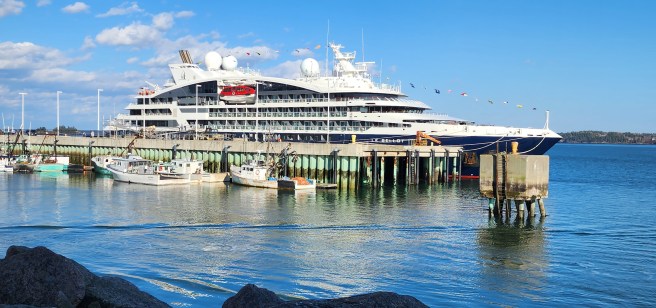
French liner Le Bellot, docked at Eastport’s Breakwater, visited town last week.

So far, these arrivals during the fall foliage season have extended our tourist season. The place typically shuts down by mid-September but these arrivals have extended that into early November. They’ve even given some, but not all, of our galleries and stores their best business days of the year. That’s a huge impact on a fragile, marginal downtown.

The landings also benefit the Breakwater and its workers, and let’s not sleight the purchases of junk food snacks at the IGA and Family Dollar by ships’ crews – sometimes up to another 600 people. They do load up.

We do enjoy seeing happy couples walking around our neighborhood with cameras in hand. Our conversations with them have been upbeat. Others have enjoyed bus tours to the Roosevelt compound on Campobello Island and the West Quoddy Light in Lubec or autumn foliage.

Economically, it’s an alternative to the Airbnb purchases that have been pulling housing away from working families, the very culture that’s a big part of the draw to our city. We do need more jobs that provide benefits, too, though that’s another big issue, one basically at the national level. I’ll save that for another time.

For now, let’s acknowledge what I’m seeing as a positive step, one that might even extend our spring shoulder season.

Nearly out of control

At some kind of outdoor affair. Summertime or so. I decide to leave and start to collect my papers and such from a table (picnic table?). Look up and see Ohio and some guy a hundred feet away or so … they haven’t noticed me, so I move frantically to escape undetected. Then I see that the vehicle I’m to take, which I’d previously seen only from the open back, is a black hearse – theirs.

Instead, I take a bus – a school bus, actually. Its route is more or less through Moraine and West Carrollton, and I wind up disembarking at a small, yellow-infused festival. (Spurred by memories of the Latin American restaurant my sister took me to?)

Somehow, I’m one of four (!) judges for a beauty contest. We’re given papers with the contestants’ names and info on one side and their photos on the other. Looking at the name I’m about to select, I see below it Ohio’s – only this time, there’s no married surname behind it. I flip the paper, see her photo in a skimpy bikini, and skewer the results so she wins. Afterward, she kisses me, tells me how desperate she’s become, which is why she entered the contest.

Do we ever escape the past?