Author: Jnana Hodson
In downsizing to a remote fishing village in Downeast Maine, this eclectic writer feels everything's coming together.
If you’re a self-published author, how do you stack up?
Yeah, we want folks to read our work, but we do dream of fame and riches, right?
Now, for a splash of cold reality.
- Even though a lot of authors are turning to self-publishing their own books, most don’t sell many copies. The typical self-published author sells about five copies, according to one report, while another has the average at 250. I’m guessing that some really hot sellers pull the average way up over the mean, kinda like winning the lottery.
- Another report has the average book now selling fewer than 200 copies a year and under a thousand copies over its lifetime. At the bottom, 90 percent of self-published books sell under a hundred copies. Not a lot to crow about, is it?
- On the other hand, self-published books account for a $1.25 billion annual market. At Amazon, that comes to $520 million in royalties. (As a self-published author, my royalties on an ebook rival what I get for a paper edition.)
- At Amazon, more than 1,000 self-published authors made $100,000 a year. Well, there goes a fifth of those royalties.
- For many authors, one secret to success is in having a lineup of titles rather than relying on just one. In that light, the average self-published author makes $1,000 a year in royalties, according to one account.
- But, back to the mean, a third of self-published authors make less than $500 a year and a fifth report making no income.
- New book sales don’t account for library patrons or the used book market. Used books? I don’t see ebooks showing up at yard sales. Consider that an advantage.
- The average American adult reads just 15 minutes a day, according to one survey that apparently doesn’t considering texting. On the other hand, just what are the others looking at on their phones?
- Still, if you’re an author, don’t quit your day job, OK?
- Only 1 percent of audiobooks on Audible are self-published.
Sometimes a little curiosity falls into place
You know, you drive past a thousand times and finally decide to explore a side street.
That’s what happened in Dover when I had a half-hour to spare before my presentation at the public library.
Upper Factory Road off Tollend was the excursion in question, and I was curious to see if I could actually get a glimpse of Kimball Falls in the Cochecho River through somebody’s back yard.
Yeah, suburban-style sprawl.
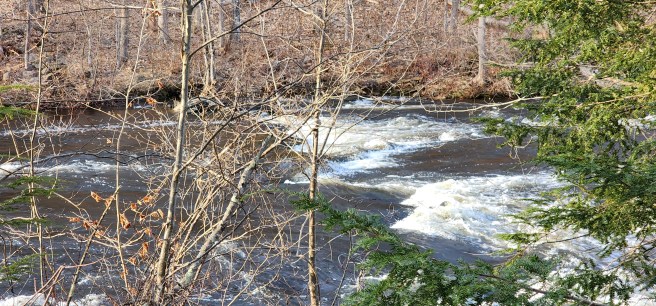
What first appeared was this falls, or rapids, at the foot of the trail. It’s the fourth of six falls as the river runs through Dover, though some of them are more accurately rapids. (I’m guessing there’s a nuance of meaning I hadn’t gotten previously – a waterfall seems to be a more clearly defined kind of “falls,” in contrast to fast-running streams like Jones Falls and Gunpowder Falls in Maryland as well as the Salmon Falls River abutting Dover.)
This one would have been the site of the Dover Cotton Factory, which bought the land before 1820, erected a dam, mills, and housing, and sold it in 1830, when the operation moved downstream to the first falls, now the heart of downtown.
Whittier Falls, which are discussed in my book Quaking Dover, were the second set going upstream.
To my surprise, Upper Factory Road actually leads to a small trail down to the water, along with a twist along the riverbank to a definite waterfall. Alas, that part was too wet to use at the time, but it is on my list for a future trip.
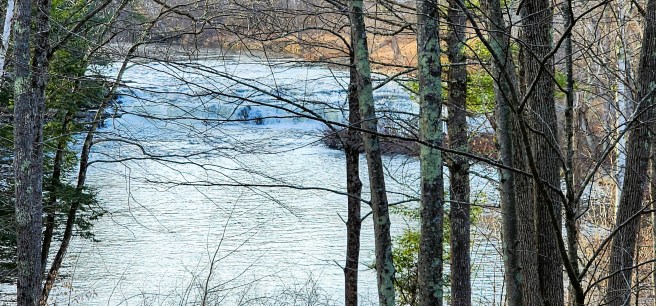

Checking the aerial map when I got home, I realized I had frequently passed the falls on the community trail on the other side of the river, but the path had veered too far inland for a direct view. But you can definitely hear them, as I recall.
It’s rather surprising how much you can find in what’s essentially your own back yard when you look. Or, perhaps more accurately, know what you’re looking for. I lived in Dover 21 years and found this 2½ years after I left.

By the way, there’s no Lower Factory Road.
What is it that makes a waterfall so appealing?
Did you know about the war between the U.S. and Canada?
More officially, it’s the Aroostook War a.k.a. the Pork and Beans War or Madawaska War of 1838-39 over the international boundary between Maine and the British province of New Brunswick.
Although militia units were called out, no actual fighting took place.
Well, there was a skirmish between armed lumbermen, the Battle of Caribou, in 1838.
The dispute was settled by negotiations by British diplomat Baron Ashburton and U.S. Secretary of State Daniel Webster in an 1842 treaty.
Without getting into the myriad details, it is how the Aroostook County towns of Fort Kent and Fort Fairfield got their full names. And most but not all of the disputed territory wound up in the USA, with Aroostook County being formed in 1840.
Reported casualties came from accidents and disease rather than actual combat.
Kinisi 185
Companions, as excess baggage.
Am I the man you wanted me to be?
The question is asked by Zorro in the opera by Hector Armienta recently premiered in Albuquerque and Fort Worth. This version of the story is much more subversive than the one I encountered as a kid. And the musical drama is, from what I heard on the radio, very much worthy of retelling.
What stunned me in the question that it’s directed toward the father. How often in today’s Western culture does a son turn toward his father that way, rather than his mother? Not in my experience.
It is making me look toward Dad anew and suspect I hadn’t failed him that much, after all. But the question remains disturbing and enriching, all the same.
How do we males find this working as well in terms of our wives – or lovers? Or our children?
This really gets serious – and unending.
If you’re a writer or a reader, look at the competition
Do you ever feel guilty as a reader? Not just in what you’re reading or in the things you “ought” to be doing in the time you’re engaged in a book or even a magazine, but also in the reality that you just can’t keep up in your particular field of interest?
And how about that nagging fear that maybe somebody else, somewhere, is already covering what you’re trying to develop … and probably doing it better?
Lest we Friends be too proud
From Bowen Alpern’s book, Godless for God’s Sake:
“Much of what we tend to regard as the achievement of Friends as a whole was, in fact, the work of individual Friends, or small groups of Friends, often in the face of opposition or neglect of their monthly meetings. (One of the most positive – if often tedious – aspects of Quaker culture may be its capacity to produce or attract individuals who are willing to stand up to it).”
An epitaph springing from a recent news event
DIED
WHILE CARVING
PUMPKINS
AT SEA
You seldom know what you’ll find in an old barn

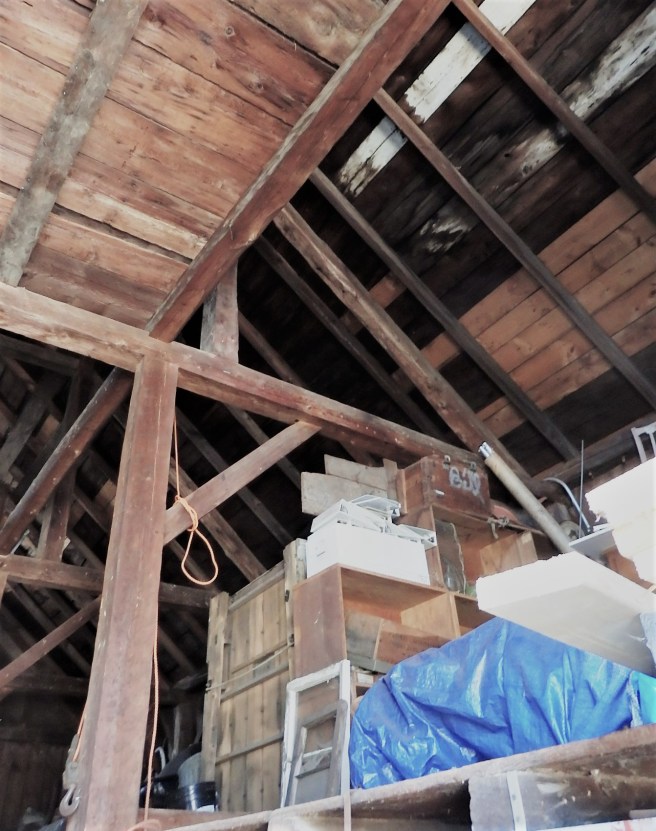
Well, it is the premise of this blog. For the record, a lot of our junk was stored under this floor, though this barn in York, Maine, was never ours.
 Jnana's Red Barn