“His poems are brilliant, even though he leaves lines unfinished, work uncorrected.”
You never know what we'll churn up in cleaning a stall
“His poems are brilliant, even though he leaves lines unfinished, work uncorrected.”
Thinking about arts performance scheduling and audiences has had me recalling some of the first operas I attended.
They were at the Cincinnati Zoo, at the corner of Erkenbrecher and Vine.
Don’t laugh. The performances were top-flight. The Cincinnati Summer Opera, as it was commonly known, was informally considered the summer home of New York’s Met, and it provided seasonal employment for members of the Cincinnati Symphony Orchestra.
The company had an impressive pavilion on the grounds, and visiting the animals before watching the singers was part of the experience, if you allowed yourself time. I especially remember being amused by the monkey island antics at intermission. And many of the singers, so I’ve read, humorously came to think of themselves as a special kind of animal.
Especially notable was the first time you heard a roving peacock screech. It sounded like somebody was being murdered and could happen at any time during a performance. Veteran singers used to wait to see if newbies could maintain their composure when the cry rang through the theater. In the opera world, this was an inside joke and a rite of passage, at least for those who passed the test.
I’ve been trying to remember how long the season ran, but there were usually four performances a week – one production on Thursday and Saturday, and another on Friday and Sunday, if I have it right. In the late ‘60s, that spanned six to eight weeks, best as I can recall.
Think of that – 12 to 16 different productions each year. Only a few big houses in the world surpass that.
But at its height, there were 18 different offerings over 61 performances in a ten-week season. Where did that many operagoers come from out in Ohio and neighboring Kentucky and Indiana?
The tradition originated in 1920, making the Cincinnati Opera Association the second-oldest opera company in the U.S., and continued until moving into the renovated and air-conditioned Music Hall in 1972, where the season still happens each summer, though on a much different scale.
Sardi’s in Manhattan?
A legendary bartender, being quoted in his retirement story in the New York Times, was amazed.
I have always been shocked by prices in the City, but for once it doesn’t seem so far out of line. Not that I go out that often.
There’s so much more I’d like to know about details related to my Quaking Dover story, but I’m not a professional historian.
Some of these could be fodder for a Ph.D. dissertation.
I don’t mean the cracker company, either, the one known as Nabisco, for National Biscuit Company. Or was that Baking?
No, I’m thinking of what was once the broadcasting monolith, first in radio and then in television, the one that projected a peacock logo at the onset of color programming.
The financial struggles for traditional mass media in the digital age are well-known, but broadcasting has been hit perhaps even more drastically than newspapers.
As a child of the ‘50s and ‘60s, I’m still shocked at the disappearance of AM radio, especially its powerhouse clear-channel signals. My daughters, savvy as they are in tech matters, don’t even know what AM is. These were coveted media, and getting a license for even a daytime frequency in a metropolitan market could be a coup. Think of WKRP in Cincinnati for the insider view. Instead, though, owners have allowed many of these to go silent. As for FM? The real competition is from streaming and satellite.
We gave up our TV years ago after realizing that whatever we wanted to watch was available online. Still, I was stunned the other day to discover that NBC no longer has an on-the-air outlet in Boston. That was unthinkable. Nobody would give up a network affiliation and go independent. Yet, as I learned, it isn’t anymore.
The trigger came the other morning when I was gazing at my Yahoo news feed and clicked on the latest Patriots football gossip from NBC Sports Boston, one of the primary regional sources. Wait, I thought. Why isn’t this identifying a station? Or at least a channel?
And that’s when I went down the proverbial online rabbit hole and found out that the once mighty network exists solely on cable in the nation’s tenth largest media market. Even the Tonight Show.
As for its entertainment lineup?
There are good reasons we’re turning to the new seasons at Amazon, Netflix, Hulu, etc. Besides, we can watch those shows at our convenience, not the network’s.
I must admit finding it hard to keep up with all of these changes. How about you?
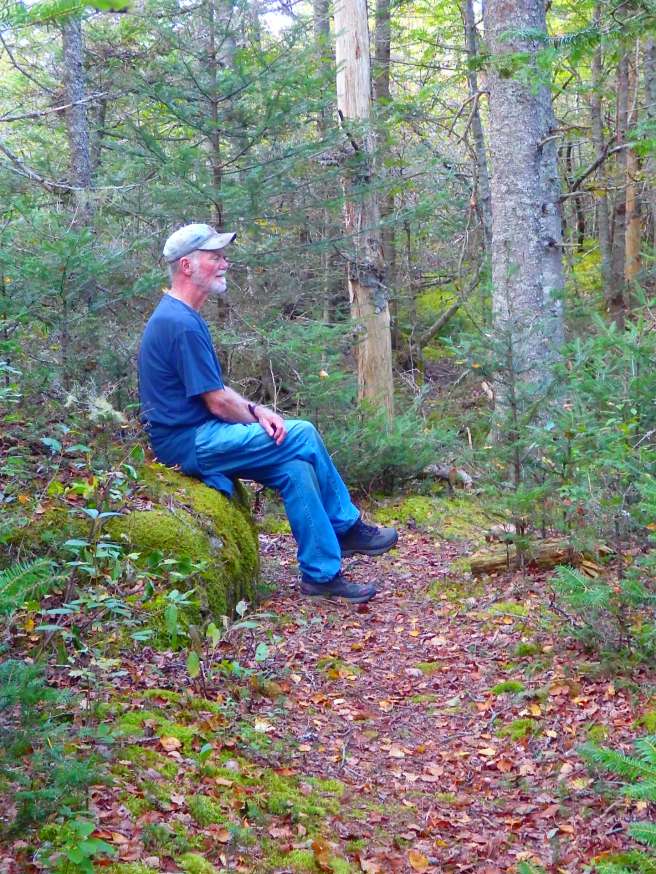
Dick in fine weather on a trail behind his farm.
It took her longer in line at the Starbucks than to get through the TSA screening.
Even so, she discovered that the alternative of driving 15 hours was still the quicker way to reach her destination.
SHOPPING FOR A PRESENT TO GIVE ME, she winds up in an antiques store, where the clerk finally sells her a Quaker Mixing Bowl from the 1800s – a slight crack, with QUAKER embossed on the side.
How delightful! Quaker style is, after all, distinctive … and part of me.
I’M CONTRADANCING IN WINONA. Turns out it’s Sunday morning and I’ve missed Meeting. (Fun versus the Old Folks.) Later I’m trying to help a Jewish group use the meetinghouse for their worship … a place we can share.
WITH A MALE COMPANION EXPLORING around the Beltway in Baltimore County. (Picks up on another dream, a year earlier.) This time I’m trying to locate a former Quaker stone meetinghouse and burial ground. A burial ground I find behind a motel is not the right one; another effort, and the road ends abruptly in a golf course.
IN A PARK-LIKE GLEN, MIXED FIELDS AND TREES … from a hilltop looking down toward a small stream and a black steel shed – a fieldhouse with bleachers – run into a few other people and we enter for Quaker worship … my suggestion of circling together countered by “No, others will come,” and soon both halves of the building are full – mostly young people – a solid worship.
Somehow feels like my ancestral Hodgson dreams with the New Jersey twist. Looking back, I seem to also recall a Poconos/abandoned steel mill feeling.
Exploring the park later, find lots of sleeping bags available for borrowing – REST! – so that’s where everyone came from?
Soon I’m in a white-walled plain room – under a fairgrounds grandstand or a livestock auction? At a long table, one of maybe a half-dozen, old-order Brethren or Mennonites – I’m their guest, eating very tasty sirloin tips, which my host pushes away from me before I’m finished, and everyone else pushes their dishes away – we all slip into prayer, a worship service with testimony, and while my host keeps trying to prompt me to speak, I wait and defer – even when we get down to time “for one more,” I yield to two women. “I came to listen,” I explain later.
In both, a sense of rich worship. So much so that real Meeting for Worship felt like the third one that morning.
A sense, too, of Elijah’s 8,000 remnant or the cloud of witnesses or the circle of elders in Revelation:
WE’RE NOT ALONE
It’s nothing like the plastic models we bought as kids and then glued together. The battleships and war aircraft. This one’s shaped like a giant awl or very dangerous letter opener or our digital thermometer for cooking.
It’s dark gray, like a black hole, for solid reason.
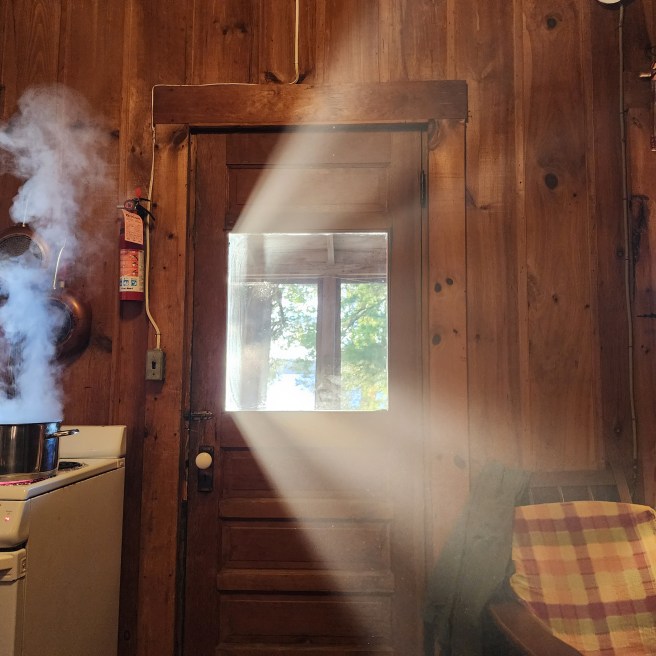
 Jnana's Red Barn