The American ideal of reflection and choice

… it seems to have been reserved to the people of this country, by their conduct and example, to decide the important question, whether societies of men are really capable or not, of establishing good government from reflection and choice, or whether they are forever destined to depend, for their political constitutions, on accident and force.

Alexander Hamilton in Federalist No. 1


In memoriam

Last year, a spate of deaths altered my position in a greater hierarchy.

First, a cousin born a few months before my dad, passed, having reached 100. Shortly after his death in 2009, we had a fruitful exchange of correspondence answering many of my questions about my grandparents, which now appear as Dayton’s Leading Republican Plumber on my Orphan George blog.

Also participating in that exchange was my dad’s youngest sister, who was halfway between him and me in age, as it turned out. She, too, died this year, shortly after her husband. They were the last of the generation in my close linage. So I’m now the eldest male in my grandfather’s descendants.

The year also had a series of deaths in Dover Friends Meeting, including a former clerk, a cherished elder (bishop), a fine minister, a very dedicated longtime treasurer, and a prominent social activist. That leaves me as the oldest surviving clerk of the congregation but living a distance away. The collective memory shrinks, in effect.

What I’m left facing is the reality that there’s no longer that umbrella of older, wiser figures over me, sheltering or guiding me. Instead, that’s now my role in reverse. Frankly, I feel inadequate.

It’s a responsibility, all the same. And a debt.

There’s more to the Northern Lights than you see

Living as far north as I do, just a hair below the 45th parallel halfway between the north pole and the equator, I’m starting to keep an eye out for the Northern Lights on clear nights through winter. Moonlight, clouds, precipitation, and pollution all block viewing, but our remote location means that many of our nights can be visually crisp and rewarding for those who bundle up.

  1. More formally, the beautiful, dancing waves of light are known as the aurora borealis, named by the Italian astronomer Galileo Galilei in 1619 in honor of Aurora, the Roman goddess of dawn, and Boreas, the Greek god of the north wind. They most famously resemble giant colorful curtains blown by some cosmic wind, though that’s all a mesmerizing illusion. In fact, where I live, they’re more likely to be detected by time-exposure photography than by the naked eye.
  2. They’re best viewed between September and April, when the night sky is longest and darkest, especially in the “auroral zone,” a cap roughly within a 1,550-mile radius of the North Pole. Places like Fairbanks, Alaska; Tromso, Norway; Lapland, Finland; Orkney, Scotland; and Yellowknife, Canada, are key travel destinations for viewing, but rare sightings have been reported as far south as tropical Honolulu, Hawaii.
  3. While Northern Lights happen 24 hours a day, seven days a week, 365 days a year, they are most intense after a geomagnetic solar storm, which tosses energized particles into Earth’s upper atmosphere at speeds up to 45 million miles an hour. As the Earth’s magnetic field shields the surface by drawing the onslaught toward the poles, the energized particles collide with atmospheric gases, producing vibrant hues of blue, green, pink, violet, and even gold in surreal movement across the night sky.
  4. Solar storm emissions run in 11-year cycles. The last peak of extreme activity was in 2014, and the next is next year. We’re already in the higher-than-usual range.
  5. The strongest geomagnetic storms can disrupt GPS systems and radio signals. One temporarily knocked out electricity across the entire Canadian province of Quebec. The largest solar storm recorded, Carrington Event of 1859, sparked fires on telegraphs. I remember some occasions in 1970-’71 when they turned the overnight teletype news reports from the Associated Press, United Press International, and other wire services into unintelligible jumbles. (Some of my Sun Spot poems are drawn from that outpouring.)
  6. The storms even have the potential to wipe out the Internet for weeks or months unless the technology is “hardened,” , according to some warnings.
  7. The night lights also appear in the Southern Hemisphere as the aurora australis but are more elusive because there’s less land mass, and, thus, fewer suitable spots for viewing the spectacle.
  8. Earth’s not alone. Jupiter, with a magnetic field 20,000 times stronger than Earth’s, has far brighter blazes. Auroras have also been discovered on both Venus and Mars, despite their very weak magnetic fields.
  9. NOAA’s forecasts are available online at NOAA’s Aurora Viewline for Tonight and Tomorrow Night page, mapping the southern-most locations from which you may see the aurora on the northern horizon.
  10. The best time for viewing? One source says mostly just before sunrise or after sunset. Another says between 9 pm and 3 am.

Acid test poet: Allen Ginsberg (1926-1997)

How curious that he should lead the parade. When my own poetry practice was taking root, back in the early ‘70s, I was largely unimpressed compared, say, to Bob Dylan. I didn’t pick up on the gay dimensions, either, only the rage of Howl. In fact, though I had some poetry courses, I wasn’t blown away by much of anything until I encountered Anne Sexton and Sylvia Plath’s searing despair. Everything was essentially head, not heart.

Over the years, my opinion of Ginsberg changed. I came to appreciate his lines that stayed close to their source of inspiration and the ways his poems faced current events. While much of his artistic voice is seen as an homage to Walt Whitman, I find his work is much more in the stream of the lives of the prophets in the Bible. I’ve come to love a masterful, righteous rant for justice, which his poems often are. (Just see my Trumpets of the Storm series, starting with Primary Care at my ThistleFinch blog).

I’ve also come to admire the seeming ease with which he presents an observation – his definition of New England as famed for red leaves comes to mind.

His 1973 collection, The Fall of America: Poems of These States, has been the volume I’ve returned to the most.

Despite his role as an avatar of drug highs or gay rights, he strikes me increasingly in his native Jewish robes more than in those of the Tibetan Buddhism he avowed. Maybe for that, you should read the book The Jew in the Lotus by Rodger Kamenetz.

Yeah, here we are already, with one author leading to another. But first, where is my set of Whitman?

Let’s fill in some more blanks

Some people sit down in the depth of winter to peruse seed catalogs and dream of harvests. We’ll be doing some of that in our household, and you’ll no doubt sample some of the results here.

Some find it a good time to revisit highlights from the previous year or further back. Yup, that too.

The snowy months also offer delightful travel opportunities, and not just to warmer climes. Even if you stay close to a wood fire or the equivalent, taking time to sift through brochures can stimulate plans for trips long or short later in the year. Consider my upcoming posts based on my week on the waters of Penobscot Bay at the beginning of autumn in that vein.

Quite simply, retirement and winters aren’t a blank stretch in my life.

~*~

One movie I viewed as a kid in the Dayton Art Institute’s tapestry-walled auditorium left a lasting impression on me. I think the film was scheduled to be shown outdoors but this was the rain site. What I do recall is its presentations of windjammers racing along under full sails. I was still far from any actual encounter with the ocean or sailing, but from that point on I did realize I had no interest in a traditional cruise, or what I’ve seen as a floating nightclub. No, if I went out on a cruise, it would be under sail. Not that the option quite came in front of me.

Instead, the closest over the years were jaunts on ferryboats in the Pacific Northwest and then the Northeast, along with whale watch daytrips and, especially, my boss’ 32-foot sailboat in the Gulf of Maine.

One impression I gleaned from those outings is how differently a geography fits together when it’s experienced from its waters rather than its land. That awareness certainly came into play in my history research for Quaking Dover.

Being on the water filled in some blanks.

~*~

As a lover of maps, from childhood on, I’ve also learned how the mere fact of being in a place transforms the charts. A location becomes real when I’ve walked around in it. Or, as I learned in my time on Penobscot Bay, if I’ve walked around in a boat just offshore.

Listening to new friends in Maine presented a series of towns I could place only vaguely – Castine, Stonington, Brooklin, Islesboro, Southwest Harbor – along with related locations like Vinalhaven, Isle au Haut, Blue Hill, Swan’s Island (not to be confused with Swan Island in the Kennebec River), or Little Cranberry. I could nod along with a blank look. My week on the water filled in more of that comprehension.

Now, let me fill in the name of the ship in question here – the Lewis R. French – and the fact she was a schooner, a very special distinction, as I would learn.

And as you’ll see.

When it comes to a home, how did you settle on the ‘right’ place?

Two dozen years ago, in our previous homebuying round, I created a list of 20 definitive items we could rank on a scale of one-to-five, only to discover that the particularly hot sellers’ market and our price cap rendered the exercise useless. The harsh reality simply didn’t present us choices to evaluate. The best we could do was simply check off Yes or No. If a place passed, we then had to beat other bidders to the punch. Forget quality and personal style. Was it habitable in its current condition? Did it fit our needs?

For the record, we were not, then or now, seeking an idealized suburban house with a white picket fence and an immaculately manicured yard. As you can imagine from this blog, we were open to something funky or organic, what some would even define as “character,” a place that could breathe and grow with our lives.

In the end, we simply lucked out, as you see in the Red Barn postings from New Hampshire.

In our recent downsizing to the other end of Maine, we had a less pressured, more leisurely pace in the market. High on my checklist was walking distance of downtown, the health center, and the arts center, plus a view the ocean, even only a glimpse between neighboring houses, and a workspace for my writing and related projects, though that could be much smaller than before, now that I’ve largely moved away from paper.

Other participants had their own priorities, including a large garden with full sunlight. As for a kitchen? Let’s just say that potential can be a checklist item of its own.

Neighbors and security are largely a wild card.

And, three years later, after several false starts, we made a bid that was accepted.

What we knew was that the place needed a lot of remedial work. And, oh yes, it had lots of potential.
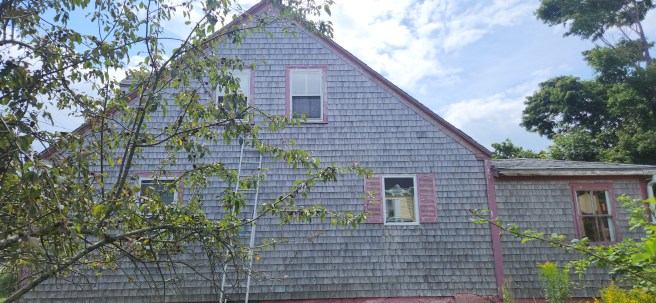
In our recent homebuying round, a right property hadn’t popped up to a consensual acclaim. Some dwellings were closer to demolition than restoration. Others had been renovated in ways that were simply puzzling – a prime memory was the placement of the only bathroom behind a master bedroom. One modest house had four, maybe five, stairwells, enough to leave me lost indoors – I’m still intrigued by the quirkiness though I can’t pick out the place now from the exterior. Let me also admit that passing on an 1820s’ residence I really liked was ultimately the smart decision. The last one had been owned by the publisher of an early newspaper here, though that wasn’t the only thing I liked; once the kitchen deficiencies were made obvious, I understood why I was in the minority in that case.

As for the winner of our quest, I must admit the house didn’t grab my attention, not until the larger vision was shared with me.

The listing had been on the market for the previous three years or more. It needed work, serious work, but it felt good inside, as others have told me afterward, even though the house is cold through much of the year, as I’ve even read in the archives of the local newspaper. A strong attraction is the natural light throughout the rooms. Our house inspector was impressed that the bones were good, especially the foundation – up to 18 inches thick in places. Were we up to the challenge of reviving the place? Life’s an adventure. I expected our low bid to meet rejection.

Instead, the seller accepted, clearing out most of our cash savings.
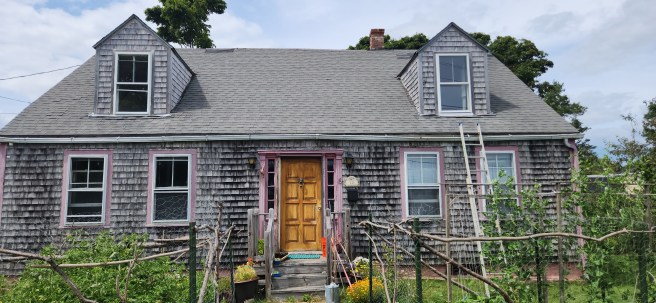
So here we with a classic cedar-shake siding full Cape dating from around 1830, although the real estate blurb placed it in the 1860s.

What has amazed me is the other participants’ envisioning of the renovations for this new venture. Not just the big, bold actions that inhibited my own thinking, but also many details that deliver a pleasurable, significant impact.

And that’s the beginning of this old house renovation story. As it unfolds, I hope you’ll pipe up with ways you’ve made your own dwelling a home a sweet home. Or, for that matter, of how your own projects required three times as much time and money than your best estimates presented.

Whatever the case, please enjoy the upcoming posts over the year. Not that it will be the only series here at the Barn this round.

Write about what you know, but best if it leads into what you don’t know

I’ve spent a lifetime writing – well, from my senior year in high school on.

I rather fell into a career as a newspaper journalist who worked mostly on the copy desk or a few steps beyond, with titles like news editor, lifestyles editor, makeup man (working closely with the production crew in what was called the back shop or, more politely, composing room).

My real dream was to have something more permanent as my legacy – books with my name on the cover and the spine. The fact was that as much as journalism engaged me, I yearned for a bigger picture than the daily deadlines usually reflected.

And so I spent much of my “free time” writing things that would never appear in a newspaper – poetry and fiction, especially, or even lengthy letters to friends and other writers. And, more recently, there’s been the blogging, which I hope you’ve been following.

Many of those years I despaired that my “serious” work would never appear as printed books, especially once I discovered how much effort was required to land even one poem in a small-press literary journal.

The persistence has resulted in eight books of fiction to my credit plus more than a thousand published poems and a few chapbooks.

The most successful entry has been Quaking Dover, a history of one of the oldest Quaker congregations in the New World.

~*~

As my diamond jubilee year wraps up, I’m reflecting especially on those eight books of fiction and the life that’s produced them.

You’ve heard the adage, of course, “Write about what you know.” But I’ve come to see how important it is to also write about what you don’t know, especially where it’s at the edge of your existing knowledge. I am among those who write as an attempt to make sense of something personal, which means being something of an explorer or discoverer or laboratory technician. A good writer, I’m thinking, wears many hats, at least of the proverbial kind. Let me confess I rarely wear a hat of any kind, though I should, considering the balding and sunlight and many skin cancers.

Drafting a story is work, even on those rare and exhilarating flashes when it seems to write itself and you’re flying too fast to worry about spelling or grammar or other details. But it’s not the most difficult part of the practice.

Revisions, I should emphasize, are everything. Or at least the hardest part, and the more essential part of writing in the hope of a readership. I find that in hard revisions I discover more of what I’m coming to know.

With my focus on Quaking Dover for the past three years, I’ve neglected my earlier books. Returning to them this year feels like a good exercise, for you, dear reader, and for me.

One of the regular weekly features here will be on things behind my books. The stories themselves already speak on their own.

Please stay tuned and tune in.