- Even if Biblical Scripture is essentially the “men’s minutes” of divine history, the women therein generally come off much better than the men – and whenever the women are named, there is growth in the church: Sarah, Rebecca, Rachel, Miriam, Deborah, Hannah, etc.
- Because the male gender language has been inclusive, representing the universal, there is no English way for men to refer to themselves in the particularity of being male – no way, in other words, that we can distinctly represent the specifics of being male only. So just who has been more impoverished by this defect?
- When I get away from my emotions, I’m also far from my God … (God is love).
- Argument: It’s possible to do religion without faith, but impossible to maintain a mutually loving connection without faith i.e. trust. Thus, positive relationship exists with the Divine.
- Hosanna and Alleluia as universal expressions of awe and ecstasy.
- Hashem = “the unnamable name” = neutral.
- Adoni = lord = male.
- Elohim = breast = female.
- The idea of “casting spells” is that you can order God/the gods/spirits to do your bidding rather than the other way around.
- Zionism originated to save a language. That is, a language needs a place where it lives.
Author: Jnana Hodson
In downsizing to a remote fishing village in Downeast Maine, this eclectic writer feels everything's coming together.
Paper bags star
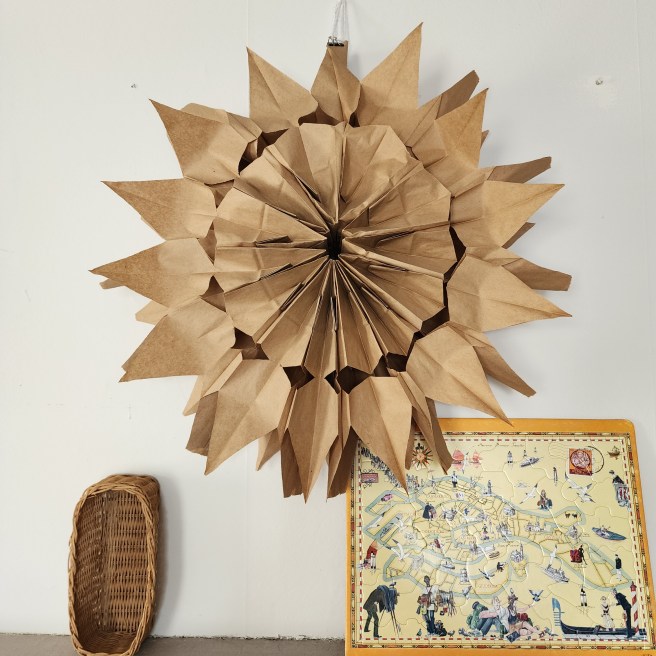
Those were lunch bags.
Acid test poet: Anne Waldman (1945- )
Perhaps best known as a cofounder of the Poetry Project at St. Mark’s Church in Manhattan as well as the Jack Kerouac School of Disembodied Poetics each summer at the Tibetan Buddhist Naropa Institute in Boulder Colorado, Waldman has worked with many of the famed Beat poets a generation older in a life of experimental writing and social activism.
In preparing this post, I was surprised to find she’s only a few years old than me. She’s often seemed to be that much further ahead in the history of contemporary literature.
She first impressed me with a few poems in Disembodied Poetics, an annual review she co-edited. I liked the way the disparate elements danced, something in common with much of what I’ve written. Later, in her collected works, I was taken with the ways she employed repetition, something I had avoided as, well, redundant. My Preludes & Fugues, especially, are beholden to her on that front.
Kinisi 193
SO NOW
SLOW
PLOW
Get primed for a windjammer experience
It’s like camping, with the canvas over your head rather than a tent.
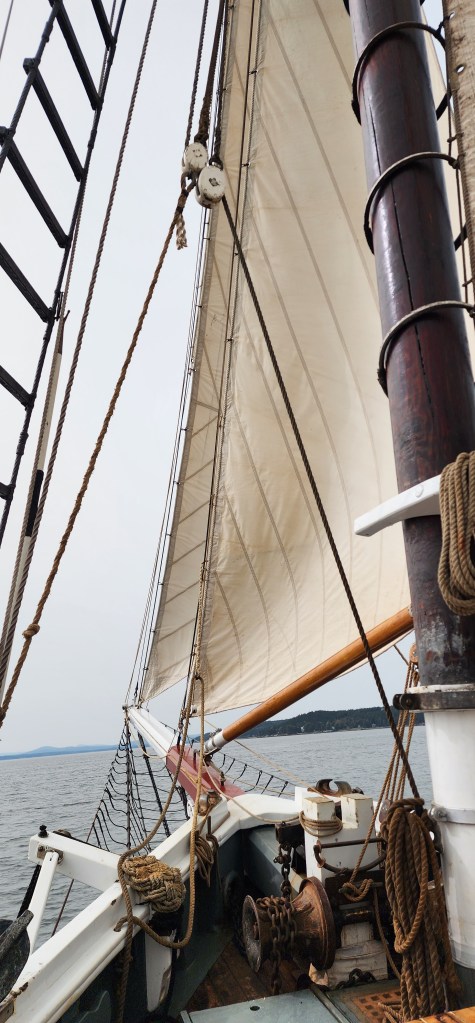
Peter tried to brace me for the, uh, unique quarters. And the pause when I mentioned taking a shower.
I had a snug berth, as you’ll see later. The only electricity on board came from some strong batteries and a small solar array.
Rather than a floating night club and hotel of a typical cruise ship, a Maine windjammer is small and laid-back. You even have to wash your own dishes.
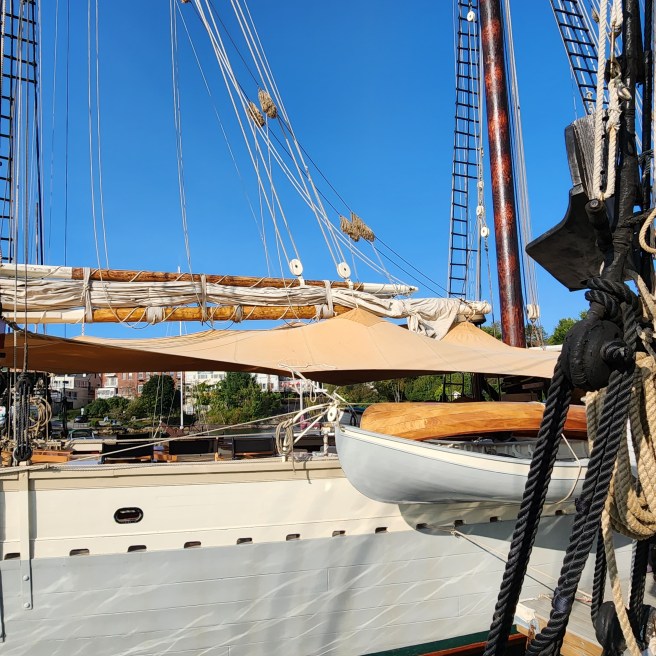
As the windjammers’ association brochure says:
Unlike large cruise ships, windjammers have bunks and cozy cabins, not monster staterooms and 24-hour buffets. Windjammers are woody and compact below decks. Crew and guests live and work in close quarters. The ship’s galley and dining areas are like your kitchen at home – everybody mingles there.
The Maine experience dates from 1936, when Captain Frank Swift started offering adventurous passengers sailing opportunities formerly only available to private yacht owners.
Last summer I got to be one of them. It really was memorable.
Homemade turkey potpie
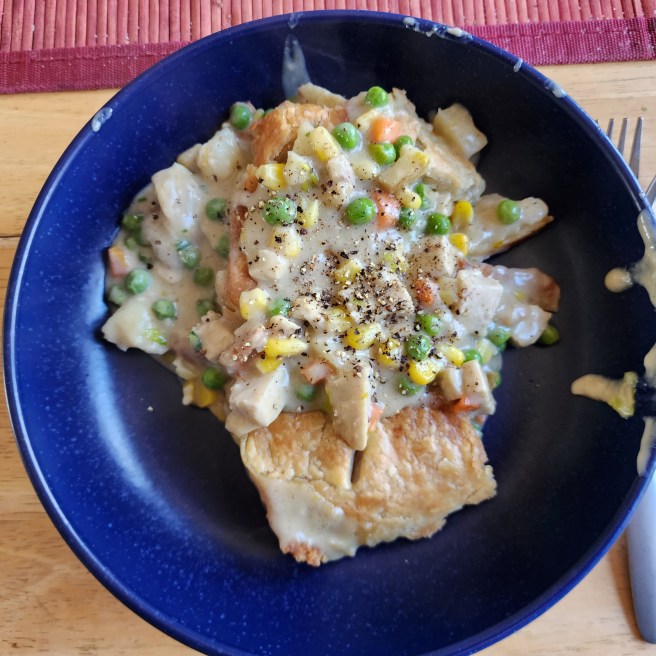
One of my favorite comfort foods, especially the way my wife creates it.
We were on hold – as in stuck – even with our money shrinking in the bank
Our gloating over our timing of selling our previous house at the giddy peak of a hot market soon darkened when we realized two nationwide tides were running against us as we tried to move ahead in our current dwelling. One was the soaring price of construction materials. The other, as inflation kicked in, was the erosion of the purchasing power of our working nest egg.
If it were only me here, I could pretty much survive quite nicely in two rooms. One of them was what I came to call my dorm, the quarters where I slept in one half and wrote in the other. The second chamber was the kitchen. That left our north parlor, with the video screen and two sofas, and the south parlor, as a guest room and storage.
When it’s been two of us, the space situation became more problematic, especially with just one small bathroom.
We still didn’t need the upstairs for much, except when others visited. We certainly didn’t want to pack in too much storage until the new roofing and reframing were done. Everybody we approached about the overhead project was booked out a year or two ahead, and most of them declined to commit to another. One who promised to the job then backed off for a season, so we waited, only to be ghosted in the end.
Whether it was just me here or maybe four of us fulltime, the overhead work and much more needed to be done. It couldn’t be put off forever.

In the absence of a dependable contractor, we did inch ahead on a few fronts.
One was a large garden shed that cost us half-again as much as it would have a few months earlier. I can joke that it’s my new barn, though it’s not red and is much, much smaller than the namesake for this blog. Still, it’s surprising what a difference it makes – almost like a garage without parking for a vehicle or two.
Another concern was a classic wood-burning cookstove that occupied the heart of the kitchen and was an inefficient supplemental heat source. Besides being a major weight on our sinking floors, it had a stovepipe feeding downward into our surviving chimney, which was also used by the furnace, a violation of current building codes. I saw the stove as a both fire and health hazard. It had to go. Distinctive it was, both as a liquor cabinet/bar and as a fun place to stash junk food and other treats for visiting family to raid, I’m glad it did find a new home, as I explained in Chief Doe-Wah-Jack’s Pride and Joy, June 10, 2022.
And then, as you may have followed here last year, we went ahead with some raised garden beds. I do wish you could have tasted some of the harvest, and I’m happy to repeat that the ravenous deer around here did not penetrate our improvised barriers, unlike the previous summer at the community garden.

Living in these conditions has carried a sense of camping. You know, as in not quite permanent. I haven’t even described our makeshift kitchen setup or the rain dripping inside windows or the cramped, windowless bathroom.
All the same, I can say I’ve never felt as much at home as I have here. Maybe that has something to do with the abundant natural light in the first-floor rooms. Or maybe with my life in general. Or maybe the lingering good vibes of Anna M. Baskerville. Or more likely, all three.
But that couldn’t go on forever. Repairs and renovation needed to be done, if only we could find an available superman. I mean, this is my fourth winter in this place and I wasn’t the only one aging. I could sense it in the walls, too.
Hope I’m not sounding whiny.
Can a location be a fictional character, too?
In my big writing projects, landscape and geography have formed a major thread.
It’s most prominent in the novel that became Nearly Canaan, which is outwardly more about tensions with an unstable spouse, the trials of career ambitions, and a sequence of three locales that culminate in volcanic explosion on all fronts. Perhaps raising a personified landscape to the fore would have been too melodramatic, but it was an option I’m now seeing I overlooked. You know, the fantasy genre.
Even so, places are a primary ingredient in my fiction and poems.
My four years in the desert of the Pacific Northwest were a revelation. I felt myself on the brink of everything I had hoped for. It seemed embodied in the landscape, including the ways the Indigenous presence resonated in the earth itself.
And then everything exploded and I was, essentially, exiled from Eden.
By the time I could hunker down to collect the debris, I was on the East Coast. I had also lost the extended elation of feeling that my big breakthrough as a poet was about to happen.
I’d say I’ve leaned toward celebrating the good and lovely sides of life – a hopeful optimist, though I loathe that term – but I finally recognized in later revisions the importance of acknowledging the ugly, too, and the overwhelming desecration that’s occurred across this land and the globe despite what I saw in the better sides of the hippie alternative.
~*~
I am a visual person and even considered a livelihood as a painter or graphic designer or architect back when I was in high school. Being named editor-in-chief of the Hilltopper ultimately changed all that. Well, much of my journalism career included selecting and cropping photos and designing newspaper pages. My visual art training wasn’t neglected altogether.
From early childhood on, I loved maps. Hiking and primitive camping in a rogue Boy Scout troop abetted that awareness. Growing up in flat Ohio, I imagined mountains. Even a bump on the horizon, say Mount Saint John in neighboring Greene County, seemed vast, at least on our bicycles. An ocean was inconceivable. The mountains I experienced were the Appalachians, especially a stretch of the Appalachian Trail we Scouts backpacked between my fifth- and sixth-grades. Those magnificent and dreamy heights didn’t have the craggy snowcaps that had captured my imagination, but they did introduce the sensation of being somewhere near heaven and looking down on the world, the way God would. (At least as I would have seen it then.)
Add to that history and historic places. Old log cabins and their unique smells are among the memories imprinted within me. I probably read the entire shelf of Landmark Books’ profiles of famous people in sixth grade, if not third.
In the middle of my sophomore year of college, I transferred from my hometown to the Bloomington campus of Indiana University, where I had hiked and camped in the surrounding hilly forests, but this was a more distinctive locale than I realized in my leap toward a degree.
I mention all this because I’m seeing how much a specific spot on the map has been an element of my poetry and fiction.
An important twist came when I was living in the yoga ashram in the Pocono mountains of Pennsylvania and our teacher, an American woman, returned from her first trip to India. She said the reason Hinduism has so many deities is that many of them reflect the unique vibrations – as she said, vibes – of the different locales.
Thus, it’s not just how a place looks but also how it feels with your eyes closed. Maybe even how it smells.
I hope I’ve conveyed that in my writing.
Subsequent relocations took me back to Ohio and Indiana, on to the mountains and interior desert of Washington state, and then, in exile as it felt at the time, eastward to Iowa, another corner of Ohio, and finally Baltimore and the year of intense keyboarding I’ll describe later. After that, I headed north to New Hampshire and now an island in Maine.
So here we are, wherever.
On the disparities of wealth
… the most common and durable source of factions, has been the various and unequal distribution of property. Those who hold, and those who are without property, have ever formed distinct interests in society.
James Madison in Federalist No. 10
Lobster gear gallery

Once quintessential and now mostly obsolete, collected along the shoreline. What one observer has dubbed an outdoor closet on a neighbor’s deck.
 Jnana's Red Barn