Some things ‘Quaking Dover’ has in common with my novels

Not that I really noticed the parallels until now.

  1. Counterculture is central, leading to an awareness of an underground community or at least kindred spirits.
  2. Both have meant learning to write differently than my neutral third-person journalism. Emotion, for instance, over fact, is the rule in the fiction. And the history opened a similar vein as creative nonfiction.
  3. The role of a narrator in both. In the history, that meant developing the gently laughing curmudgeon as he pored over historical data. In four of the hippie novels, it was the snarky daughter reviewing her late daddy’s hippie experiences.
  4. Both veins are self-published, falling under the shadow of being “not commercially viable” by publishing houses. That places an additional burden on the author.
  5. Marketing is a huge challenge. Apart from Subway Visions, none of my stories take place in a big city or address a big audience. How many hippie novels can you name, anyway. As for Quakers?
  6. Spirituality and religion run through all of them. In the novels, it’s often yoga, though Hometown News runs up against a puzzling array of churches. In Quaking Dover, though, it’s often the clash between the upstart Friends and what I first saw as rigid Puritans before both traditions begin to, uh, mellow.
  7. There’s a strong sense of place, even if these locations are far from the mass-media spotlight.
  8. I go for the big picture. I really would like to have a simple book – something, as Steven King advises, having only one big idea – but that’s not how my mind works.
  9. They’ve all undergone deep revision. Much of the fiction actually got new titles and new characters after their original publication.
  10. They were all labors of love.

Acid test nature writer: Barry Holstun Lopez (1945-2020)

My introduction was at a multidisciplinary conference at Fort Warden State Park in Port Townsend, Washington, in the late ‘70s. Lopez had just published his celebrated Of Wolves and Men, and this was a weeklong gathering of writers, naturalists, scientists, and a few others.

Three of his smaller, later books have especially held my attention: Desert Notes, Arctic Dreams, and Giving Birth to Thunder, Sleeping with His Daughter, presenting Native American mythology, especially the Trickster figure, Coyote. These volumes are sometimes classified as fiction, but they really straddle genres.

Maybe that’s why I return to Lopez more than to Rachel Carson or Annie Dillard or even Henry David Thoreau.

He did serve as an inspiration for two of the novellas that appear in my book, The Secret Side of Jaya. Well, maybe even the third one, too.

I had already drafted my longpoem, Recovering Olympus, as well as probing Native American lore since my years in the ashram, where Asian mythology also started infusing my awareness.

Lopez, though, had some serious fieldwork to support his visions.

We weren’t exactly living in a war zone

Starting this project was like being buckled into a big roller coaster, say the legendary Son of Beast just north of Cincinnati, or finding yourself pregnant, or so I’ll presume, either way resigning yourself to going along for the ride, wherever. Well, in either of those examples there is a destination, and we’re assuming there’s a fine outcome here, too.

I had no idea how much I didn’t know the morning Adam showed up with his tools.

Let me relate how relieved I was to learn that we could still live in our house during the renovations. Stories circulated of people who not only arranged for accommodations where their crew could live during big renovation projects but also had to clear out themselves for the duration.

Look, our financial pockets aren’t deep. We’re addressing my lifetime savings, unless my novels somehow turn out to become blockbuster bestsellers, even at this late date.

Taking more than a few deep breaths, then?

Adam hit the ground running.

At the end of Day One.

And Day Two.

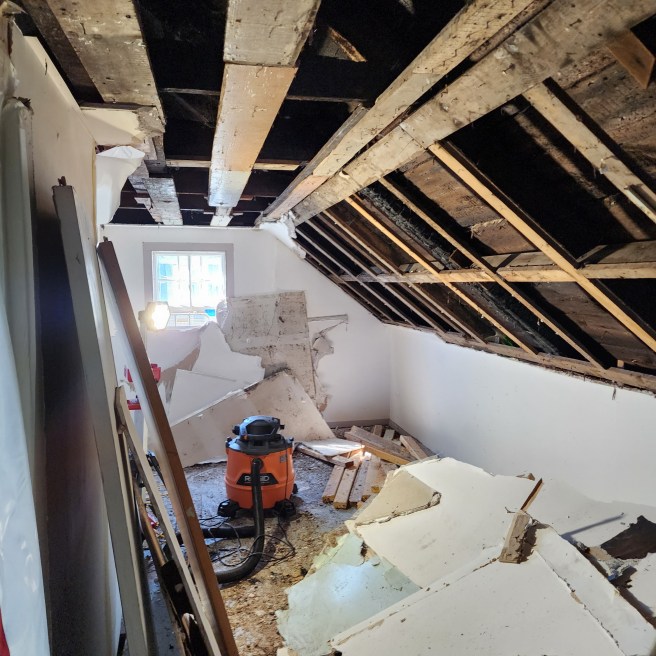
Once we were underway, I was impressed by the measures that were taken to minimalize the spread of dust and debris and I would like to acknowledge those.

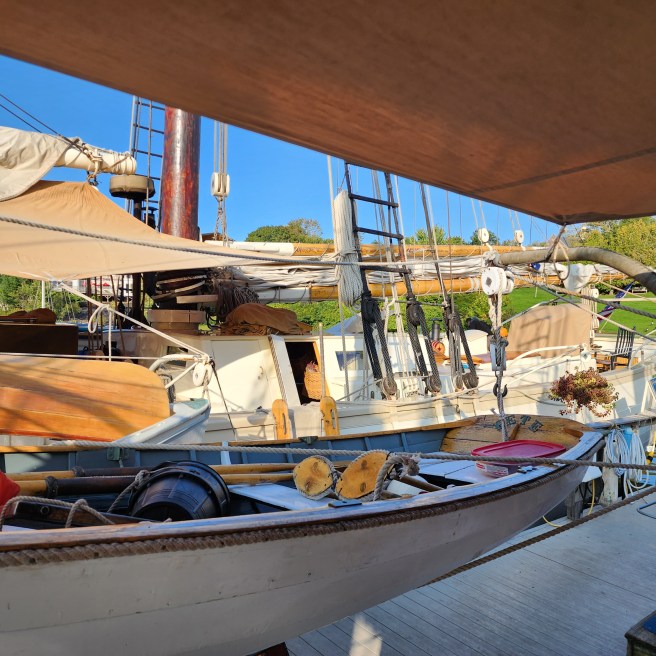
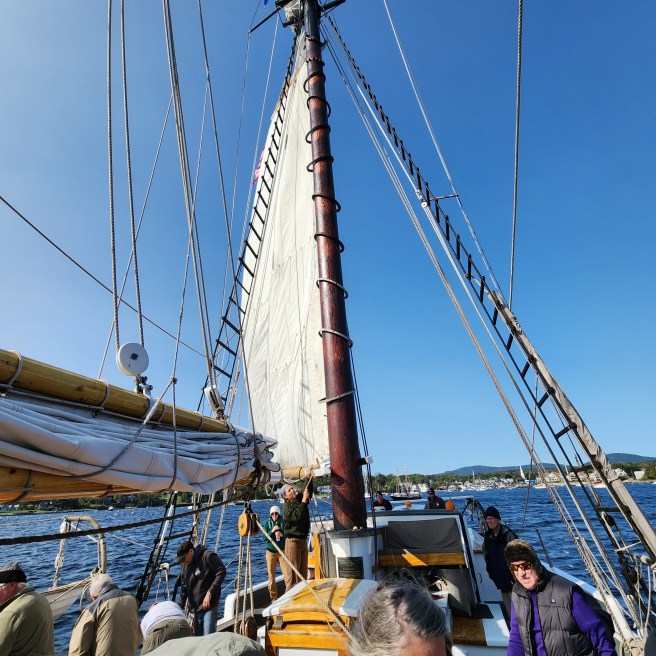
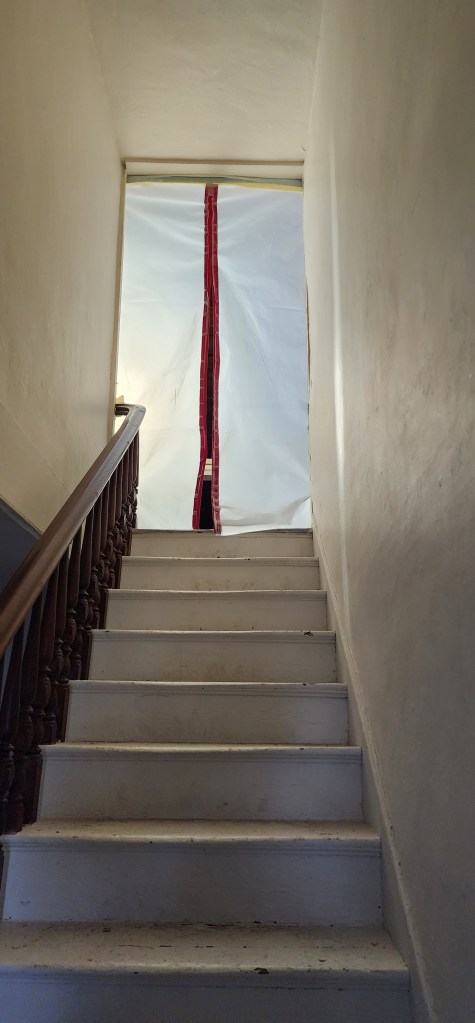
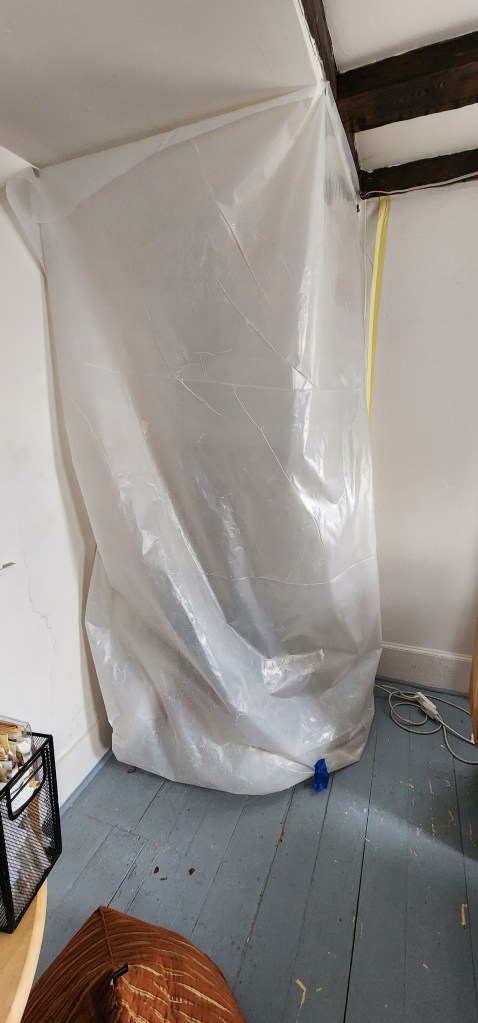
The zipper doorway to the second floor was the first step. And when working on the main floor, Adam erected clear-plastic envelopes he could work within. Made me think of the so-called “state rooms” on the historic schooner I sailed on last summer, where every inch was treasured. Adam’s power vac became a familiar sound.

It wasn’t the only place he was fastidious. I would never get my sawing accurate to 1/16 of an inch, especially not when dealing with an old beam underneath that was a half-inch shorter on one side.

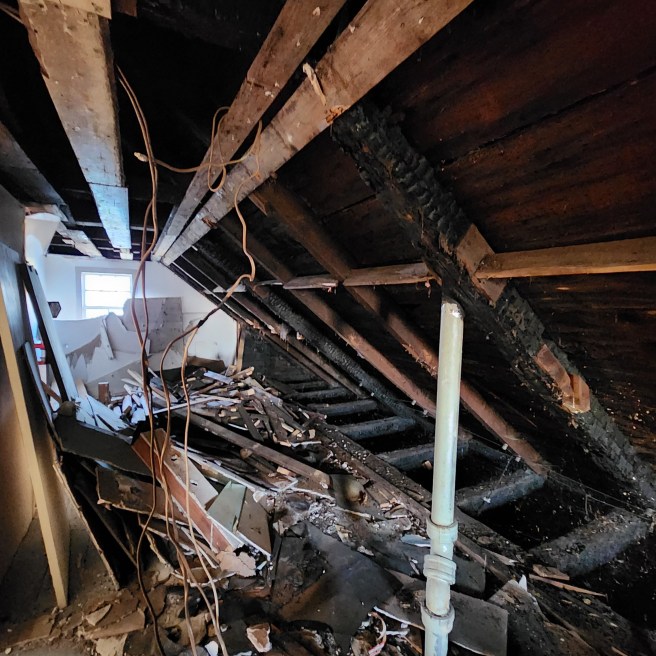
Do note, a lot of unsung artistry goes on in projects like this. As well as a lot of weird shit, done by rank amateurs, those whose weird decisions you discover along the way. Long ago, on projects on our little city farm back in Dover, we realized there are many, many very good reasons for modern building codes and for the inspectors who ensure they’re followed.

Also appreciated were the health measures of venting the upstairs or wearing earplugs and a face mask. Our previous carpenter, back in Dover, discovered the hard way about the alternative, hearing loss, and maybe the lungs, too. I don’t know what to advise about plumber’s knees, either.

By being able to be present when all this was happening, I did get to follow the action. I’ll hope you, too, finding that entertaining.

Here these go again

The random notes in no particular order continue:

  1. Did college recruiters ever come to my high school? We weren’t elite and we weren’t any of the other demographics they were hot for. How about yours?
  2. Our high school guidance counselors did little more than sign you up for a draft card, as far as I can see.
  3. Genji was a definite historical character.
  4. Argentata chard … doesn’t taste like chard … hardier and cleaner than spinach.
  5. Gentrification versus decay.
  6. An inept lover, too charming by his very incompetence, unintentionally funky, nothing more than some everyday world seen through myopia. So why am I bothered?
  7. I love some of the drone videos filmed around here. But definitely not all.
  8. And then we learn that the mayor’s involved. As we said in the news biz, this story has legs.
  9. Yes, I remember Hudson, it’s up in the Cuyahoga Valley, a lovely New England style village not far from the Cleveland Orchestra’s summer home.
  10. Some writers place most or all of their plots in a particular locale, usually a big city or perhaps a state. Just never mine.