Acid test short-story master: Catherine J.S. Lee (1949- )

The newest addition to my list is someone I’ve come to know and admire since moving to Eastport.

Lee, a longtime high school teacher and valued community figure who has written short fiction for most of her life, finally released a collection of 12 stories in 2022, and it’s a treasure. Island Secrets is rife with every-day, blue-collar existence on a remote fishing island in Maine – veiled Eastport – but the secrets are those that lurk unspoken in the open. Consider the trials of harvesting scallops in the dead of winter, which runs through the final story. Few consumers have a clue to the dedicated labor involved in the occupation (I’m tempted to call it a profession, including the fact that it is highly licensed and regulated) or of the domestic tensions that accompany the precarious business.

She’s original, a consequence of digging intuitively into the world in front of her, with her prose infused with the precision of her succinct poems as well.

Mysteries were lurking behind the walls and above the ceiling

When Adam set about ripping out the drywall upstairs – and immediately filling his first dumpster in the process – the emerging picture soon presented a number of challenging hurdles. I’ve mentioned the lack of a ridge pole and matters regarding rafters, plus the wiring situation. This wasn’t going to be nearly as straightforward a project as I hoped.

The dumpster, by the way, was a new step for me. Back in New Hampshire, our carpenter hauled the debris to the transfer station in his pickup – or I burned what I could in the side yard. We even used a lot of the ripped-out sheetrock and plaster to “sweeten” our garden pH. How much would the alternative cost us, anyway?

I’ll say it was a bargain, especially considering the time that would be lost if Adam were driving that to the trash transfer station an hour away.

Adam’s selective demolition led to a small collections of old wallpaper examples. Meanwhile, a hippie-dippy yellow crab painted under some of the later wallpaper, alas, couldn’t be preserved, not that I quite wanted that. Mine was the minority vote. Still, we’d love to know the story of its creator – a kid? – and its inspiration.

More puzzling were the broken bricks in the walls and joists away from the chimneys. Huh?

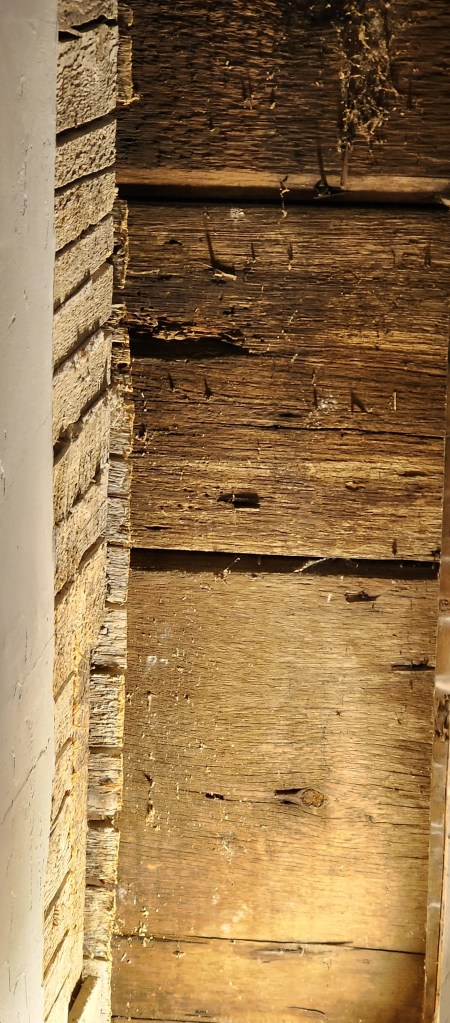
Or, more impressive, finding some of the exterior sheathing is more than 18 inches wide. Try buying that today.

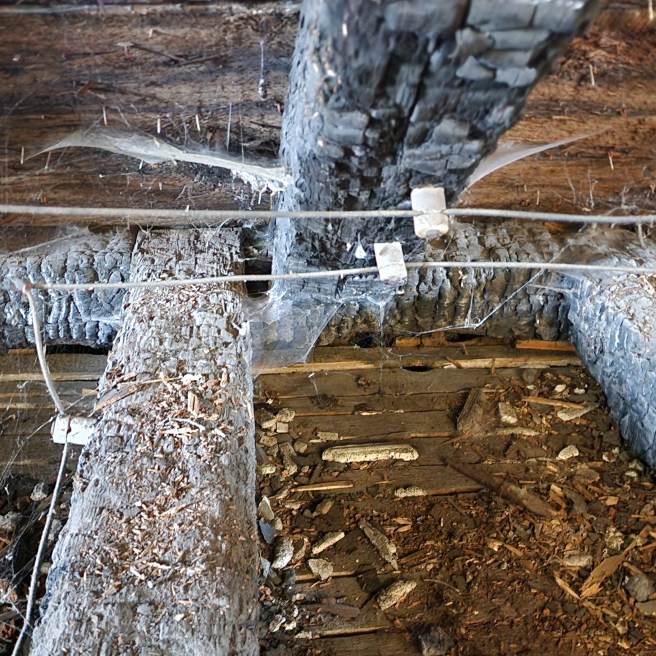
The fire damage was more extensive than we had imagined. Not just the historic downtown fire of 1886, charring our rafters but not setting them ablaze, but also a later chimney fire that charred the insulation off electrical wiring that we were still using.

What if the char damage on the beams and rafters wasn’t superficial but went deeper into what we assumed was still solid wood? (We were relieved to find out just how much good lumber remained inside.)

We’re left wondering. Did a fire originate in one of two wings once attached to the house and then spread to the roof? Sounds like an archaeology problem to tackle sometime ahead.

In addition, earlier carpenters here didn’t seem to do much measuring. I had to ask Adam, “So how does it feel to be correcting 200-year-old work?”

He gave me a look.

As I said, Adam set to work with determination and within a day filled the first dumpster.

Beyond the fire damage, he uncovered more knob-and-tube wiring to contend with than we had wished.

But to our surprise, Adam is not only a master carpenter but also a licensed electrician. This was sounding too good to be true.

Love life ups and downs

I promised my first lover I’d never write about her, meaning in my books. And I promised another that no matter what, I’d always leave the door open.

So while neither of them is outwardly present, my novels originate in heartbreak. There, I’ve said it. And also in hope.

Yes, I promised her I would never write about her, even though I’m pretty sure she’s never read anything I’ve written in the past 54 years.

It’s not that she didn’t cast a shadow over the story, but rather that her spot on the stage is abstracted into a more universal figure, perhaps even an archetype. Details from later lovers have also been woven in to the point a composite female emerges.

How could I deny the passionate devotion or yearning? Like so much else of the hippie outbreak, it could be embarrassing today.

I did ceremonially burn the letters I had kept until moving to Dover. It was a long fire.

~*~

It’s unlikely that my life would have gone in the direction it did if she hadn’t appeared in my life.

The hippie side, definitely.

And my yoga, while she veered off with the Sufis.

I didn’t realize just how rich they were or how much of my ancestral farmland they were buying up. Her parents were still quite supportive of me, anyway.

I still needed someone to fill her place in my novel Daffodil Uprising.

~*~

Much of what followed turns up in Pit-a-Pat High Jinks, including my first Summer of Love.

I’m curious to hear their side of the story. Most likely, I was pretty pathetic. I certainly was naïve and not the most savvy romantic. Like what did I really have to offer anyone? In my revisions, I was able to include details from twenty-some years later, my second Summer of Love, but Peace and Love had more grittier aspects than the dippy love songs present. Let’s turn to the blues.

For me, at least, the experiences turned out to be very confusing.

At one stage in the later drafts, as I tried to come to grips with the conflicting accounts of one character’s past she had revealed to me (the real-life person, not the abstracted figure in the story), I actually broke down weeping as I sensed she had been a victim of sexual abuse from at least several directions. No wonder her accounts to me hadn’t added up.

We did reconnect online, but I didn’t dare broach the possibility. Was she even aware of them or was she still in denial. There was no way to ask, though. Besides, she barely recalled me, though she had been a big thing for me.

~*~

The love life definitely came into play with Nearly Canaan, though the abstraction underwent greater transposition. Ages and genders changed, for one thing. Tracking real life, the relationship turned into marriage now mirrored in the marriages around the central couple.

I was really dashed when one literary agent said she didn’t like the character based on my now ex-wife, someone I still saw on a pedestal. Back to the drawing board, along with some therapy sessions for a clearer understanding. My remarriage helped me recast much of this, too.

If only I could have kept this within the bounds of a Romance genre, I might have had a bestseller. Right?
Cover update: Sometimes minor tweaks count

One of the delights of ebook publishing is the ease with which updates can be made. It’s not like having a warehouse of paper volumes to discard in the process.

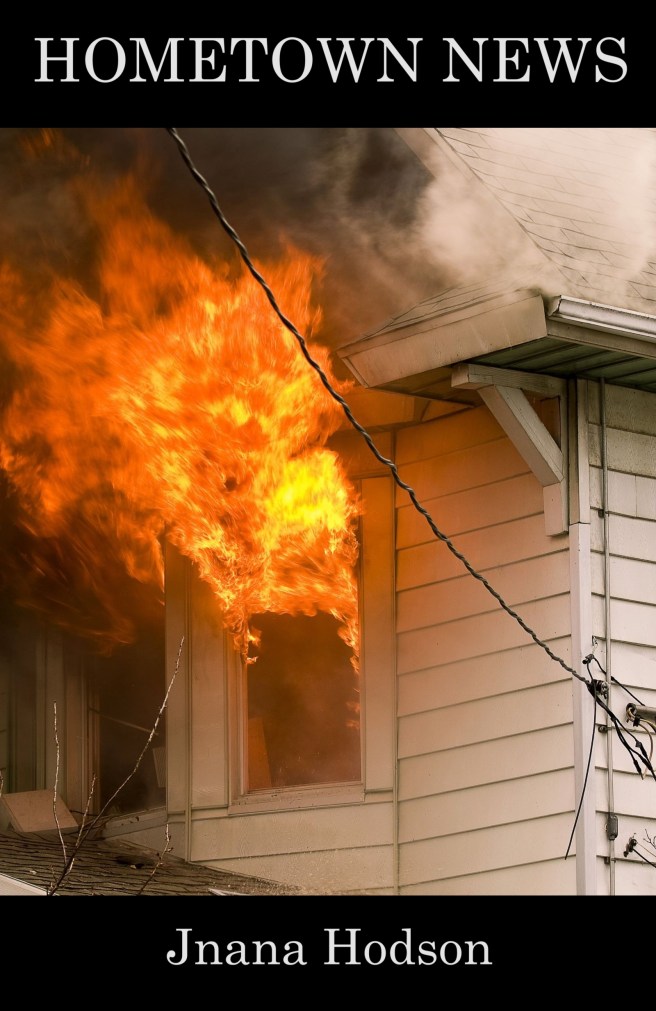
Recently, while preparing a new book for release at Smashwords.com, I revisited my novel, Hometown News, and wondered if the cover might work more effectively than it did.

I liked the cleanness of the current design and the graphic impact of the elements but questioned whether it might convey a better sense of being about the news business itself. The typeface on the cover conveys the title but nothing else. The story does play out in a moderately-sized industrial city, which also needs to be hinted at in the design.

The photo delivers on the idea of hot news and impending disaster as well as a working-class, blue-collar neighborhood, but I was curious to see if it might have more punch if it reached both sides of the cover. Or “bled” off the page, as we’d say in the trade.

The previous version of the cover did just that, but cropping the photo to accommodate the title and author type was another matter. Remember, ebook covers are essentially thumbnails to be viewed on a cell phone, laptop, or tablet computer screen.

The photo here is cropped less tightly than on the later cover. Does including a portion of the porch roof below add to the message or does it lessen the immediacy? Does the placement of my name detract from that?

There are good reasons this one went back to the drawing board.

The first cover, below, played on the idea of bucolic small-town America and fit into the series of covers of my other novels, but as you can see, there’s no promise of the coming drama within the book itself. So much for brand identity.

While this one was produced by a professional designer at low cost, I must ask myself what an artist would do as an alternative to a photo as the key graphic element. Perhaps a roll of newspaper reaching out across a steel mill and downtown? Downplaying color might allow for the title and author’s name to float over the artwork and still be readable, something that simply wasn’t working with the house fire photo.

Few newspapers have managed with a feel-good approach to community, no matter what many critics would wish. Everybody hates a fire, right? With a morbid fascination?

Returning to the design challenge, here’s where the book stands now:

The key to the redesign was having the name in a single line, like a newspaper nameplate. Thus, a different serif typeface in the new cover. Admittedly, it is harder to read as a thumbnail, but I am going with the tradeoff. I’m venturing that it will reenforce the type on a Web site’s pitch rather than run alone.

The photo, once again, bleeds off the page, delivering maximum visual impact.

More and more, I’m looking at an ebook cover as a poster than as packaging for a commodity.

What do you look for in a book cover?

Recognizing a degree of imperfection

But cool and candid people will at once reflect, that the purest of human blessings must have a portion of alloy in them, that the choice must always be made, if not of the lesser evil, at least the GREATER, not the PERFECT good; and that in every political institution, a power to advance the public happiness, involves a discretion which may be misapplied and abused.

James Madison in Federalist No. 41


Just in time for the new political season

My series of polemic political poems – they’re not exactly protest songs, but I wouldn’t complain if they were – has moved from Thistle Finch editions to Smashwords.com, where they’re now available in a range of ebook formats, hopefully for a wider readership.

In the transition, the poems are now presented in a single volume rather than six shorter chapbooks.

These blasts of alarm and rage, 1976-2008, are an emotional mirror of events leading up to today, a not-so-distant past that’s been intensifying toward devastation. Let them stand as a call for personal honesty and engagement, too.
Take heed, if you will.

For me, this also presents the excitement of my first book release since September/October ’22, when Quaking Dover appeared. It comes with an admission that these poems are largely spontaneous, as in combustion, and sometimes sophomoric. I’ll ride with that, considering the fervor of adolescence, including ambitions.

While the poems are rooted in recent history and its headlines, they’re more pertinent than ever.

Having originally appeared as six short chapbooks, this collection is now available on your choice of ebook platforms at Smashwords.com and its affiliated digital retailers. Those outlets include the Apple Store, Barnes & Noble’s Nook, Scribd, and Sony’s Kobo. You may also request the ebook from your local public library.

Please take a look.