Acid test garden writer and poet: Celia Thaxter (1835-1894)

Although she was known as a poet and story writer, her book that I most value is An Island Garden (published the year she died), with illustrations by Childe Hassam, an Impressionist painter I admire highly. (He hated the term, by the way, and didn’t fit the label neatly, but it gives you an idea.)

The island, in the Isles of Shoals of the shore of Maine and New Hampshire, is a remarkable place, as I found in a visit I posted here on June 14, 2020, “Celia’s garden … on Appledore Island.”

Under her guidance, the hotel her family owned and operated became what can be seen as the nation’s first artists colony every summer, attracting a who’s who of writers, painters, musicians, and more. Her influence can be seen especially in many of New England’s authors of the period.

Reading about her, I’ll confess, can be as pleasurable as reading her work itself.

Hoisting the sail

perfect weather, sunny, 60s
a knot = 1.1 mph

a little more up
meaning into the wind

luffing, meaning chuffing in the sheets

no sea legs yet
wobbly

even on calm seas

bit queasy
edge of mal de mer?

slow lull

slow sun

will I feel a late-season burn?

“all on the bowline, we sing that melody
like all good sailors do when they’re faraway at sea”
a song our Dylan doesn’t know
in his impressive repertoire
a generational gap

116th Street Blues, starts out with Captain Ahab
then more nautical lines

find your own style

it’s an active experience
just relax

Preparing to reframe the top of our house while we still lived below

This was turning into a more serious project than simply raising the roof.

Had we merely replaced the covering itself – either with asphalt shingles or upgrading to metal – without expanding our usable floor space on the second floor, we would have been glossing over serious structural issues. It’s a miracle the roof held as long as it did. One insurance company had cancelled our homeowner’s policy when it saw the photos of the roofing, and another insisted on a replacement within a year. That route would have been a very expensive band-aid in the end.

We had a dream of making better use of that space, as you’ll see. And now, after three years, we finally had someone to pull the project off.

As a starter. Adam needed to address some serious structural issues.

Was anything holding our roof up? It may seem strange to find that concern intensifying as we set out to remove it and its rafters, but we would need something to keep half of it up while the other half got ripped away. As an additional complication, we’d be living in the house rather than gutting it and starting over.

The absence of a ridge pole meant there would be nothing to hold up the front half of the roof when the back half came away for the new. Its lack also meant the existing ridge wasn’t straight but rather serpentine.

Adam had to make room for a ridge pole between the existing rafters. It was tedious and required some precise calculations.

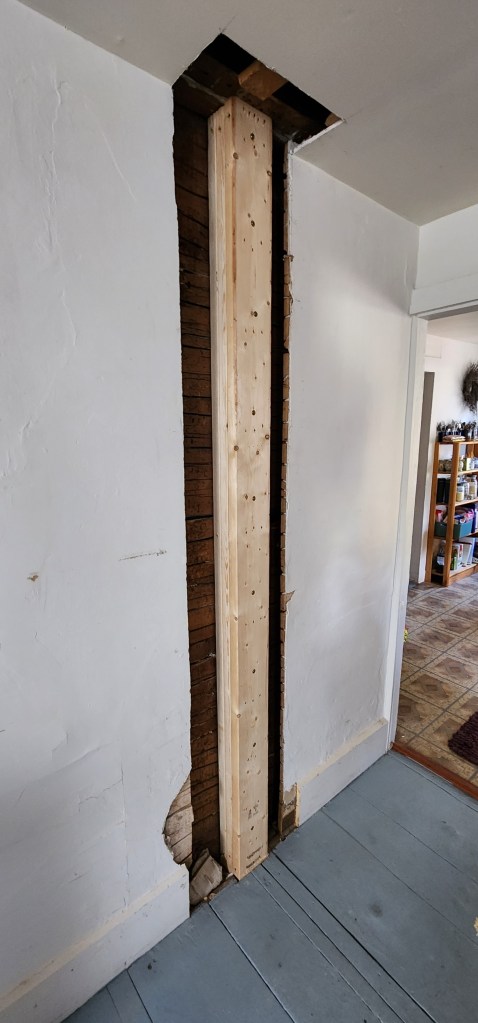
Structurally, all the weight of the roof for nearly 200 years was directed outwardly to the walls – and, as he was finding, they weren’t exactly perpendicular.

Now he needed to have something to support the weight of the ridge pole and roof, too. That meant constructing four columns from the crown of the roof down to the cellar – one on each end of the house, the other two spaced in-between. That required going through two floors as well, plus building concrete pads in the cellar.

This was time-consuming work, and he was racing winter weather. We had reason for concern.

As these findings sank in, we realized our earlier option of just putting new shingles on the existing slope would have done nothing for real issues lingering underneath. Even without raising the back wall or consolidating the dormers in front, we would have had a larger problem waiting to erupt overhead. Living beside the ocean exposes us to many gale-force blasts. It’s a wonder the roof hadn’t gone years ago.

After taking some deep breaths, we appreciated what our contractor was telling us. Now, just exactly where was the center of the roof or the alignment down under? He did have some amazing laser tools to determine that.

We were really glad Adam was a pro, maybe more than the others working in town. He was definitely earning our trust and respect.

It’s not really taboo, is it?

Is a writer really expected to explore deep matters without including the hot subjects of religion and politics? Here I’ve been writing about the hippie movement, which had a strong anti-materialism streak, at least on the surface, as well as a strong anti-war stand, though I’m sensing it wasn’t quite as anti-violence as well. Early drug use was often described in religious terms pointing toward a union with the divine or transcendental wisdom.

For some of us, at least, spirituality and religion (shorn of religiosity) were a big part of the era. Not that that many others wound up there by now, from what I see.

As for politics? What a disaster.

~*~

In my journey, the time in the ashram was the ultimate of hippie. We were a tight-knit community (think of the ideal of tribe), vegetarian, back-to-the-earth (though not off the grid), sitting in meditation twice a day (the best way of getting high). The celibacy ran counter to the broader movement, but we did have a better balance of the sexes than elsewhere. We were focused, after all, on changing ourselves first before trying to change society.

So that’s the basis of my novel Yoga Bootcamp, humor and all.

I tried to walk a line between guru adulation, which I saw in books about various religious leaders of all stripes, and an expose about their shortcomings, mostly sexual and financial. While there were problems after I moved on, I had learned and grown much during my residency. To turn on that for larger readership would have been a betrayal.

~*~

I wasn’t so considerate with the churches in Hometown News. What I saw in the industrial city that modeled Rehoboth was rivalry, and I never got to know the ministers. I was worshiping with Quakers an hour to the south.

~*~

The subject became more nuanced in Nearly Canaan, where Jaya ventures forth to spread yoga-based spirituality along with her progressive social service. Having her become close friends with an evangelical pastor’s wife, which evolved in the final revision, is one of my favorite strands in my fiction, along with the middle novella in the Secret Side of Jaya, with its more primitive Baptists.

~*~

Let’s return to my first book, where a third leg of the original saga was Tibetan Buddhism. Memories of a documentary I’d seen in childhood about the flight of the Dalai Lama had taken root in my psyche, and my yoga ashram residency included teachings about karma and reincarnation. Even my fundamentalist mother had been impressed by some of that. Well, and maybe the fact that they were fighting the evil Communists.

Once the seemingly absurd premise of a lama being reincarnated in Iowa, I was off running. And then, a few years after publishing the book as Subway Hitchhikers, news stories presented claims about such an occurrence actually happening. For me, though, the prompt fit a personal sense of being born into the wrong place and time.

After the book was drafted, I returned to Indiana as a research associate and found myself taking the bus to work some days with the Dalai Lama’s brother as one of the passengers. I was too abashed to try to converse with him, but he was on the university’s faculty and, as another coincidence, a Tibetan Buddhist center took root in Bloomington, something I was already anticipating in the story line that finally jelled as What’s Left, springing from the ending of the subway story.

Drafted a quarter century after Hitchhikers was published, What’s Left picked up with the Greek-American family the lama married into, except that I felt I needed to tone down the reincarnation possibility. Besides, I was exploring dimensions of Greek-American culture and Orthodox faith, which I’ve presented here at the Barn.

This has me thinking about the original scope of my subway novel. What if I had envisioned it as a graphic novel sans the graphics but one where each encounter somehow builds toward his establishing a temple somewhere in the Catskills or Berkshires or other high point near the big city? Instead, I intuitively had him zoom back to Indiana, a reflection, I thought, of how far Manhattan’s tentacles reach.

Tibetan Buddhism was a way of abstracting my Hindu-based yoga training, and my Buddhist tastes leaned toward Zen.

After moving to Dover, though, I got to know a deeply committed woman who was on her way to becoming a Tibetan Buddhist nun slash teacher. Some of her insights have been woven into the revised story as it stands today in Subway Visions.

Keeping a scoundrel at bay

An avaricious man, who might happen to fill the offices, looking forward to a time when he must at all events yield up the emoluments he enjoyed, would feel the propensity, not easy to be resisted by such a man, to make the best use of the opportunities he enjoyed, while it lasted; and might not scruple to have recourse to the most corrupt expedients to make the harvest as abundant as it was transitory; though the same man probably, with a different prospect before him, might content himself with the regular perquisites of his station, and might even be unwilling to risk the consequences of an abuse of his opportunities. His avarice might be a guard upon his avarice. Add to this, that same man might be vain or ambitious as well as avaricious.

Alexander Hamilton in Federalist No. 72

Historic ironworks dam

Evidence of the long-gone Pembroke Iron Company, established in 1832, is seen in the half-hidden stonework ruins of its dam along U.S. Route 1. In 1856, at its height, the company produced nearly 5,000 tons of iron spikes, rivets, and nails – many of them used in the town’s shipbuilding industry.

The Pennamaquan River now flows naturally around it to a newer dam and fish ladder carrying nearly 10,000 migrating alewives a day from the head of the tide nearby to breeding grounds in lakes upstream.

Chocolate facts, just in time for Valentine’s Day

Remind me that not all candy is chocolate and not all flowers are roses. But you might want to check out just what’s inside those heart-shaped red boxes tomorrow.

Here’s some perspective:

  1. Chocolate accounts for 59 percent of all candy sales in the U.S. The chocolate portion of that comes to an average of $145 a person each year.
  2. The average American eats three chocolate bars a week.
  3. The most popular time of the year to buy candy is the week before Halloween, followed by Easter, and then Valentine’s Day. Not all of that is chocolate. Think of all those little hearts imprinted with pink messages you’ll be facing tomorrow. But chocolate still weighs in big. For Valentine’s Day, it adds up to 58 million pounds – or, including all candy, $2.4 billion. Kaa-ching!
  4. The top day for chocolate sales in the USA is November 1, right after trick or treating.
  5. The most popular time of day to eat chocolate is in the evening.
  6. Most candy is sold after 2 pm, with peak sales between 4 and 5 o’clock.
  7. Online chocolate shopping now accounts for 40 percent of consumer action. What, it’s not the vending machine at the office?
  8. Milk chocolate is preferred by 49 percent of the American public, followed by dark at 34 percent. My favorite, white, has to split the remainder with some other subcategories.
  9. Three of the five biggest chocolate manufacturers are in the U.S. (Hershey’s comes in fifth, Modelez third, and Mars first.) But Europe is the biggest market.
  10. The Covid-19 outbreak led to a sharp rise in the popularity of fine chocolate who turned to it as an emotional comfort. The consumers were generally younger, living in urban areas, and earning above-average incomes.

Thanks especially to Max at Dame Cacao. She just might be worth a Tendril of her own.