Deer Isle Tunnel
or back
to Cape Cod
Author: Jnana Hodson
In downsizing to a remote fishing village in Downeast Maine, this eclectic writer feels everything's coming together.
Fire on board
Wooden sailing vessels traditionally had only one fire onboard, the cook’s stove. I can’t imagine how cold sailors, much less passengers, were through most of the year.
Windjammers hew to that tradition.
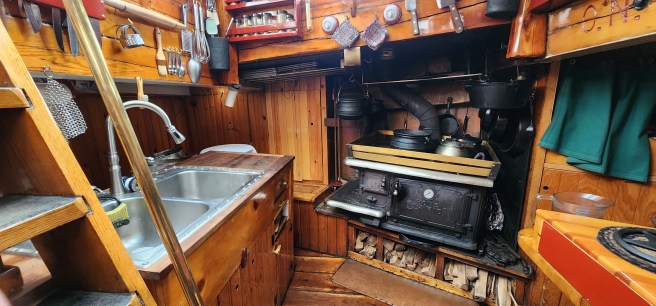 a wooden sailing vessel
with a wood-fired cook stove
and kerosine lanterns
two iceboxes
Smoke from the cookstove goes
into a T-shaped chimney vent
don’t get too close
“Smokestack,” not “chimney”
maybe “noble Charlie”
As for a big hole in the middle of our house
While waiting three years for our big renovations to transpire, I often joked that living here was like camping. I won’t go into the list now, but I did accept defects that could have greatly raised my blood pressure if they weren’t already on the to-be-addressed list.
I could even go into the pro-gentrification argument that if big repairs weren’t being undertaken, these dwellings were well on their way to collapse.
Our renovation, daunting as it is, remains a minor effort compared to a few others in town, including true mansions being brought back from the brink. One is a fussy restoration project to keep the place as close to historic accuracy as possible, apart from wiring and a kitchen upgrade. Another is to improve its Victorian social showcase qualities.
I’m also finally understanding why so many old houses out in the surrounding countryside have been left to fall in. They simply weren’t worth the cost of upgrading, not when you could build newer, better, even closer to the world for less.
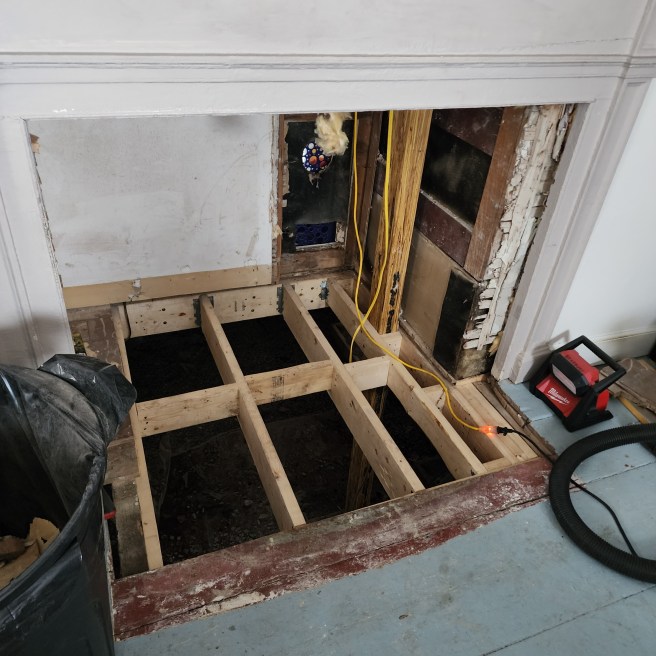

One of the annoyances we had tolerated was the big cavity where the second chimney had stood – the one that was about to collapse when we bid on the house.
We had passed on an offer to rebuild the brickwork, no matter how charming a working fireplace would have been. The chimney would have limited our remodeling options on the second floor, or so I argued, and without it, we do have a 2½-by-5-foot space to develop into a closet or something on the main floor. Patching the floor itself would be a huge improvement, as well, rather than having a light covering that couldn’t bear weight.
The cavity now provided a place where that 28-foot-long LVL column could run down through the house, as well as some new electrical wiring.
And, during a later break, Adam even fixed the holes.
Yes, step by step, it was all coming together.
How the style and ethics of my journalism career clashed with my literary ambitions
When I sat down to my personal writing, I felt an ongoing tension between the daily grind of newspaper editing that paid my bills, contrasted to my ambitions for something more permanent, more confidential, and more creatively advanced than the anonymous work that went into the next day’s trash. The pejorative “hack writer,” often applied to newspapermen from the early 18th century on, was what I aspired to rise above. The term has haunted me ever since reading Samuel Johnson’s derision.
In my private labor I aimed for something unique, thoughtful, sophisticated, meticulously developed, complex, and even challenging for both me and the reader. If news stories limited attribution for a quote as the neutral “said,” I nearly banished that colorless word from my prose, relying instead on everything from “answered” or “asserted” to “cried” or “swore“ to “wept” or perhaps “whispered,” with a wide range of variants in between. Do note, I’ve come to treasure a thesaurus for ways in can enrichen a text and sharpen the underlying thought and feelings, even though doing so requires additional time and consideration.
My journals, on the other hand, sought mostly to catch up on my life from the previous entry, often in cryptic terms I might get back to and fill in later, though that rarely happened.
~*~
Hemingway could write for a sixth-grade level reader because he was no longer in a newsroom. It could kill you, believe me, if it’s all you got to do.
I needed to foster my literary ambitions simply to keep my editing skills sharp.
It did make for tension in my private work, though. I still love a good 250-word sentence.
~*~
Let me also say something of the ethics. Being told not to wear a politician’s campaign button. No appearance of partisanship. Leonard Downing of the Washington Post even refused to vote in an election for fear it would taint his neutrality or objectivity.
Were we, as one girlfriend taunted me, ethically castrated? My first editor, Glenn Thompson, worked behind the scenes to get progressive things in motion and did urge us interns to have causes.
By the way, I have worked for some very conservative papers and also some very liberal ones. It didn’t affect what I did for them.
Avoiding a hydra
The mere necessity of uniformity in the interpretation of the national laws decides the question. Thirteen independent courts of final jurisdiction over the same causes, arising upon the same laws, is a hydra in government, from which nothing but contradiction and confusion can proceed.
Alexander Hamilton in Federalist No. 80
Let’s be honest
The only reason to buy an assault rifle is to kill other people. Do you want that on your conscience? If you have one?
Can you beat this?
Hello, Readers!
We’re fast approaching Read an Ebook Week, an opportunity that encourages readers to pick up the digital device of their choice and download a new book or more to own and read.
I’m excited to announce that three of my books will be available as part of the promotion on Smashwords to celebrate Read an Ebook Week 2024, March 3-9. Yes, starting Sunday. This is a chance to get these books, along with books from many other fine independent authors, at a discount so you can get right to reading.

I’m offering two of my poetry collections – Trumpet of the Coming Storm and Blue Rock – for free, along with my New England history book, Quaking Dover: How a counterculture took root and flourished in Colonial New Hampshire, at 50-percent off.
You can’t lose by participating. I look forward to your responses to reading these. Do check them out. It’s one of the joys of publishing online.
Thank you for your help and support.
Happy reading!
Things we still need a can opener for
I don’t eat canned soup anymore – can’t stand it, not after being upgraded at home.
Beer, meanwhile, has a tab or comes in a bottle.
So here are my reasons for not throwing our can opener into the trash:
- Tuna fish
- Tomato paste, as well as whole and diced tomatoes
- Sweet corn
- Sweet condensed milk
- Garbanzo beans (already softened)
- Pumpkin filling, not just for pies
- Coconut milk
- Chipotle
- Pineapple (not fresh)
- Baked beans
If we only had a dog or cat and their cans of pet food.
Acid test poet and novelist: Charles Bukowski (1920-1994)
What is it that made Bukowski such an unmissable figure in the reading life of young poets and others in the ‘70s and beyond?
You probably wouldn’t want to meet him in person, he seemed to be rather obnoxious, even ugly, even before getting drunk or in a fistfight. He was, from evidence he presents, an abusive lover.
Even so, part of the appeal came, I sense, in his unflinching reflection of life in near-poverty, a world where many of us were also residing. His subjects, though, were everyday poor people, drudging away in marginal jobs when they could, rather than recent college graduates intent on moving on.
Another part of his appeal, though, was his embrace of being a Poet and the ways the daily practice of writing kept saving his miserable life. Black Sparrow Press, with its signature look and literary dedication, was created for his work, and the successful relationship provided a platform that gave exposure to many other poets and novelists – the “bird mob,” as one poet I knew said with outright envy.
Was there even a poetry scene in Los Angeles at the time? The focus in California was almost totally on the Bay Area to the north.
I was especially fond of his short novel, Post Office, but the spare lines of his poetry are unpretentiously masterful and sharp-eyed. He cut the BS, for certain, in a life of squalor that’s a revelation. It’s a life most of us would rather avoid yet somehow touches on our own.
Kinisi 198
Duma Luma
like
Wavy Gravy
 Jnana's Red Barn