Acid test novelist: Diane DeVillers (1956-2023)

While Tom Wolfe charged that no great novel sprang from the hippie counterculture, a challenge akin to the holy grail of the great American novel, his quest overlooked some fine stories that reflected any of its many dimensions.

Among the gems are the three self-published novels of DeVillers’ Eve Chronicles, grounded in the author’s experiences in moving from her native Wisconsin to the Pacific Northwest, where she spent several years – harsh winters included – with a crew in the rugged mountains of eastern Oregon replanting forests in the wake of clear-cut logging. I had heard of the legendary Hodads in the western part of the state (they took their name from the short-handled pick/spade they used), but DeVillers’ case gently probes the realities of the marginal existence and the varied types of people it attracted. Though this was not the Haight-Ashbury stereotype of the era, it was one of the counterculture’s many flavors. She was definitely back-to-the-earth throughout the span of the books.

Another was the holistic health-care work she took up in what she called a nomadic life before settling down in the Willamette Valley, where the Chronicles continue, again reflecting the conflicts of living out deeply felt values.

She began writing the novels after being diagnosed with MS and drew on her spiral-bound notebooks as source material. (Fortunately, those had survived her many moves.) I love the fact that she’s not inventing stories or characters but distilling what she’s known firsthand. She presents scenes – even aromas and lighting – I’ve experienced, too.

I was going to say her tone is reminiscent of Joni Mitchell but now see the singer was an inspiration. How right, then.

She was working on a manuscript about the health care industry and big money and big politics set in the Covid pandemic, but I don’t know how far she had gotten with it.

So far, no lipstick. And then? Zip, zip, zip!

After a week or more of finetuning the ridgepole and columns, Adam was ready for more drama. It was time for the old roof and rafters to go.

By now, much of the time the work was mostly loud reverberations punctuated by pounding and thuds within the top half of our house. Most of it mystified me. It often sounded like a war zone, especially when the air compressor kicked in. Not that I’m complaining.

Here we were, six weeks and thousands of dollars later and nothing we’d done was of the sort that would appear on a flip-this-house kind of a video streaming channel – the superficial changes that one local inspector we know dismisses as “lipstick.”

You do have to love an old house. Or, for perspective, an old lover.

Now we faced the decisive moment. Off with the back half of our upstairs!

A large, “rolling” dumpster was in place.

That saw appeared like the fin on a shark.
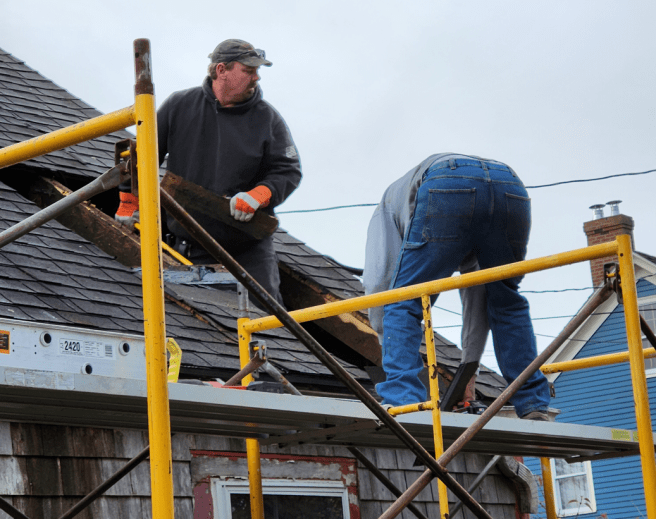
And then the roofing was removed in panels.

We got an idea of what a deck up there would be like.

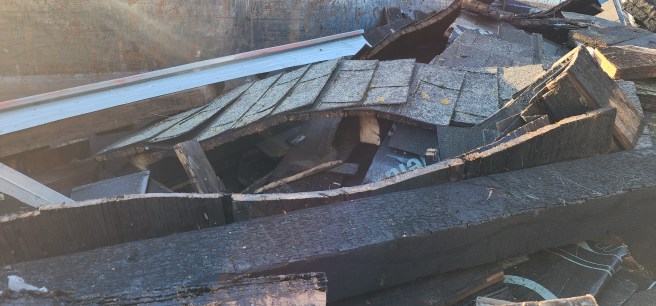
The dumpster quickly filled.


Ten random questions

  1. So what if it’s NOT historically true?
  2. Is there any egg in a Chinese egg roll?
  3. Who was Jack Russell?
  4. Has anyone used “Jack Russell Terrier” as a nom de plume?
  5. Can brilliance compensate for lack of depth?
  6. Enemies? Present within? Or without?
  7. How are you supposed to answer, “How ya doin’?”?
  8. What’s that noise?
  9. What do I have to do to get my books banned?
  10. Is it better to have no taste than bad taste?

Acid test poet: Denise Levertov (1923-1997)

Levertov is a poet I began reading the summer after I graduated from college. There was something in her work that seduced me, something along the lines of Brahms and Rilke, as one early advocate said of her. (It was Kenneth Rexroth, whom you’ll meet later in this series.)

What I didn’t see straight-out was the religious underpinning of her work, even in her atheist phase.

I do remember an encounter after a poetry reading in Baltimore, where one audience member approached her and asked how one could sustain a pacifist stance while remaining an atheist. She replied that without faith, the practice was very difficult. A few minutes earlier, I had asked how she had come to become a pacifist and she replied it was through her first lover, who was a Quaker.