
Centerpiece on our dining table by someone who doesn’t think of herself as an artist. It includes her homemade votive candles, if you were curious.
You never know what we'll churn up in cleaning a stall
Centerpiece on our dining table by someone who doesn’t think of herself as an artist. It includes her homemade votive candles, if you were curious.
if not a schooner
a ketch

Technically, a ketch rather than a schooner.
the Angelique a beautiful ketch
at anchor nearby
rust-colored sails
quite distinctive
yes, ketch that

everyone else went ashore in the yawl
to the boat school etc.
Brooklin
just me and the crew left aboard
someone in a white sweatshirt
jumping rope on the dock
the sound of the slapping rope
across the water
caught my attention
finally wearing my new hoodie
with its kangaroo pocket
learned that phrase yesterday
Joe bought the E.B. White democracy book while ashore
after hearing us discuss the author
(the son became a famed boat builder)
boat school temp tattoos stamped
on other passengers, crew
we’re leaving the Angelique at anchor
I’d love to know the story. Every time we travel to or from Bangor or beyond, we pass this well-maintained memorial along Maine Route 9, “the Airline Highway,” in Township 24. It’s just east of the Wilderness Lodge. I finally stopped to investigate but found no names or dates. Do any of you Mainers know more?
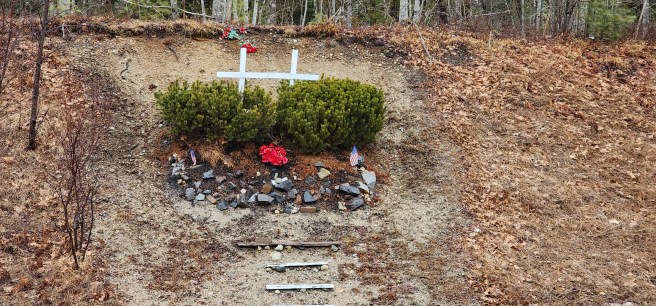
So far, I’ve found nothing solid.
One person said something about a hit-and-run that’s never been solved.
As former radio newscaster Tom McLaughlin said, “There are plenty of places around here where something happened and there’s no memorial at all.”
He added, “Jnana, there have been so many crashes and fatals on Route 9 in the time I was covering news (1992-2016). That may have been from a crash in July 2002 that killed a guy from Perry and injured his brother who may have succumbed later. Also in that general area, a dad, mom and older son from Calais died in a head-on crash on a snowy night 20 or so years ago. Guess I haven’t given you anything definitive, here. Not sure who I can ask. All the troopers I knew back then are long retired.”
The state’s fatal crashes web site turned up nothing.
So that’s where it stands for now.
Week 7 brought the dramatic steps that would be seen from the street. This is a small town, after all, and people would talk. Fortunately, all we heard was approval and admiration.
As another plus, the weather turned in our favor, a week without rain.
As an added blessing, Adam, our exacting contractor, was joined by Keith, a simpatico master carpenter (even mediocre ones are hard to find around here). Fortuitously, they melded into a relentless team that raised the back wall, crafted new rafters, and encased the roof like clockwork.
Doing that precisely to an old freeform house like ours required many adjustments akin to sculpting, which these two performed with great understanding and patience.
The new wall would be sitting atop an old wall that was serpentine in length and height. It required a lot of precise correction.
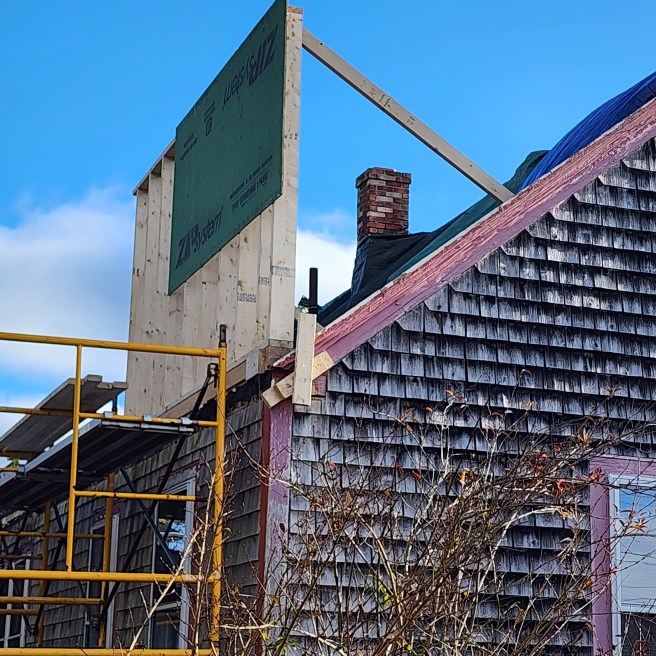
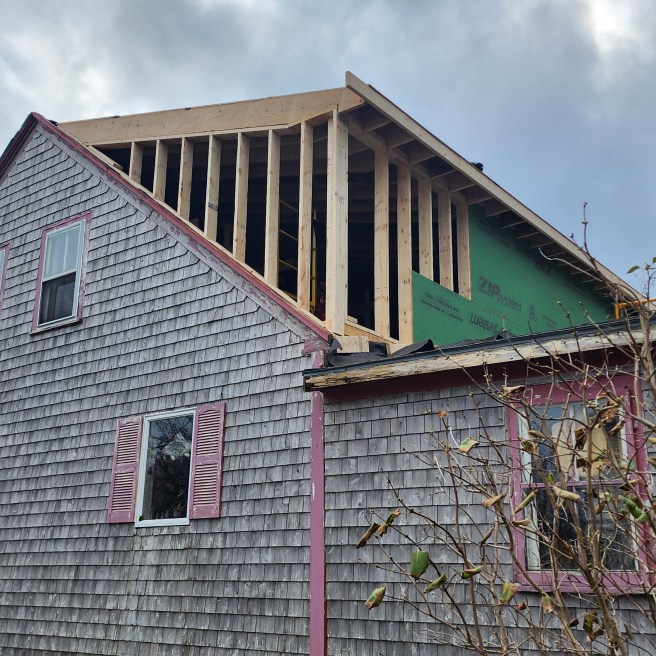
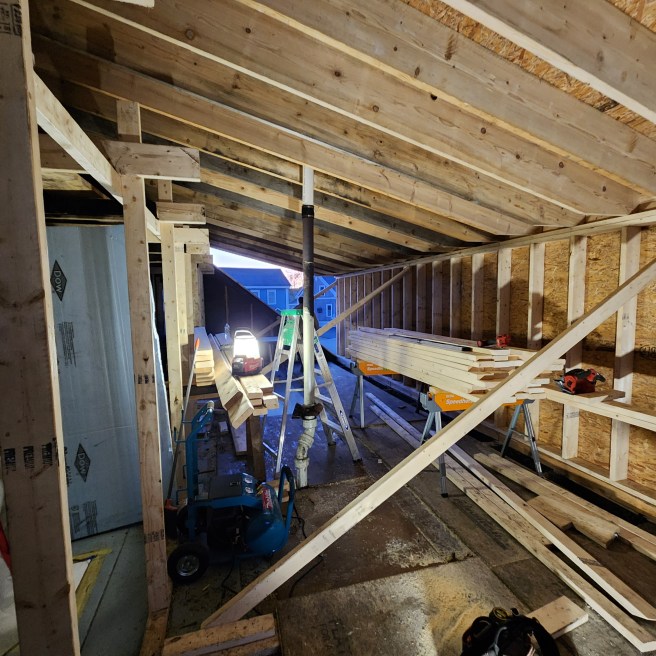

The week ended with the thrill of seeing back half of our greatly expanded upstairs actually buttoned up days before Thanksgiving and the wintry weather to follow.
The front half will have to wait till spring, but there’s plenty to do before then. Much more, actually, than I wanted to consider.
Shortly before finding myself officially unemployed, I engaged a typist to prepare a clean draft of Subway Hitchhikers for submission to literary agents or book editors. At least that would be moving forward.
And then, when the ax fell, I was surprised to find that after arriving in Baltimore, in debt from divorce and selling a house at a loss in a recession, I had saved up a bundle in just two years. Having a company car and an expense account covering my meals during the week added up. Rather than return immediately to the workforce, I decided to give myself some time off, a sabbatical, as it were, to concentrate on the writing I had always wanted to do. The kind that would put my name on the cover and the spine. Something more lasting than a byline on a daily paper or even, more prestigiously, a magazine.
Watching a colleague who was waiting till retirement before he could tackle the children’s book he always wanted to write nagged at me. I had heard a few similar dreams – wait for retirement. Except that a heart attack felled Russ shortly after he got that farewell cake.
In my job-free spree, I hunkered down to hard writing, up to 12 hours a day. By this point, I was pretty proficient with my personal computer and its dot-matrix printer. And so, while she was typing up Hitchhikers, I turned to keyboarding other material.
What I see as I look back on my sabbatical was that I entered the year more prepared than I’ve assumed. It wasn’t like I was sitting down and staring at a blank page and waiting for inspiration to strike. Besides, I had journal notes, correspondence, even maps and photos to draw on.
Every writer works differently, as interviews in the Paris Review demonstrated. The one with Jack Kerouac had inspired to use the end rolls of teletype paper for drafting, freeing me from having to keep inserting new sheets into the typewriter. Using a PC was like that, only instead of having to replace paper I had a 5¼-inch flopping disk that filled up. If only I had an editor waiting, like he had.
As I awaited word on my query letters to agents and publishers, I began examining my life from college to the present through the eyes of fiction. Keyboarding large sections from my journals gave me a foundation for following my moves from the East Coast back to Ohio, on to Indiana, again, and finally the Pacific Northwest, events that included my first marriage. Making it work as fiction, though, was the challenge.
My primitive PC was still a huge advance over typewriters, in my case, an Olivetti Editor 2. And here I had been seeing the ubiquitous IBM Selectric as an enviable sign of a successful writer? The thought is rather amusing today. Gee, and there was no Internet yet, hard as that is to believe now.
In my sabbatical I concentrated on a single manuscript and then put it aside as I awaited feedback from potential agents or publishers or maybe just for a space to season until I could come back to it afresh. That opened a window to start drafting another. I was a fiend, having waited years for this opportunity.
My hunkered down life? I got the deepest tan of my life by taking a midday break at the pool, at least through the summer. And did get out for hikes, especially in nearby pine barrens that had lead mine remains and a waterfall. Spiritually, I was connecting with Plain Quakers, liberal Mennonites, former Amish, and a small circle from the Church of the Brethren – all in the pacifist tradition. There was even a writers’ group that Tom Clancy addressed just as he was on the cusp of celebrity.
What I see now when I look at my earlier writing is that I could never have created those pages later in my life. Too many details would have vanished, along with the urgency and originality and even the voice.
The sabbatical was also a period of heavy reading for me, including the brat pack being edited by Gary Fisketjon at Vintage Contemporaries, Lawrence Durrell’s Alexandria Quartet, and George Eliot’s Middlemarch.
As my savings ran out, I still hadn’t found an agent or publisher. Realizing I’d need at least another year clear to achieve that, I reluctantly headed back to my career in newspaper journalism, this time in New Hampshire. There was a crucial shift, though. The archconservative Union Leader had a unionized newsroom where I could go back into the ranks as an editor and still earn more than most small paper managing editors across the country. I even had job security and a 35-hour workweek that allowed me time for a real life.
I packed up with the first rambling draft of what would become Promise, released via Smashwords in 2013, and two related novels, plus Hometown News and all of the outtakes from the subway project. I could continue to revise those drafts in my free time, but the book publishing world was changing in ways that baffled even the most celebrated literary agents.
Looking back, I must admit how much risk I took in my year off. I had no health insurance, for one thing, and no guarantee I could return to the shrinking ranks of journalism. I was also perceiving the pace I was working at could not be sustained.
I had been appalled in reading interviews with famed authors who boasted that they worked four hours a day – what slackers, I thought. Now I see that as a rather lavish amount of time, considering the additional hours of research, related correspondence, submissions, reading, and basic home-business demands (yes, writing is a business). Gee, how did I overlook all those hours of lunch conferences or cocktail hours in the lives of the literati, which were essentially business? Or even their hours in psychotherapy?
The operations of the Federal Government will be the most extensive and important in times of war and danger; those of the State Governments, in times of peace and security.
James Madison in Federalist No. 45
Looking at someone on Facebook who had been a hot-but-not-quite girlfriend (meaning wife material) way back when but am thinking now, it never would have worked out.
Take a breather, that’s really heavy.
Whew!
As my younger step-daughter said of something else way back when, “It seemed like a good idea at the time.”

Around here, this can happen well into spring.
Or more properly, in the northern hemisphere, today is the vernal equinox, derived for the Latin vernal for “spring” and equinox for “equal night.” And that means it’s officially spring, even if there’s still snow on the ground or a blizzard in the forecast.
For folks south of the equator, today’s the beginning of autumn.
Either way, the date usually falls on March 20 or 21 – the 19th is more of a rarity, with the next one not until 2044. (Hmm, looking that far ahead, I’m not seeing any on the 21st. I’ll let the experts argue.) The problem arises in the fact the Earth doesn’t circle the sun in exactly 365 days – there’s that nagging quarter-day that gives us our Leap Year and its February 29, which we just passed.
That said, let’s allow ten other items spring up. Remember, in much of the world, we’re coming out of hibernation, of one sort or another.
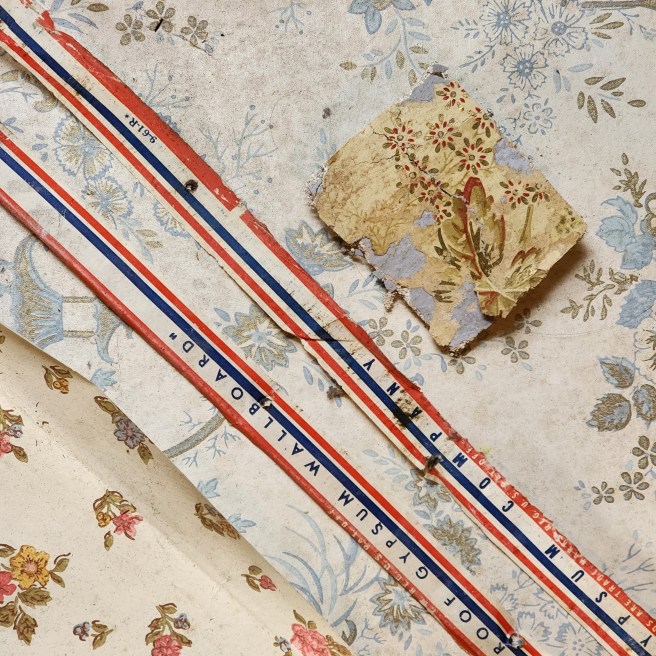
Old wallpaper is part of an old house history. Some of it’s showing up inside old closets, not that we have many of those.
 Jnana's Red Barn