Cardboard
Catbird
You never know what we'll churn up in cleaning a stall
Cardboard
Catbird
 Yes, autumn is in the air.
Here it’s seen on Penobscot Bay from a cruise aboard the historic schooner Louis R. French.
For more schooner sailing experiences, take a look at my Under Sail photo album at Thistle Finch editions.
You may have guessed we’ve taken tons of photos of the renovations in our historic home. You’ve been viewing some as progress reports in this weekly series, but those show steps along the way.
Sometimes it’s helpful to skip over those, going straight from how things looked at the beginning and then leaping to what the work delivered in the upstairs phase of renovations.
Should you be interested in that comparison, I’ve assembled a gallery of before-and-after contrasts in a free photo album, one I’m making available to you, should you be interested.
As I’ll explain next week, we’re hardly as far along as we had hoped. So I’m calling the album “Before & Midway After.”
In assembling the photographs, I was emotionally overrun in seeing how dramatic some of the advances have been. It’s helpful in facing the remaining work ahead.
~*~
That said, check out the free tour at Thistle Finch editions.
You’ll also find the history of the house and its previous residents in another booklet, should you be curious.
After four decades as a daily newspaper editor, I was recognizing I was among the last in a long tradition. I do worry about the future of community and democracy in the aftermath.
As I pitched my novel at the time, “Hi, my name is Jnana Hodson and I’m not surprised American newspapers are in crisis. In my four decades as a professional journalist, I’ve seen news coverage under attack – not just from the outside, but more crucially from owners who first bled billions from its renewed growth and vitality and now give the product away without a viable business model in sight. My novel, Hometown News, pays homage to the battle and what could have been, along with journalists’ role in the survival of communities across the continent and democracy itself. Along the way, Brautigan and Molly Ivins meet Dilbert and Kafka on the prairie, even when their names, sex, and races are changed. May I introduce you to the full story?”
An alternative version went, “Hi, my name is Jnana Hodson and my career as a journalist has placed me in enough decaying industrial cities to shape my novel of high-level global investor intrigue. If you think Dilbert tells of modern business operations, think again. May I show you my take?”
A bigger question was why anyone would be interested in this or see themselves impacted by these corporate machinations.

At their best, daily newspapers have shaped both a central identity for localities across America, and their conscience.
For many years, despite the arcane business structure in which advertising rather than sales of copies provided the bulk of the income, hometown newspapers were cash cows for their owners – who, in turn, paid their reporters and editors minimal wages.
The resulting management practices – reflecting those of surrounding corporate retailers and manufacturers – have put news coverage at risk, endangering both the communities and democracy itself. How will they, like the reporters and editors, survive?
As a journalist, my touchstones have been Accurate, Informative, Useful, and Entertaining. I wonder how those apply to poetry, as well.
The novel is cast on an experimental frame, one that anticipated AI and then backed away from it. The daily events, however, get weirder and weirder as the demands and tensions ratch up. You might even think of it a dystopian.
That said, you can find Hometown News in the digital platform of your choice at Smashwords, the Apple Store, Barnes & Noble’s Nook, Scribd, Sony’s Kobo, and other fine ebook retailers. It’s also available in paper and Kindle at Amazon, or you can ask your local library to obtain it.
If AGE was a sign of WISDOM, a vast age might have been a sign of great wisdom, so that Biblical ages stand not as a measure of time but as a scaling of experience or insight.
Methuselah, 969 years; Noah, 950.
Also, the the closer to historic times, the more normal – i.e., smaller the number, though still bigger than today’s.
Good thing negative numbers don’t apply here.
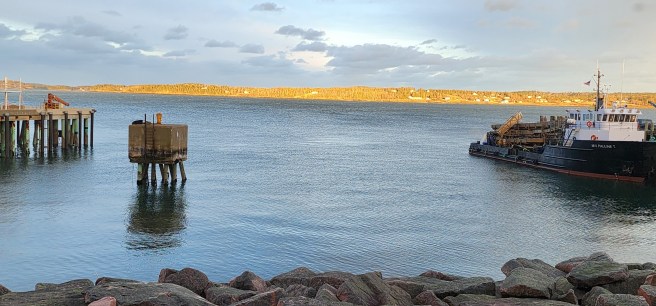
Time the view right and you may see Campobello Island, New Brunswick, turn buttery in the late afternoon sun. As an added touch, a few house windows suddenly burst into bright reflections. Here they’re simply vivid white boxes.
New Englanders sometimes joke that a town name will be found repeated in five of the six states of the region. It can be confusing. You know, people moving from one place to a new one but keeping the town name.
Maine, however, has its own twist, since much of the settlement occurred after the American Revolution, especially in the early 1800s, when “singing schools” became a popular community activity. Many of these were related to church life and the spread of four-part harmony hymn singing. So what if someone else had claimed the town name you had hoped to repeat, here was a fresh source.
Today many songs in a hymnal carry a title reflecting the words, but in earlier times the name identified the music itself – many of their lyrics can be transported from one composition to other scores within a given syllable-count system anyway.
That older tradition is continued today in a style of a four-part cappella singing called Sacred Harp, reflecting the title of the hymnal of shape notes that it used. Shape notes, should you ask, are not all of the round kind you see in most musical scores. Instead, some are little flags called fa; others are little boxes called la; or diamonds called me but spelled mi; and the round notes are called so. And there are no instruments, not even harps, much less pianos or organs, in this often rowdy tradition.
So much for that arcane sidetrack. Back to the song names.
I had assumed that the composers applied them to honor where they were written or some such. “Detroit” is one that always makes me smile.
At any rate, during a sacred-harp singing session a while back, it was mentioned that some Maine towns were actually named for the tunes, rather than the other way around.
Bangor was one. Though not in the Sacred Harp collection, the tune was written in 1734, “Oh very God of very God,” and influential. The Maine city was incorporated in 1834 from what had been known as Sunbury or Kenduskeag Plantation. The name “Bangor” is said to have been taken from a Welsh tune. Voila!
Now, for ten examples drawn from the shape-note collection. The name of each tune and town is followed by its date of composition and then the first line of the text it accompanies in the Sacred Harp collection, the date of the founding of the town, and then by something about the Maine community.
There are arguments that some of the hymns were named after Maine towns. Just consider Mars Hill, 1959, or Mount Desert, 1985.
w i i n d
schooner or later

The first French attempt to colonize North America took place in 1604 on this island in the St. Croix River but ended disastrously. The historic site is now an international park between Maine, USA, and New Brunswick, Canada.
Access to the island itself appears to be problematic.
Here it is seen from Ganong Nature Park (east of St. Stephen, New Brunswick) at the confluence of Pagans Cove, Oak Bay, and the Waweig River while the St Croix River veers off to the west and quickly narrows before continuing the international border.
 Jnana's Red Barn