People looked skeptical when they heard that we were living in the house during all of the renovation.
It’s not like our budget had enough of an edge for us to lease quarters elsewhere. Were we just more daring or more tolerant than others?
A key to the project turned out to be the translucent plastic “door” created at the top of the stairwell at the beginning of the work, the one with the zipper. It reduced the amount of dust that escaped from the construction and also kept much of our heat down on the first floor.
The sound of that zipper became a fact of life for us. All three zippers we had over the course of the project.
~*~
What awaited us on the other side of that veil went through a progression.
At first it faced a crowded set of shelves set in under the sloping roof, along with sliding doors to two makeshift closets and a narrow hallway running to each side.
After that came the demolition that revealed charred rafters and sheathing.
We briefly had a stretch of open sky followed by the raised roof and then the framing for the bathroom and laundry room.
What caught us by surprise, though, was the blank wall when the sheetrock went up. The stairs didn’t lead straight to another door. What would we put there? A large painting? A bookcase? A settee?
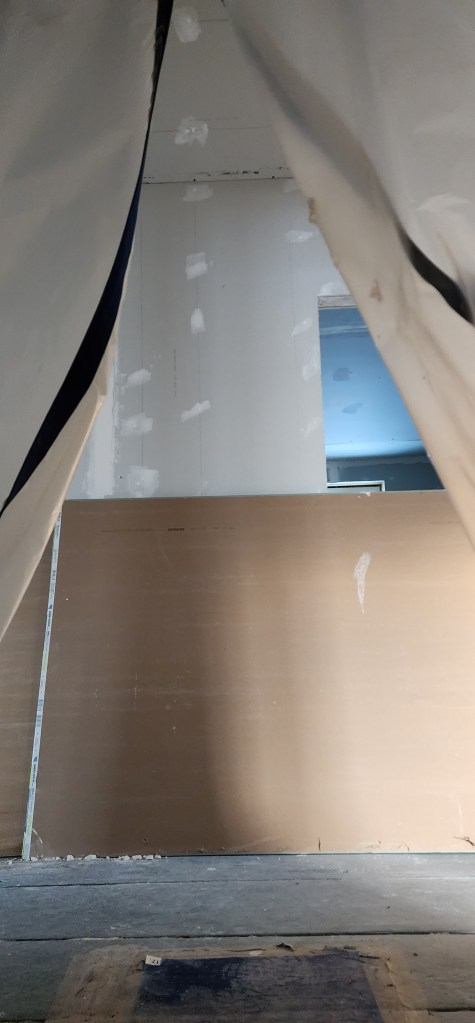
One of the coconspirators in our planning insisted on having a wide hallway, or perhaps more accurately, a landing – 6-by-16 feet, it turns out – conjoining the doors for the four bedrooms, the bathroom, and the laundry room. As a practical matter, this would make moving large items much easier, but aesthetically, the space feels wonderful, especially when we decided to keep the ceiling there running all the way to the crown of the house rather than having a low flat one.
No photo would get you a sense of that.
~*~
Somehow, Adam managed to keep the stairwell in place through all of the demolition and rebuilding. It did have that hand-cut oak lathing that predated 1830, for one thing, and the period molding.
For months, it stood like a dark ark at the center of all the action.
Once the new upstairs walls and details were in place, he turned to repairing the stressed stairwell walls and ceiling. One alteration we had envisioned was an interior window for natural light from the bedroom nook. Minor touch, but satisfying. Alas, one that was cut, in part for budget considerations.
We also gained storage space above in a kind of mini-attic accessed from a bedroom. It’s perfect for seasonal decorations that are needed just once a year. Easter, Halloween, Christmas, mostly.
~*~
As I had to confess by this point, the project was much more complicated than I had expected. I could now see why one contractor had just wanted to gut everything from the get-go, while another wanted to rip the top off and replace it with a gambrel roof. But I’m confident neither of those routes would have led to what’s emerged.

 Jnana's Red Barn