think of these as dream fragments
not always bad
You never know what we'll churn up in cleaning a stall
think of these as dream fragments
not always bad
 This is the Louis R. French at its berth in Camden, Maine. Cruises begin the night before departure as passengers arrive to settle in for their first night aboard.
For more schooner sailing experiences, take a look at my Under Sail photo album at Thistle Finch editions.
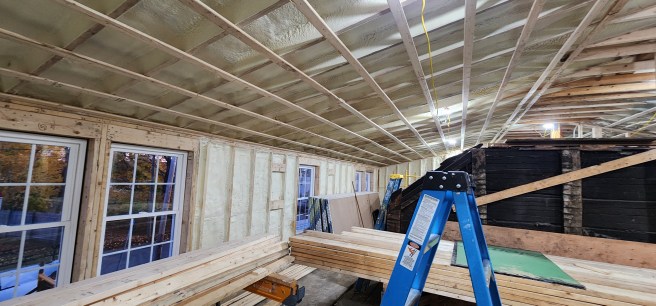
There were moments when we wondered about leaving all of that space open – just one big room. Maybe something like an artsy loft apartment. But then we returned to our projected needs and the plan at hand.
As the framing and wiring and flooring moved along, as well as the drywall itself, our hopes of painting the interior in the weeks between Thanksgiving and Christmas got pushed back till after New Year’s. Still, we were able to sleep some of our visiting family up there in primitive conditions as the drywall taping and mudding dried, thanks to a flurry of action just before Christmas.
The two front bedrooms are nearly twice as large as ones in the back. No surprise there, since the back half also has a small hallway and the bathroom and the laundry room.
Altogether, we have twice as many electrical outlets up there than we do on the first floor. And twice as much natural light.
As for the views? Sometimes breathtaking.
The good news is that the upper level, which prompted all of this work and expense to date, is largely complete.
Yay! Yes, Phase One is in place. The part that demanded we do something, or at least have it done.
~*~
Not surprisingly, this first phase cost about three times what we budgeted and took at least three times as long as we planned. Sadly, it is a rule of thumb in these undertakings. We have arranged refinancing to assure the work will be finished in the months ahead while we have our beloved contractor, rather than trying to reschedule later, but other projects we intended were reconsidered.
Working solo, as many of the carpenters do around here, meant our contractor was moving along at a slower pace. The good news came in the appearance of an enthusiastic apprentice two or three days a week, along with a helper as needed.
Immediately ahead of us was painting the ceiling, walls, and floors and then moving our stuff out of storage and up from downstairs.
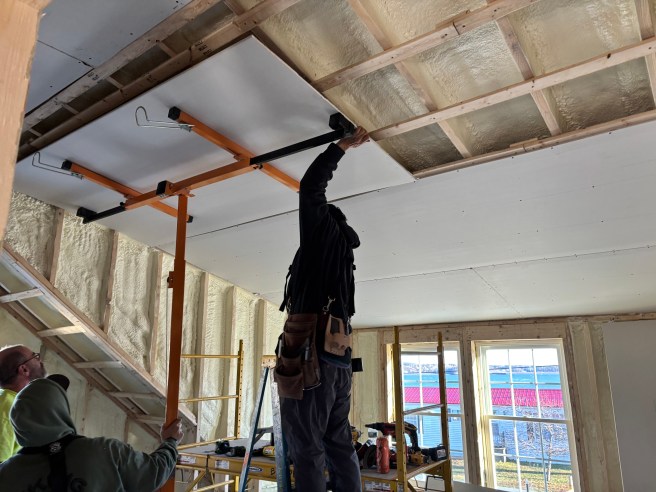
In the coming weeks, we’ll be looking at specific areas of the work inside.
At this point, we did take time to review our budget and resources, and consider modifying our direction as needed. Just getting the upstairs under control was a huge relief and accomplishment, one much larger than I had anticipated.
~*~
The most maddening item involved moving the wood-burning stove from one corner of the front parlor (aka living room) to another. It made sense for several reasons, safety for one, but also straightening out the stainless-steel chimney pipe to allow for more room in the kitchen and bedrooms above. Getting a subcontractor back to finish the job was another matter, one not uncommon problem around here, as we’re finding.
That stove is an important factor for us when it comes to the frequent electrical outages in Maine, at least in all but the summer months. And it is a major improvement in heating the house through our cold winters.
Maybe if we had decided on the emergency generator back when?
There are tradeoffs, after all.
As for the placement of electrical light switches or which way the doors opened?
Right-handed or left? Have you ever considered that? You just reach and hope, right?
~*~
We were far from finished, of course. The kitchen remained a priority, along with the adjoining mudroom. And the downstairs windows, with all of their rotting, did need to be replaced. The small downstairs bathroom and tweaks to the other rooms could, if necessary, be put on hold. Not that we’d prefer.
In the bigger picture, we’re hoping the extensive renovation of our old house assures its continuance for another 200 years or more.
In being held aloft as the epitome of English language and arguably world theater, too, the Bard of Stratford on Avon stands as an overbearing, even oppressive, figure.
Any writer since has faced the reality that by definition no one else can measure up, period. The fact that others have managed to carve out niches in the field in the centuries since is remarkable, considering.
Still, William’s presence was the reason I didn’t major in English when I transferred to Indiana University in mid-sophomore year. The department required a Shakespeare course predicated on memorization, something that’s not high in my skillset.
Beyond that, my focus has been on contemporary literature, at the time fiction and non-fiction but soon turning to poetry as well.
As a contrarian, I see no value in iambic pentameter, which we don’t speak, OK, and when I wrote in the form, the lines were always needlessly wordy. I like tight, direct, distilled, edgy. Later, the more flexible lines on Japanese poetry fit my ear as more reflective of American speech, at least as it was being applied by some West Coast poets. Count me in.
Not to deflate the Great Bard myth, but long ago I came independently to debunk William Shakespeare’s authorship of the plays. Nobody could have such an acclaimed vocabulary, for one thing, especially in the days before a thesaurus or dictionary. As for such a wide panorama of human values and foibles? Maybe it was a committee or at least a collaboration of greats – you know, a circle of improvisers whose takes were dutifully taken down as dictation – I was willing to accept that much. Sir Walter Raleigh has his backers as the likely author, and his poetry is more vernacular than his contemporaries, more akin to what we were doing in America in the 20th century.

Remember, though, having to memorize his plays, or at least the great moments, was the swing factor in why I majored in political science instead. Otherwise, I would have continually been trying to rewrite it. Instead, avoiding the Bard, I was still able to minor in English abetted by the Comparative Literature department.
More recently I’ve embraced the argument that Emelia Bassano Lanier was the actual playwright. From the existing evidence, she was better read and had a wider command of foreign languages. She likely had more time for composition, considering all the time Billy Boy would have been tied up as a theater manager, director, and actor. To pursue the fuller case, you can start by looking her up online.
~*~
For my own quirky entry here, I’ll remind you of my own Hamlet, a collection of poems spread over five two-scene acts with intermissions and intermezzos.
You might say it has more in common with Chaucer, though, with a rock ‘em, shock ‘em beat.

You can find it and more in the digital platform of your choice at Smashwords, the Apple Store, Barnes & Noble’s Nook, Scribd, Sony’s Kobo, and other fine ebook retailers. You can also ask your public library to obtain it.
In my revisions of the novel Daffodil Sunrise into a more sweeping Daffodil Uprising, I added backstory involving Indiana politics and efforts to extract personal wealth from one of its state universities.
Considering the current effort of the governor to seize control of the school’s board of trustees has me realizing my dark imaginings were all too naïve.
We know what one-party rule did in Germany and also in the Soviet Union.
In my book, the administration had little interest in listening to the students, much less in responding to their needs.
You can bet that will be a renewed breakdown ahead.
As I reflect on the many facets of my life to this point – including the zig-zag route that has led me to here – I realize what draws them together is the two central metaphors I’ve found in the early Quaker movement: divine Light and the corresponding Seed. One, as spirit, draws forth; the other, as physical matter, responds. These two, however abstractly, are embodied in both my writing and spiritual practice.
Not that anything’s been quite that easy or direct, even before our current dark times.
At least I haven’t been alone.
~*~
In my fiction, they’re most prominent in Kenzie’s Tibetan Buddhist discoveries in the novels Pit-a-Pat High Jacks and Subway Visions and in Jaya’s practices in Yoga Bootcamp, Nearly Canaan, and the Secret Side of Jaya.
Not to be dogmatic in any of this. What I have now is what I found missing in both the Protestant circles where I grew up and the Eastern practices later. The second, as the ashram, was a step that taught me to sit in silent meditation as well as to live in community, lessons that flowered in relation to my Quaker, Mennonite, and Brethren circles that followed.
Trying to live in the “real world” of employment and a partner and family definitely thickened the plot as these have unfolded. As I’ll concede, a spiritual life needs to be grounded. That is, the gritty realities.
~*~
Trying to be faithful to the Way as it has opened before me was hardly the path I would have expected. It has, though, been blessed with mutual irradiation, in Douglas Steere’s brilliant term, including a Greek Orthodox infusion.
More recently, attempting to get back to some of the basic hatha yoga exercises, has inflicted the humbling blunt recognition of what 50 years of neglect can do to the physical body.
And cutting through the platitudes and BS of the literature remains a challenge.
~*~
These elements drive the essays of my book Light Seed Truth, examining the three central metaphors of Quaker Christianity. It really becomes a different way of thinking.

Here are some of the things I’ve noted along the way.
I’ve been a Quaker for nearly four decades now, coming to the faith of my ancestors by chance after living and working on a yoga farm in Pennsylvania. Lately, I’ve been uncovering a revolutionary understanding of Christ and Christianity – one the early Quakers could not fully proclaim in face of the existing blasphemy laws but experiences they couched in metaphors of the Light, Seed, and Truth. As I systematically connect the dots 3½ centuries later, I’m finding a vibrant alternative to conventional religion, one full of opportunities to engage contemporary intellectual frontiers, individual spiritual practice, and societal crises. As an established writer – a professional journalist, poet, and novelist – I’ve organized these insights into a book-length manuscript. Would you like you to see it?
What I’ve found is an astonishing course of religious thought no one else has previously presented systematically. Reconstructed, their interwoven metaphors of the Light, the Seed, and the Truth provide a challenging alternative to conventional Christianity, one full of opportunities to engage current intellectual frontiers ranging from quantum physics and Asian spiritual teachings to psychology and contemporary poetry.
Embedded under the conventional interpretation of the scriptures and teachings about Jesus is an alternative definition of Christ and Christianity.
When early Quakers in mid-1600s Britain experienced this as their “primitive Christianity revived,” they were forbidden by the blasphemy laws from proclaiming their understanding openly. Instead, they couched it in overlapping metaphors of the Light, the Seed, and the Truth.
Embracing holy mystery, I’ve found the Hidden Path emerges.
Forget everything you’ve heard about Christianity. Let me show you an alternative portrait of Christ, and a much different practice that results. It can change your life. For starters, you need to realize that Christ is bigger than Jesus.
I can introduce you to the Universal Christ, which is quite distinct from Jesus. It can transform your spiritual understanding and make your life deeper and richer.
This can revolutionize your experience of Christ and what it means to be Christian.
This is not simply an intellectual exercise, but a visceral awareness
The results will startle and provoke, not just across the spectrum of today’s Society of Friends, but among Christians everywhere.
Sometimes I experience the act of writing as prayer. Neither is done for outward compensation, much less any guarantee of results, but rather to open one’s heart and mind to what is eternal and true – and attune oneself to that, regardless.
Culling my collection of photography and tearsheets, I’ve recognized I no longer desire to travel many places I haven’t been, but would rather revisit places I have. Either in person or, in the case of Tibet or Japanese temples, in my thinking and study. I also recognize that could change, given different economic circumstances and an influx of free time.
I now seethe early Quaker vagabonds were Dharma bums, too. The itinerant ministry proffers its own humor.
Quakers are still around, all right. And more relevant than ever. Just listen.
You can find it in the digital platform of your choice at Smashwords, the Apple Store, Barnes & Noble’s Nook, Scribd, Sony’s Kobo, and other fine ebook retailers. You can also ask your public library to obtain it.
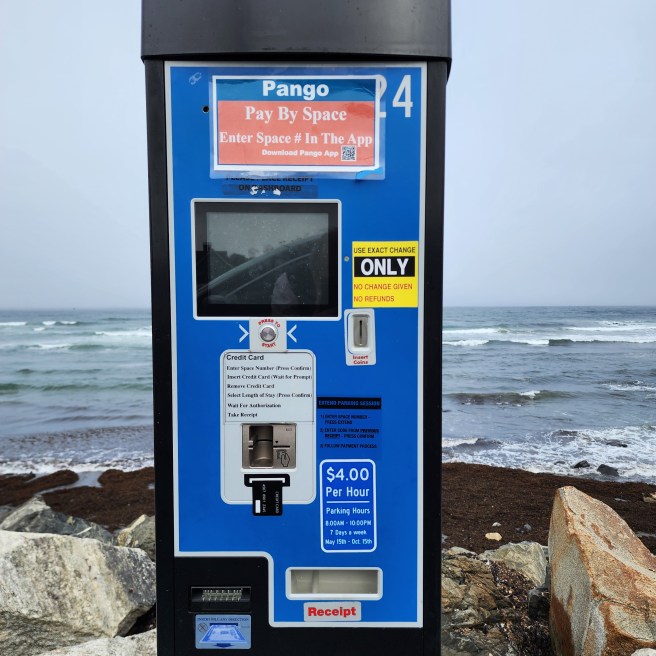
Gone are the days of paying with quarters, especially not now that the hourly rate has gone up to $4. We have many memories of the Long Sands stretch of York Beach, Maine.
On our end of the state, the ocean parking is commonly free but the water’s too cold for swimming. Alas.
Ever wonder how they work? No electricity, motors, or anything like that? Flush toilets are taken for granted by half of the world’s population, except when there’s a malfunction.
For perspective, check this roll. Well, actually two rolls today – it’s a Double Tendrils occasion.
Now, for some historical and global angles.
Usually, it’s to get either the spiders she fears or the dust she’s allergic to.
Yes, some chores can be seen as acts of love or devotion.
Even if I would rather avoid housekeeping altogether.
Immaculate
Misconception
 Jnana's Red Barn