One of the artistic ideals in my life originated in the fantastic illustrations by Inuit craftsmen as they expressed the world they inhabit. Perhaps you’ve seen some of their calendars exhibiting owls, seals, the sun itself, and the like.
As I was told by the couple who introduced me to the Inuit works, an artist in the tradition does a subject just once, at least in the position or perspective that results. A bear, for instance, might be shown standing, but only once. If a bruin shows up again, it would be fishing or lumbering along or maybe paired. Each appearance, though, must be unique. There were still plenty of ducks, geese, walruses, whales, and other Inuit – hunters, mothers, and children – remaining for close examination, even in their Arctic environment.
The husband who told me this, let me add, was a coauthor of the Alaska constitution who had some acquaintance with the ecosystem. He had grown up at its southern edge, northern Washington state.
After more than two decades with that as a guideline, I faced a conundrum as I tried to assemble my own poems for submission as a competition for a chapbook – a booklet, essentially. A book needs to flow from start and middle to an end with some sense of continuity. My one offering that had that, American Olympus, had a received a provisional acceptance from a prominent press that later rescinded, claiming a cut in their grant funding. And my other pieces hopped, skipped, and jumped from one setting to another – if only I had been able to remain in one setting long enough for continuity in their completion.
Beyond that, my own life had moved on, providing me a lode of new material to draw upon. That’s when I turned to the idea of theme and variations, a major element of the classical music I so love and also big in jazz as improvisation. What hit me, especially, was Ted Brautigan’s sonnets from the ‘60s. They were essentially three poems, reworked over and over, into a full and very stunning collection.
I took that as my springboard into two intense weeks – while working fulltime as a newspaper editor – of reworking raw notes of loved desire that had incinerated into what you can read as Braided Double-Cross – a set that was rejected by the jurors in a competition based in its principal subject’s hometown. Maybe it was too intense. The poems are searing.
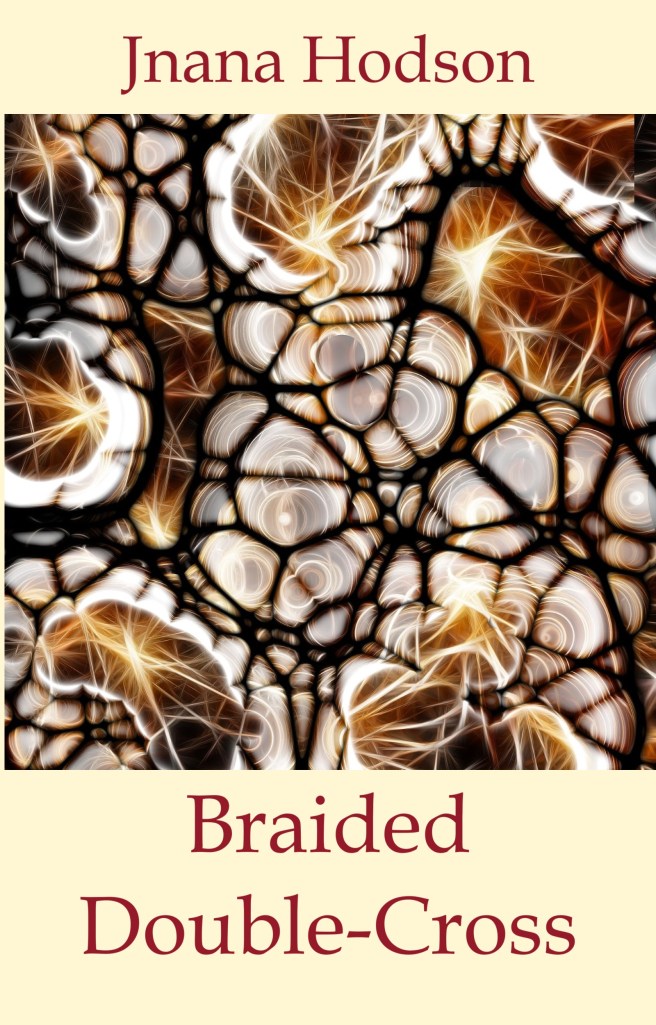
The night I finished drafting the 60 poems, I should note, I went out to dinner and have no idea how much I tipped the server. I was thoroughly exhausted, not just emotionally. Not that I remember of the meal I devoured.
Love really can be such a bitch. At least it still is with me, no matter how much she wonders why I still worship the one who continues in my life.
~*~
For now, let’s turn to the question of what makes a poetry collection “hang together”? In contrast to an assembly from my “best work,” however sporadic.
For perspective, also consider my aversion to series in fiction, where I’ve seen too many series as the same book done over and over with a few tweaks, even if that has led to way too many bestsellers. Yet I’ve gone back to my novels and reworked them to create linkage from one to the next, at least in two separate series. What I think now separates mine from most series is that none of my novels is a carbon copy of any of the others. Mine do, in contrast, represent a sequencing of growth from one to the other. In that way, they create one longer epic rather than imitative episodes like a TV sitcom.
Still, what is it that draws you back to a particular author, book after book?
~*~
I think now of the observation that an author’s next book springs from what was left unsaid in the volume published just before it. That point resonates and returns us to the question of how does an author know when a work’s finished.
Regardless, I’ve definitely done much more in the vein of “series” since completing the first.
~*~
You can find Braided Double-Cross and more in the digital platform of your choice at Smashwords, the Apple Store, Barnes & Noble’s Nook, Scribd, Sony’s Kobo, and other fine ebook retailers. You can also ask your public library to obtain it.

 Jnana's Red Barn