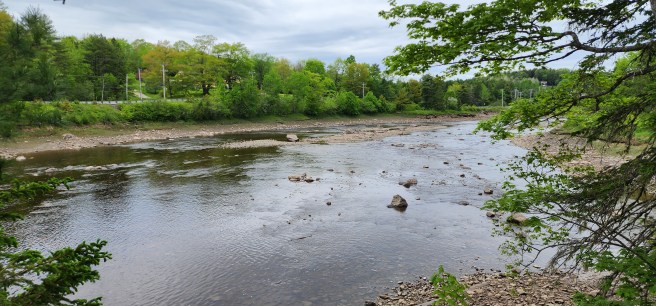
 I just missed a shot of two eagles. A week later, with the water higher, I watched two harbor seals at play. Cobscook Bay is less than a mile downstream.
Month: May 2025
When’s the last time you went bowling?
Well, the sport does figure prominently in the movie The Big Lebowski and the TV series Surreal Estate, a device that slyly dates the both stories.
That said, here are ten factors to consider.
- A realization that parking lots outside bowling centers were largely empty in sharp contrast to their crowded condition only a few years earlier prompted a landmark study by Harvard political scientist Robert D. Putnam. His 2000 nonfiction book, Bowling Alone: The Collapse and Revival of American Community, expanded on his 1995 essay, “Bowling Alone: America’s Declining Social Capital,” examining the steep decline of in-person participation in group activities pf all kinds by adults across the nation. It wasn’t just bowling but civic clubs, social lodges, churches and synagogues, labor unions, political meetings and campaigns, even neighborhood parties.
- In America, the sport usually refers to indoor ten-pin bowling on polished wooden lanes, although lawn bowling is popular in across much of the rest of the world. Think of the places named Bowling Green as a referent. Bocce and curling are close relatives.
- The pins themselves come in differing sizes, which then have matching balls to be rolled at the targets. The most common in the eastern United States and Canada are ten-pins – tall, fat, and the heaviest, matched with a large ball about 8.59 inches in diameter, weighing between six and 16 pounds, and having two or three finger holes. Duckpins, invented in Boston in the early 1890s, are shorter and like candlepins, invented in Worcester, Massachusetts, in 1880, are played with balls that fit in the palm of the hand and have no holes. Other varieties include nine-pin and five-pin.
- At its height of popularity in the United States in the years after World War II, hoards of players – men and women – participated in weekly leagues, wearing customized team shirts and their own bowling shoes and playing with their own balls. Non-league players could, of course, on a lark rent the shoes and balls, if they could find an open lane. For many, it wasn’t a bad date-night option.
- I won’t get into the intricacies of scoring – I never did figure that out, much less those for tennis. But I can admit that candlepins are tricky.
- Traditionally, the balls are constructed of blocks of maple glued together and then lathed into shape and covered with plastic, paint, and a glossy layer. Synthetics are now also allowed, depending, and rubber pins were once even in use.
- The sport has a long history in antiquity before some action moved indoors, as best as I can tell, in the mid-1800s. In 1875 in the U.S., rules for ten-pin play were standardized by the National Bowling Association in New York City, superseded in 1895 by the new American Bowling Congress.
- Chicago-based Brunswick Corporation was already well established as a maker of billiard tables when it began making bowling balls, pins, and wooden lanes to sell to taverns installing bowling alleys in the 1880s. The company became synonymous with bowling.
- The arrival of automatic pinsetter machines in 1952 eliminated the need for pin boys, a precarious and dangerous job for males who sat unseen above the pins to clear them and reposition new ones after each frame of play. (As I was saying about scoring?) The machines made by American Machine and Foundry of Brooklyn, New York, speeded the game and sent the sport’s popularity rocketing.
- The Golden Age of Ten-Pin Bowling took off around 1950, including weekly television coverage. Some professional bowlers earned as much as their colleagues in baseball, football, and hockey. The era ended in the late 1970s.
More bits from one writer’s journey
I am one of the few poets and novelists who has spent the bulk of his career editing daily newspapers, rather than teaching literature or creative writing. Still, when it came to creating a contributor’s note for a literary journal, I had to think of myself in the third-person.
Here are some of those contributor’s notes I don’t think were published … until now.
- In a typical year, Jnana drove enough miles to circle the globe, yet rarely ventured far from his relatively small state.
- Jnana admits there’s something quite frightening in any occasion of encountering a dragon, much less being carried off by one. He’s been scorched more than once.
- In his lifetime of writing, Jnana has found himself addressing issues of PLACE as much as character or social conflict or even religion and ethnicity. Place, of course, intertwines with history and the natural sciences. In examining where he lives – where we live – and have lived – he also examines movement, change, home, and community.
- When Jnana graduated from college, the economy was in a tailspin. The hippie movement was flourishing. He was too skinny to be drafted for Vietnam.
- Jnana once spent a week at an ecological workshop in Port Worden, Washington, where Barry Lopez, Gary Snyder, and Howard Norman were joined by biologists and anthropologists. It’s as close as he’s come to a writing seminar.
- As copy desk chief, Jnana was a glorified secretary rather than the top grammarian.
- Jnana began his professional journalism career as an Action Line research assistant.
- As a homebrewer, Jnana handcrafted more than 2,500 bottles of fine ales and lagers.
- Jnana’s elder daughter wanted to raise chickens, ducks, and bees at their small-city homestead. He wondered about the neighbors’ dogs and cats, as well as the possums, groundhogs, and skunks. He didn’t want the misery of another henhouse raid.
- His wife thought Jnana would have fit the mid-1800s better than contemporary America. She wondered how someone engaging an Anabaptist religious line could be so unorthodox in his art.
- As a daily newspaper editor, Jnana sensed he was among the last to uphold a vital blue-color trade. He wondered how democracy could survive without independent reporting or clear writing.
- Considering the brevity of New England summers, Jnana had hoped to launch a line of Hawaiian sweaters.
- Jnana hates onions but loves a good martini. (Gin, not vodka.) With or without olives.
- As a journalist, Jnana lived in the trenches of community life – in the tensions of industry and finance, retail commerce, social inequalities and prejudices, and reactionary politics. He admires the progressive activists who have maintained their optimism in spite of it all.
- In management and as an editor, Jnana had his head and heart handed to him on a silver platter more than once.
- He hopes he never has to load or unload another U-Haul as long as he lives.
- Jnana is quite grateful his younger daughter gave up rugby for crew as her first college sport.
- Jnana senses rural values are rooted in his soul. His dad was born on a farm.
- Jnana’s mother was born in St. Louis. She loved taking him to the zoo.
Kinisi 261
SUCCESSFUL
STRESSFUL
Only eight miles away from us, by water
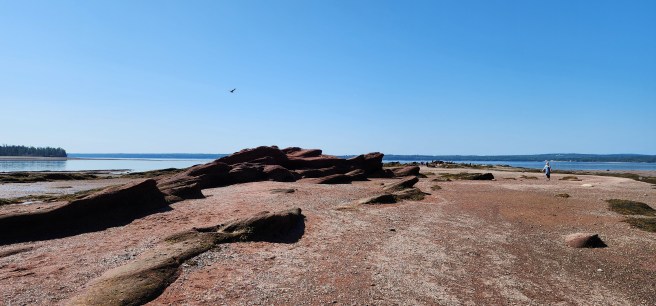
St. Andrews, New Brunswick, is an hour-and-a-half drive from our home, but it does strike us as a Providence, Cape Cod, kind of place in a somewhat more respectable vein. Get away from the tourist strip downtown and you’ll find this at low tide.
The land beyond is Maine, USA.
So much past under one roof
I never suspected our humble cottage would hold so many stories and twists. A sea captain’s home should have a widow’s watch, right?
Ours, as you’ve noticed, doesn’t.
Still, a single house like ours can be a miniature version of the whole island’s history.
There are still so many unanswered questions to work around in this puzzle, along with points that will require clarification and correction. Consider this, like the house itself, a work in progress.
Besides, we’re living out the next chapter, including the renovations and restructuring that’s occurring as I write this.
Journaling over the years
Prodded by a crusty newspaper editor-in-chief to keep a personal journal, I started the practice 55 years ago using spiral-bound notebooks. At the time, I was largely in quest of exploring “my problem,” meaning the deep depression and loneliness that followed the breakup with my first lover and my inability in social circles to find another. Long story to pick up later.
What I found instead was the manic upside in my funky settings during the hippie outbreak. Many of those entries, some of them in my favored 8½-by-14-inch notebooks – an option that disappeared all too soon from the market – found their way into my eventual fiction and poetry, though much of the rest is dross. At their best, they do have a sense of Richard Brautigan. Look him up, if you must.
As for the banal run of most of the entries, people who snooped into my journals and then voiced their disappointment in what they found told me as much. Note to those of you who consider doing something similar, it is an invasion of privacy and will likely bruise your relationship. It is an abuse.
Entries were rarely a daily thing for me, more likely weekly or, of late, even monthly. When I sat down to do so, I was more likely to record what was going on around me than I was to delve into my emotions or underlying perceptions. Those latter elements might appear whenever I had more time at the project. The big lesson was that my life was much richer than I had suspected, and I was too prone to lose the connecting threads without these times of reflection. In some ways, they were like Lewis and Clark’s explorations across the continent, I suppose. Who knows who might need the maps later.
In earlier returns to these, I did find I had duly noted details of unfaithfulness and other impending disasters that I was denying to myself, yet there they are in clear daylight when we return.
Among my goals this year is a thorough revisiting of the 200-plus volumes to date, the latter half mostly in hardbound 8½-by-11 artist sketchbooks. Most of what I review will be discarded, harsh as that sounds, but I the act will release emotional burdens as well. My novels and poems distill and carry much of that journey, thank you.
The ones beginning in 2000, though, retain so many details of my current situation, I really can use the reminders of things I don’t recall when they’re raised by others. I’ll let you guess who, especially.
~*~
My practice has definitely changed since I began blogging. Much of the recording of events, personal observations, and reflections has deflected from the hardbound journals to these online entries. Well, so has much of what would have gone into long letters to friends and colleagues now has vanished online as well. Emails and texts fall far short of real correspondence, OK?
The journaling on paper continues, though at my age, life feels more routine, less worthy of intense recording. So much of it I’ve already said, even to myself. Still, as a practice, it’s one more thing I can see as prayer, too.
You’ll likely be seeing more of what I turn up in those yellowing pages.
My favorite radio program at the moment
It’s called “My Music,” a Saturday morning staple on the CBC Music FM radio network.
For two hours each week, a notable Canadian classical musician is invited to share his or her favorite music. Not all of it’s classical, either. Sometimes it’s a pianist or a violinist or even a conductor or composer. Some are quite famous in musical circles, while others are fairly obscure. Organ, clarinet, harp, percussion, and varied ethnic instrumentalists have hosted as well. And there are some amazing singers, not all of them opera.
Sometimes they stick to their particular niche, but I especially enjoy the ones who venture far beyond that.
It’s quite touching when they honor their parents, siblings, teachers, and friends with their selections, and quite enlightening why they explain what makes someone they admire stand out. As I said, it’s not always classical. Canadian jazz pianist Oscar Peterson turns out to be a huge influence.
I do wish classical stations in the U.S. had a similar program. To attempt this on a national level would be too overwhelming. Part of its joy is a small-town feel. Basing one in Boston or Los Angeles or Chicago might even be too big.
Bloomington, Indiana, would be a natural, or San Francisco, or even a whole state like Minnesota.
Whaddya think?
Pocket beach on Eastport’s north end

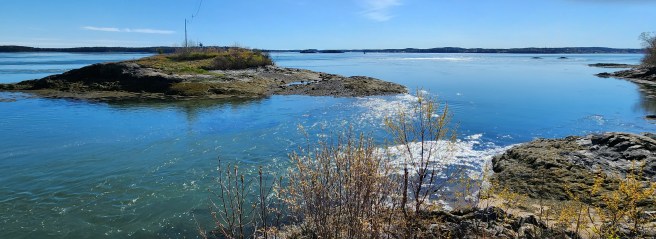
Our rocky shoreline includes sporadic pocket beaches, too. This one faces tiny Dog Island, shown below.
Meet patriot Lewis Frederick Delesdernier
In researching the history of our house, I learned about many of its earlier neighbors as well. Of note to the south was one with a rather exotic surname. Turns out he was a rather influential figure in the establishment of Eastport.
Here are a few points about him.
- He was born as Louis Frederic DeLesdernier in Halifax, Nova Scotia, in 1752 to Gideon de les Dernier and Judith Marie Madelon Martine. As for that French surname? The precise location at that time could have been under either French or English rule – the conflicts are quite tangled. He was, however, a generation removed from Geneva, Switzerland, by then. French-speaking, all the same, however anyone wound up spelling it.
- His uncle Moses was the first Protestant to farm among the French Acadians.
- When the American Revolution broke out, Lewis enlisted in an effort to bring the American Revolution to Canada. The attack on British Fort Cumberland in Nova Scotia was defeated and then, in retreat, Lewis ultimately wound up in Machias, Maine, where he was charged with maintaining good relations with the local Passamaquoddy to assure that they didn’t defect to the British. During this time, in 1779 he married Sarah Brown, the daughter of a fellow garrison member. For a Frenchman, attacking the English makes sense.
- After the war, he resettled on an island in the waters either in today’s Lubec or Eastport, Maine, one called variously Fredrichs or De Les Dernier island. There he was appointed as the first customs collector for the district, possibly encompassing both today’s Lubec and Eastport, and, in 1789, when the first post office was established, was named postmaster. Could that island have been what emerged as Moose Island, today’s Eastport?
- In Eastport, he was not only the first postmaster but also the first collector of customs. Case closed?
- The first owner of our house did have a ship named after him. In those days, naming a ship after someone often obligated them to buy a share in it. Did this present a conflict of interest for the custom’s collector?
- After Delesdernier’s first wife’s death in 1814, he married the widow Sophia Fellows Clark in 1817. Trying to determine the number of children remains elusive, but I’m finding no descendants in the region today.
- When he died in December 1838 at his son’s home in today’s Baileyville, Maine, a warm friend, Alfred A. Gallatin, the fourth U.S. Secretary of the Treasury (1801-1814) under President Thomas Madison, said, “He is to me of all Americans I have seen, the most zealous and full of enthusiasm for the Liberty of his country.”
- An 1803 arrival in Eastport of Harvard graduate Jonathan D. (the initial for you can guess what) Weston was auspicious. Shortly before his death, provided details on much of the early settlement of Eastport in a history published in 1834 and later woven into William Henry Kilby’s 1888 volume. He also hosted famed ornithological artist John J. Audubon at his 1810 home at the corner of Boyden and Middle streets. I’m not finding any direct relationship, but will venture that the middle name was in honor of Lewis, perhaps even hinting at the reason for Jonathan’s moving to Eastport.
- Lewis’ circa 1807 house was eventually moved from down on the water to higher ground. The only remaining evidence of its original location is in the naming of Customs Street, far from the later custom’s offices. Today, the Delesdernier home on the south end of the island is proudly owned by symphony conductor and cellist Dan Alcott, who anticipates moving into it year-round. We can’t wait!
 Jnana's Red Barn