Lighthouses do stir the hearts of many coastal residents and tourists, though foghorns have long provided at least as much foul weather warning for seafarers along the coasts. These horns do get overlooked, though.
Do note:
- The earliest known form of a fog signal comes from ancient China around 250 B.C.E., where bamboo pipes produced sound warnings in foggy weather. The concept was later adopted by other early civilizations such as the Greeks and Romans, who used trumpets made from animal horns or bronze. It was one way to keep musicians employed.
- Small cannons or other explosives were later used, though they were labor-intensive and time-consuming. Not much bang for the buck, ultimately.
- In 1851, a powerful steam whistle in Liverpool was first used, according to one version. As Emma Sullivan’s account at Working-the-Sails.com goes, “Its thunderous blast cut across thick curtains of fog with astonishing clarity.”
- Scotsman Robert Foulis apparently kept tinkering. While walking home one foggy night, he heard his daughter practicing piano and realized the lower notes she was playing came through most clearly. That led him to create what would become the first automatic, steam-powered foghorn in 1859 in New Brunswick, Canada, though the credit long went to others. The one in Canada, generally considered the first foghorn, remained in position on Partridge Island and in use until 1998.
- Crucially, lower notes have longer wavelengths, which allow them to pass around obstacles better than high notes do. As a result, the water droplets of fog do not diffuse the low notes as much as they do the upper ones. So the explanation goes.
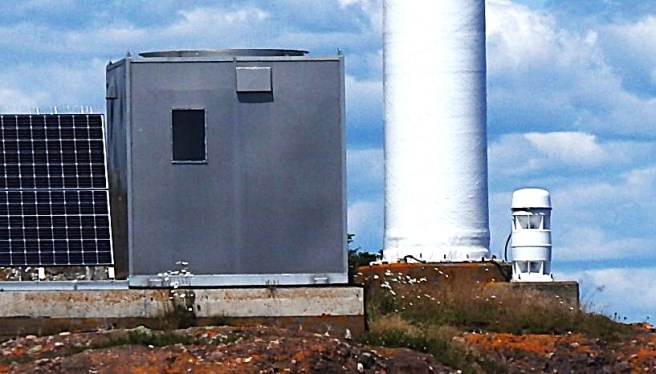
- More common designs have relied on compressed air to create the booming alarm. Each of these horns requires a clever interplay of air pressure, diaphragms, and acoustic amplifiers. Other horns have used vibrating plates or metal reeds, somewhat akin to a modern electric car horn. Others forced air through holes in a rotating cylinder or disk, much like a siren. That may be why I’ve been unable to find much in the way of illustrations.
- More recent versions include electronic sirens and acoustic transducers. I’ll save the technical mechanics and their history for discussion in a museum setting or the like.
- A horn typically has a “sound signal” or frequency pattern, say an initial blast of about four seconds followed by a pause of a minute or so. This originated with a semi-automatic operation achieved by using a coder, or clockwork mechanism, to open valves for the air, giving each horn a timing characteristic to help mariners identify them. Today it’s probably computerized.
- They come in different sizes and shapes, depending on their mission and situation. Many but not all are associated with lighthouses, where the beacon of light can be obscured by heavy rain as well as fog. Many others, though, are on ships to warn others of their presence or even under bridges.
- Some foghorns can be heard up to eight miles away. Maybe not in a storm.

 Jnana's Red Barn