The Shackford children had their joint holdings surveyed in January 1833, with Hannah Shackford’s husband, Darius Pearce/Pierce, performing the task. A flurry of real estate transfers followed, formalizing their agreements.
By 1820, according to the Census, the sons were heads of household.
Trying to follow the transactions gets rather confusing.
William and Jacob had even gone into business together in 1833, turning their attention away from seafaring. Their dealings included waterfront between the high-tide and low-water stretches as well as bands of shorefront below our house that would be developed into wharves.
From what I see, the boys weren’t getting a family discount. In 1830, John junior paid his father $1,000 for one parcel next to his brother William’s. In a transaction dated December 30, 1831, John senior specifies a band of waterfront “partially in front of my own dwelling house,” with the sellers being himself and “my wife Elsie.”
Among the deals were one on the easterly side of Water Street “to the fence of my homestead” and then westerly to Water Street, confirming that his homestead included both sides of the road.
Of special interest to me in confirming that our house was the one John senior occupied are the two deeds conveying adjoining land along Water Street. First was a sale to Myrick Bibber, a furniture merchant, on June 13, 1839, for a lot on the southwest corner of Water and Shackford streets, and then on July 10, to Daniel Aymar for the lot between the two.
Each of them is measured to the line of “the yellow house lot owned by me.”
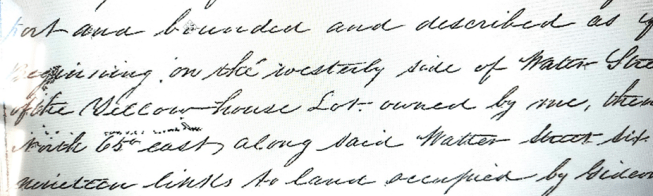
Here’s how the description appeared on the two deeds recorded at the Washington County courthouse.
I was surprised to see that he signed the deeds with his mark, X, as did his wife in several instances. New England was noted for its nearly universal literacy, both men and women.
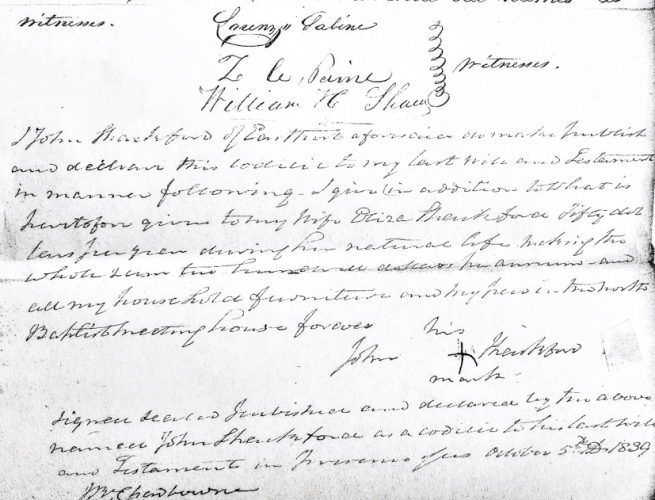
Here’s his X on his will.
Grandson Samuel Shackford said Esther, John’s first wife, “had been well reared and was a woman of superior intelligence” and that her children “were indebted to their mother for nearly all the educational advantages they ever enjoyed.” Unlike her husband, she signed some of the documents, as noted in the record, “her seal.” “School-teachers were rarely obtainable, in those days, in this then out-of-the-world. For a brief period, the services of William Lloyd Garrison’s [future] mother were secured to teach in the family” when she lived on neighboring Deer Island, Canada..
The real estate transactions indicate the children were all literate.
Esther died June 21, 1830. His second wife enters the picture rather obliquely soon thereafter.
His will of June 14, 1832, bequeathed “to my beloved wife Elsie the use during her life of my homestead or the house in which I now live, together with the lot and privileges thereto.”
Further down, it directs his six children and grandson Samuel to pay “to my wife Elsie the aforementioned annuity of one hundred & fifty dollars. And on my demise the homestead on house in which I now live with the lot come privileges pertaining thereto, and the one of which I have willed I am bequeathing to her during her life, I am bequeathing to them, my six children … in the same proportion of my other property.”
A harder to read codicil of October 5, 1839, raises the amount of the annuity to “my wife Eliza Shackford” to $200 during her natural life and “all my furniture and my pew in Baptist meetinghouse forever.”
After Captain John’s death, as Samuel Shackford confirmed, Elsie (or Elise, in his account) obtained the Revolutionary War veteran’s pension based on his service.
Elsie was later recorded in the 1850 Eastport Census as Eliza Shackford, 70, living in a household headed by Abigail Winslow, 37, along with four children — Anna E, 12; Lucy M., 6; James F., 4; and Mary A., 2; as well as Ethel Olmstead, 37, with his occupation as “gold digger” in the metal mining industry. An index to that Census listing placed Ethel as the head of household, even though he was at the bottom in the family. I am perplexed by the Winslow identity.
All of it, of course, has relevance on the house we bought.

 Jnana's Red Barn