This one doesn’t seem that long

Or so I keep muttering to myself when I realize I’ve lived here on an island in Maine longer than eight other locations in my zig-zag life’s journey. Somehow, looking back, those others feel more action-packed, dramatic, even influential while this one seems to have flowed by more gently and quickly and, yes, more pleasantly overall.

This, of course, is Eastport, my remote fishing village with a lively arts scene at the easternmost fringe of the continental United States.

The mere idea of writing from an island in Maine strikes me as pretentious, yet here I am, far further east than the others, and I am here year-round, whatever.

My habitations of shorter duration were all in my 20s and 30s, largely career moves one way or another and mostly taken as professional stepping stones to something higher, though the next move was rarely the one I anticipated. This, in contrast, is in my 70s, with any dreams of next steps largely evaporated. Rather, I’m savoring an awareness of culmination, even if the big successes I desired ultimately remain vaporous. Especially the bestseller rankings or critical approval or genius grant recognition remain vaporous.

Add to that the fact of time going faster the older you get, something I’ve previously remarked on here at the Barn.

Returning to the thought of residency, the three longer locations in my route were my native Dayton (20 years) before I set forth to other fields, and then, finally, slowing down again in New Hampshire, with 13 years in Manchester and 21 in Dover.

I’ve been attentive to what I have in all the turmoil.

Turning to real estate

As the growing village took shape, John senior had his tract surveyed by Benjamin R. Jones, resulting in Shackford’s Plan of lots. A copy of that would help make sense of the wheeling and dealing that followed. Many of the purchasers were by John’s own children, individually or in combinations of partnership often formalizing land they had already “improved” and buildings they had constructed or sites where they would. Others went to Eastport’s new merchants and tradesmen. In all, I find 73 transactions, most of them as a grantor, or seller, recorded at the Washington County courthouse in Machias. I’ve probably missed a few, so take that as a rough figure.

It wasn’t just housing lots, either. Captain John’s waterfront properties were valuable sites for wharves, docks, and storehouses. He was even selling sites between the high and low tide lines. I’ll spare you the tensions between low tide mark claims today.

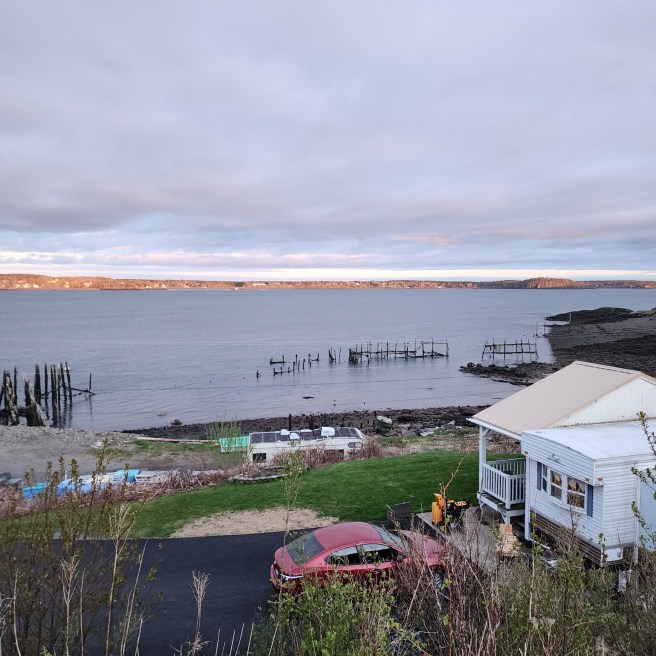
This is how some of the shoreline below our house looks today.

The one transaction I haven’t been able to track down is his title to Shackford Head. Was it simply overlooked by the indexers?

A significant deal took place on April 14, 1826, when his surviving offspring, all in adulthood, paid him $3,000 for the land between High (also known as Back) Street and County Road. And here I thought he had given it to them. Where did I get that idea? That was a huge figure for the time, by the way.

Was he a Scrooge with his offspring? Or merely cunning?

He still had plenty of lots left to sell.

Esther died on June 21, 1830, age 76.

All of it, of course, has relevance on the house we bought.


No, I’m not going swimming nude in a group at a summer lake any more

As I’ve previously mentioned, for much of my adult life, I’ve thought of myself as a retired hippie. Or I’ve simply been called one by others. One of millions and, unlike many, one who’s not embarrassed to admit it, that was a time to remember, no matter how short we’ve fallen from its promise and potential, even though I’m not so sure how much I’d want to go skinny-dipping with others these days or even sleep on the ground or a mattress on the floor.

That said, I’ll also admit that much of my first year after graduation from college in the height of the hippie movement was deep misery and loneliness punctuated by playful discoveries. The writing of Richard Brautigan definitely fits in here.

What’s often overlooked in the era is that the central element was the hippie chick. Plus, personally, I was without one, since mine had moved on and left me stranded. (Oh, misery, oh, woe, I am sounding pathetic, but let’s move ahead.) My novel, Hippie Farm, celebrated her in her many guises, even if you can’t even use the term “chick” anymore without being corrected. At the time, though, it was a badge of honor and invitation – one leading, in this case, to that rundown farmhouse in the mountains outside a college town I definitely restructured in terms of fiction.

A second novel, Hippie Love, retold the same plot line from a different perspective, one more of a what-if optimism. I would love to have heard that story retold from their impressions. Ouch? Were they as lost as I was? One I’ve been in contact with all these years has shared her insights, helpfully, and another, reconnecting much later, barely remembered who I was. And here I had thought she might be The One. Oh, my.

In the light of the publication of What’s Left, those two books were then greatly revised and newly released as a single volume, Pit-a-Pat High Jinks. Compressing the two was a major effort, but ultimately satisfying, at least for me. So much happened personally within that short span.

The inspirations cover quite a cross-section of people, with one becoming a United Way executive, another a U.S. Attorney, yet another one an OBGYN physician. Not that you would have guessed it at the time. As for most of the rest, I have no clue. Some were real losers, likely lost to drugs now. Others, tragically damaged. Being hippie wasn’t always a quest for enlightenment, justice, and equality. And when it was, it was countered by powerfully invested self-interests. Sometimes I’m surprised any of us survived, even before we look at the Vietnam veterans on the other side and their continuing traumas. Not all addicts, by the way, were hippies.

Flash ahead, then, and I don’t see youths today finding community anywhere, much less a shared cause. This is supposed to be an improvement?

Contrary to many people who lived through the era, I saw much that happened needs to be remembered and often cherished, even comically. It’s a place where people can begin rebuilding. I’m holding on, then, in my Quaker Meeting as one root to be grafted.

Look closely at the women, especially, and see how much of the legacy continues in spite of everything. (The kids today have it right, their perception of hippie as a girl thing.) Or, as they say. We’ve come a long way, Baby.

Yet that hippie label, I should add, has undergone its own transformation, rarely positive. Alas. Especially for us males.

Most of them, I hope, come across better in the book.

Still, it’s an account of history as we encountered it.

You can find Pit-a-Pat High Jinks in the digital platform of your choice at Smashwords, the Apple Store, Barnes & Noble’s Nook, Scribd, Sony’s Kobo, and other fine ebook retailers. It’s also available in paper and Kindle at Amazon, or you can ask your local library to obtain it.
Do I miss the goddess Caffeina?

Mugs of coffee laced with sugar and cream have accompanied me from high school on, especially while sitting at a desk writing or editing. Cutting back from my five or so big mugs a day did become an annual health goal, not that I ever pressed that hard. Working the night shift didn’t help, either.

Alas, since retiring from the newsroom, I’ve had to eliminate caffeine altogether from my diet. Doctor’s orders. My favorite drug of choice, it turns out, counteracts a daily medicine prescribed to me.

Here are a few related considerations.

  1. Tea may be the first caffeinated beverage, from 2737 B.C.E., according to one line of argument, but I’ve never found it satisfying. Sorry if you feel a need to object.
  2. Coffee beans are not really beans but the pit of a red or purple Coffea fruit. The leading producers are Brazil, Colombia, Vietnam, and Venuzuela.
  3. Was the first usage of coffee by an Ethiopian goat herder named Kaldi in 850 C.E. after he noticed his goats had extra energy after eating the fruits?
  4. Today an estimated 80 percent of the world’s population imbibes a caffeinated product daily – a number that rises to 90 percent of adults in North America.
  5. It’s also found in some soft drinks and in chocolate.
  6. Add to that cold, allergy, pain, and weight-control medications.
  7. One study found that two to three cups of caffeine coffee linked to a 45 percent drop in suicides.
  8. Significant daily consumption of caffeine in coffee or tea may also greatly reduce the likelihood of Alzheimer’s and Parkinson’s diseases. Other health benefits are reported.
  9. The United States is the leading consumer of coffee. I doubt, though, that we can blame that on the Boston Tea Party, which was a tax protest.
  10. Decaf does contain a residual amount of caffeine. Not enough, apparently, to keep me awake.

It’s not like I’m suffering, though. I must say I’ve found some good decafs for my morning ritual, sometimes abetted by French chicory. Still, there are some dull days I would really like that jolt of bitter stimulant to the nervous system.

How relative is time, anyway?

Let’s consider fourth place, as far as length in time. That is, realizing that I’ve been dwelling in Eastport four years now strikes me as a bit of a shock. I’m finding it difficult to make sense of the fact, at least in light of earlier landings.

Quite simply, I’m still settling in here, even if it’s in my so-called sunset years. And, yes, I’m still feeling this is it, a very suitable end of my road, even if I am being greeted by name by people I don’t recall knowing, this is in sharp contrast to earlier locales.

For perspective, those shorter spans were in my early adulthood: Bloomington, Indiana (four years in two parts); Binghamton, New York (1½ years, in two parts and three addresses); the Poconos of Pennsylvania (1½ years); the town in northwest Ohio I call Prairie Depot (1½ years); Yakima, Washington (four years); a Mississippi River landing in Iowa (six months); Rust Belt in the northeast corner of Ohio (3½ years); and Baltimore, my big-city turn and turning point (three years). You’ve likely met many of them in my novels and poems.

Looking back, each of those addresses was filled with challenging turmoil and discovery, soul-searching yearning as well as glimmers of something more concrete and fulfilling just ahead.

In contrast, my longest period of living anywhere was Dover, New Hampshire (21 years), my native Dayton, Ohio (20 years), and Manchester, New Hampshire (13 years).