Most Americans, dare I venture, have vast gaps in their knowledge of the history we inhabit. And inherit, as well.
Even though I had visited the site several decades before I wrote my book Quaking Dover, the impact of the attempted Popham settlement came back with a whammy in the developments that followed.
More recently, a post-concert conversation with Fred Gosbee of the folk-music duo Castlebay thickened the plot.
Here we go with ten points.
- As far as North America goes, the French had already failed with their St. Croix Island settlement, 1604-1605. I’ve posted on that previously, since it was only a few miles from where I now live. Quite simply, New England winters can be brutal. The English established a toehold in Virginia, at Jamestown, 1607, and were attempting a twin in today’s Maine, at Popham. Again, weather would be a factor.
- Sir Ferdinando Gorges, the godfather of New England, as I describe in my book, was the major mover behind the project. As I’ve argued, he’s largely overlooked in his impact on what would become New England. The Native honored today as Squanto actually lived for a few years in Gorges’ manor in England, where he learned English. (Alas, he had been kidnapped. Another story, no matter that Gorges was appalled.) The Puritans would arrive in New England only because they ran a successful end play around Gorges, and then had King Charles I, fatefully, fall prey. Not that I’m particularly pitying the king.
- Back to Popham, 1607, where the settlers at the mouth of the Kennebec River somehow managed to build a seafaring vessel during their dark winter. Try to picture them felling and shaping trees in the depth of winter, and then framing them into a ship. Where did they get the sails, nails, and other essential items? They were barely surviving as it was.
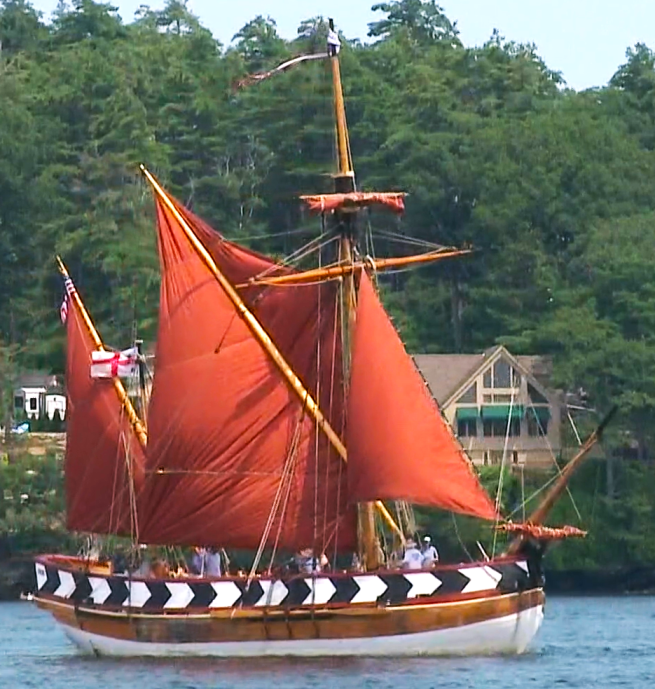
- The ship, which they named Virginia or Virginia of Sagadahoc, was a pinnace, a small tender. Even so, once a supply ship arrived in 1608, they were able to use it to abandon the new colony and sail back to England. The small ship not only made it but later returned to the New World.
- The second and third “local” pinnaces (Deliverance and Patience) were built soon afterwards in Bermuda following the loss of Sea Venture, another story altogether. Let’s just say that conditions in Jamestown were dire.
- One of the Popham colonists, a young boy named David Thomson, was intrigued enough to return in 1623 to the mouth of the Piscataqua River and briefly lead the settlement in what’s now New Hampshire. That plays into my Dover book, even though he vanished before he could claim any title. His colleague Edward Hilton, however, stayed on and earned due rewards.
- Gosbee also told me that one of the Popham leaders had also received a major inheritance during his New World sojourn. Hearing the news of his windfall, he joyfully headed a return to Merry Old England on the new ship.
- The site of their colony later served the bunkers at Fort Popham and Fort Baldwin on the opposite side of the river, defenses against intruding vessels. The beach, meanwhile, is a very popular state park with some of the best swimming along the Maine coast.
- The Jamestown colony, meanwhile, could be the basis of a big, juicy, scandalous streamed series. Folks who are opposed to “woke” would be truly rattled by the turns in Virginia’s origins.
- A replica of the Virginia now has naval scholars wondering about some of the rigging. She is a most unusual vessel, from today’s perspective.

 Jnana's Red Barn