Fishing for the purchase document by the Bucks led to Fisher A. Buck, who bought our Cape from Lucy M. Hooper, Anne Dodge, and Mary Roberts in July 1875, beginning a century of family ownership, the longest span in the property’s history.
Who were the three women? They lived in Boston and Brooklyn, not Eastport. And they weren’t Shackfords, as far as I could tell.
The Bucks, on the other hand, saw many changes in the place.
Sometime after urban mail delivery was established during the Civil War, the stylish front entry, with its vertical mail slot and side panel windows, was added, followed at some point by the downstairs two-over-one sash windows, perhaps larger than the originals. (When we replace them, do note, there was significant rotting.)
The house narrowly averted destruction when the 1886 downtown fire that started in a cannery just below our house and continued northward along the waterfront, destroying 160 homes plus stores and wharves. The rafters in our house were intensely charred, though. The Bucks would have also installed the electrical knob-and-tube wiring, along with indoor plumbing and the small bathroom.
The two large ells shown on the 1855 and 1879 maps were removed, for whatever reasons, eliminating the small courtyard on the back of the house. We can speculate about their uses, a horse shed in one and a kitchen perhaps in the other. Or perhaps one was a cabin that first sheltered the Shackfords while the deep cellar was being dug for the bigger main house. As for a woodshed? Why not?
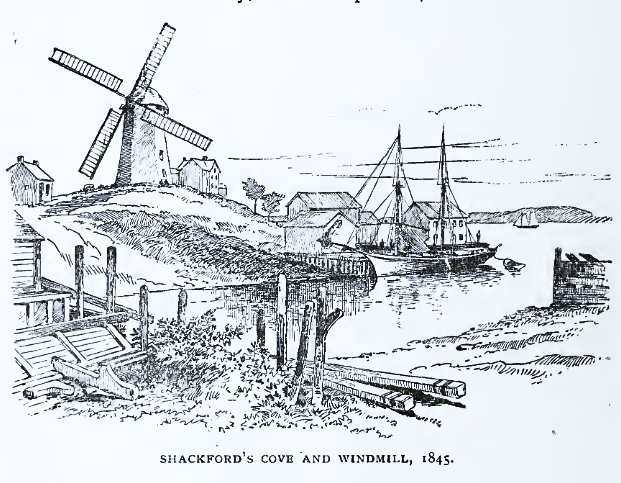
Over the Bucks’ time, portions of the foundation were replaced or upgraded, and a mudroom was added, slightly smaller than the ell it replaced. The two dormers may have also been added — they’re not obvious in the 1879 map of Eastport though they may be the two white dots and there are none in an 1847 sketch of the windmill where the house appears in the background. (Windmill? We’ll get to that later.)
Significantly, there was at least one chimney fire and perhaps one or two additional house fires, as well as the downtown fire of 1886 that charred the rafters.
Quite simply, it was a different house when it left the family than when it had entered it.

 Jnana's Red Barn