
Around here, this can happen well into spring.
You never know what we'll churn up in cleaning a stall
Around here, this can happen well into spring.
Or more properly, in the northern hemisphere, today is the vernal equinox, derived for the Latin vernal for “spring” and equinox for “equal night.” And that means it’s officially spring, even if there’s still snow on the ground or a blizzard in the forecast.
For folks south of the equator, today’s the beginning of autumn.
Either way, the date usually falls on March 20 or 21 – the 19th is more of a rarity, with the next one not until 2044. (Hmm, looking that far ahead, I’m not seeing any on the 21st. I’ll let the experts argue.) The problem arises in the fact the Earth doesn’t circle the sun in exactly 365 days – there’s that nagging quarter-day that gives us our Leap Year and its February 29, which we just passed.
That said, let’s allow ten other items spring up. Remember, in much of the world, we’re coming out of hibernation, of one sort or another.
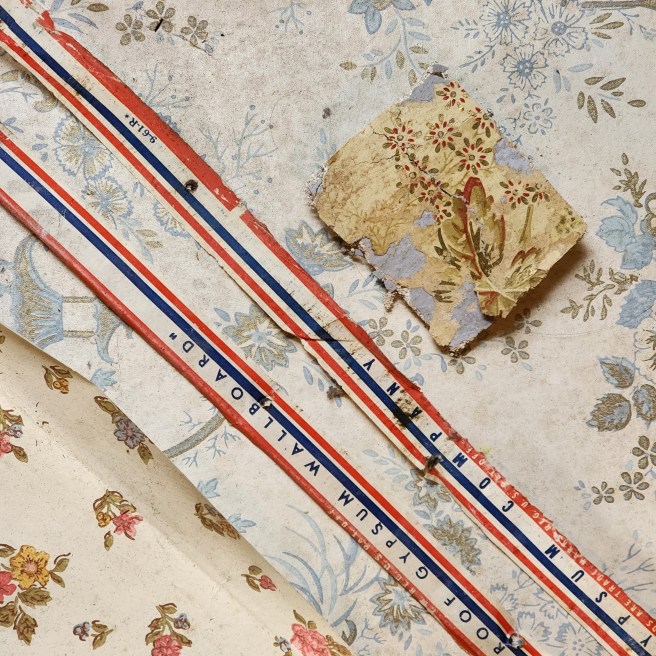
Old wallpaper is part of an old house history. Some of it’s showing up inside old closets, not that we have many of those.
While Tom Wolfe charged that no great novel sprang from the hippie counterculture, a challenge akin to the holy grail of the great American novel, his quest overlooked some fine stories that reflected any of its many dimensions.
Among the gems are the three self-published novels of DeVillers’ Eve Chronicles, grounded in the author’s experiences in moving from her native Wisconsin to the Pacific Northwest, where she spent several years – harsh winters included – with a crew in the rugged mountains of eastern Oregon replanting forests in the wake of clear-cut logging. I had heard of the legendary Hodads in the western part of the state (they took their name from the short-handled pick/spade they used), but DeVillers’ case gently probes the realities of the marginal existence and the varied types of people it attracted. Though this was not the Haight-Ashbury stereotype of the era, it was one of the counterculture’s many flavors. She was definitely back-to-the-earth throughout the span of the books.
Another was the holistic health-care work she took up in what she called a nomadic life before settling down in the Willamette Valley, where the Chronicles continue, again reflecting the conflicts of living out deeply felt values.
She began writing the novels after being diagnosed with MS and drew on her spiral-bound notebooks as source material. (Fortunately, those had survived her many moves.) I love the fact that she’s not inventing stories or characters but distilling what she’s known firsthand. She presents scenes – even aromas and lighting – I’ve experienced, too.
I was going to say her tone is reminiscent of Joni Mitchell but now see the singer was an inspiration. How right, then.
She was working on a manuscript about the health care industry and big money and big politics set in the Covid pandemic, but I don’t know how far she had gotten with it.
works if you know
the proper pronunciation
Long, thin wedge in the bay
Hollywood stars summer palaces
Somebody’s mansion and grounds all alight

Phosphorescent water
stirred up into tiny fireflies,
sparks
plankton summer
a summer home
on an island in Maine
is here
and there, too
After a week or more of finetuning the ridgepole and columns, Adam was ready for more drama. It was time for the old roof and rafters to go.
By now, much of the time the work was mostly loud reverberations punctuated by pounding and thuds within the top half of our house. Most of it mystified me. It often sounded like a war zone, especially when the air compressor kicked in. Not that I’m complaining.
Here we were, six weeks and thousands of dollars later and nothing we’d done was of the sort that would appear on a flip-this-house kind of a video streaming channel – the superficial changes that one local inspector we know dismisses as “lipstick.”
You do have to love an old house. Or, for perspective, an old lover.
Now we faced the decisive moment. Off with the back half of our upstairs!
A large, “rolling” dumpster was in place.
 That saw appeared like the fin on a shark.
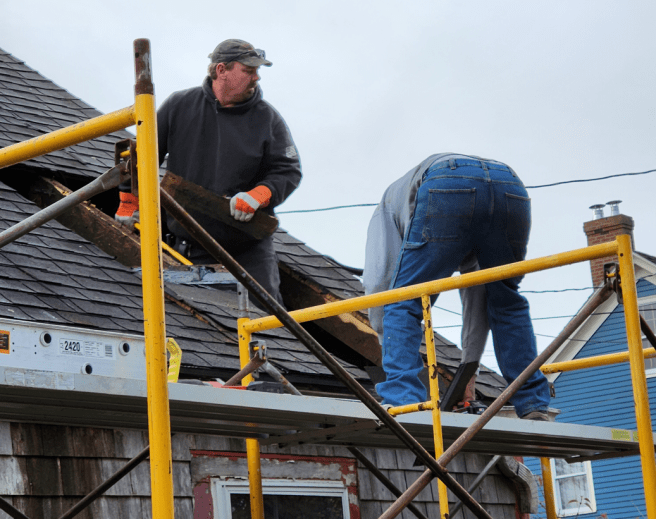
And then the roofing was removed in panels.

We got an idea of what a deck up there would be like.
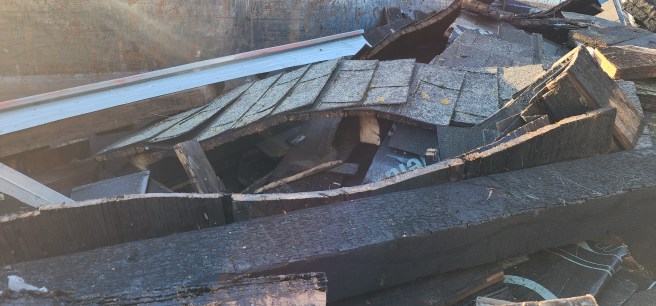
The dumpster quickly filled.

In the general course of human nature, a power over a man’s subsistence amounts to a power over his will.
Alexander Hamilton in Federalist No. 79
Since coming among Quakers, I’ve known the last of what my grandpa called the old-order sort. Almost all of them, in fact. The ones who dressed in Plain-style clothing and used the thee-thou everyday speech.
My, that seems like a long time ago now.

In Whiting
 Jnana's Red Barn