Burnt Trailer
Month: March 2024
Bunny parade
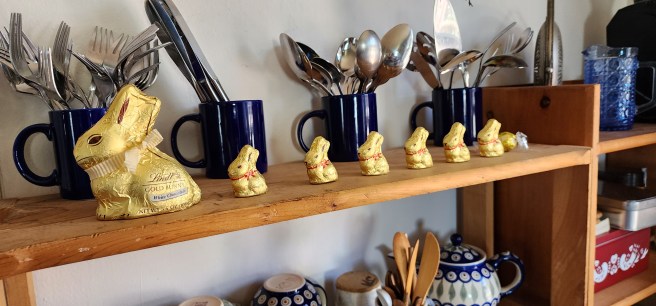
She knows I love white chocolate. And it does remind us of the pet rabbits who’ve graced our home and often nibbled away at it.
Fine carpentry, too
Jesus was a carpenter, after all, surrounded by fishermen and their boats. Maybe he built a few to float, too.
the curve of the deck – sheer
ours noticeably higher at the bow
than even the stern
while the crown with its sides
for water runoff

a dutchman
a piece of wood
cut in
to replace a rotten section
ditto in our home
Weatherproofing the new exterior came next
We now faced some related decisions, beginning with the kind of roofing.
Our preference was for standing seam metal, but we were concerned about the price. It would, however, allow for a lesser roof pitch, and that would give us more headroom, and that was in addition to its added durability.
Asphalt shingles may be less expensive, but we live in a heavy winds-prone town. The forecast seems to have gale warnings every other day, at least for small craft out on the water. After a strong storm, the streets and yards are littered with blown-away shingles, even from new houses.
As I said, living beside the sea exposes us to a lot of wind.
~*~
The next decision involved the color. There were more standard color options than I’d thought from casual observation.
We liked bright red and the bold cobalt, at least for homes out in the country, but ours is tucked into a tight neighborhood and we wanted to continue to blend in. Our goal was something subtle but still classy. The color of the metal would also determine the shade of trim we would be applying later, maybe around the foundation, too.
We settled on a pale blue, which we find is common around the neighborhood.
There was far more to do up there than we could see from the street, and far more steps than simply putting the metal sheets down.
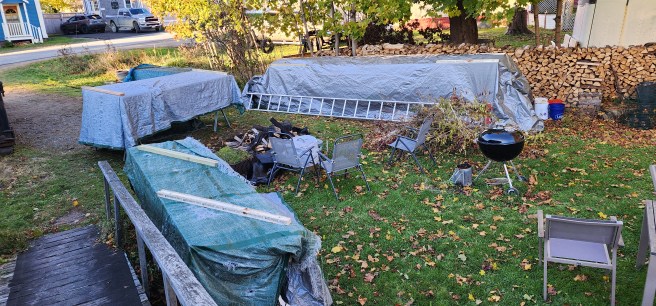
With condensation as a consideration, a vapor barrier went up. Strapping and rigid-foam insulation boards were fitted and secured. A weather-resistant fascia went around the trim. As did flashing.
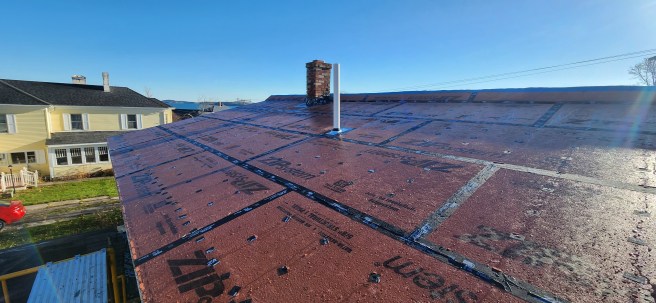

And finally, we had the metal roofing itself.


After several setbacks from bad weather, Adam and Keith worked like maniacs over the weekend to have it securely in place before a hurricane-force storm – and then Christmas, a storm of a whole other nature.
~*~
As for the exterior walls, new cedar shake shingles were a given.
Haunted by a big bad Wolfe in a white suit
“You’ll be the next Tom Wolfe,” one creative writing prof promised me. I loved the guy’s flashy writing and, for the most part, his subject matter.
Where he eventually rubbed me wrong was his consternation that no big novel of the hippie era had appeared. There, he kept ringing as a prompt for me.
Part of his hook for me was the fact that my dream job in the newspaper world would have been as a columnist, especially one like Hub Meeker’s State of the Arts in the Dayton Journal Herald. Arts journalism was, alas, a shrinking field, along with the more general community columnist, like that paper’s Marj Heydock or Binghamton’s Tom Cawley.
Wolfe had briefly been one of those, at the New York Herald Tribune.
The bigger part, of course, was about that novel. He was dismissing Richard Brautigan’s unique voice altogether and others, like Gurney Norman, John Nichols, Tom Robbins, who rode the vibe.
Wolfe was also snidely suggesting that he had been the one exception, with his Electric Acid Kool-Aid Test, which really wasn’t a novel and predated the blossoming of the hippie movement.
His idea of the Big Hippie Novel reeked of the misguided quest for a Great American Novel.
Quite simply, there were too many strands of the movement to fit into a single book. Political or social action, anti-war witness, civil rights, gender equality, environmental awareness, organic and vegetarian foods, intentional community, group housing, alternative education were all part of it, even before the sex, drugs, rock’n’roll, hair, fashion, or slang.
These other factors would come more fully into play when I revised Daffodil Sunrise into Daffodil Uprising, and Hippie Drum and Hippie Love into Pit-a-Pat High Jinks.
I’d like to think of those books as nominees for the Big Hippie Novel distinction.
Wolfe’s charge also overlooks the outstanding nonfiction books that reflected the experience, such as Zen and the Art of Motorcycle Maintenance.
Moreover, I still feel that many of the difficulties in the current political scene arise from a failure to clearly understand the demons raging from the Vietnam conflict, both for those who fought in the army and those who fought the unjustified war itself.
So here we were, struggling through disco without having faced the lessons of either the hippie outbreak or the Vietnam disease. Hippie had become a dirty word, and many who had been happy to be one were no in psychological denial. It was something nobody wanted to relive either, apart from maybe Woodstock.
As others have observed, an ignorance of history carries a heavy price.
On the Senate as a court of impeachment
… the senate, who will merely sanction the choice of the executive, should feel a bypass towards the objects of that choice, strong enough to blind them to the evidences of guilt so extraordinary as to have induced the representatives of the nation to become its accusers.
Alexander Hamilton in Federalist No. 66
Not that anyone else cares
The fact is I’ve gone through much of life with a vague sense of incomprehension or at least in a blur.
Perhaps I shouldn’t care, either?
Sushi and me

I remember hearing the poet Gary Snyder back in the late ‘70s talking about his years in Japan and some of the cuisine he discovered, not that he exactly used the artsy menu term.
Sushi? My, how times have changed! I just wish we had a seafood bar of note here in Sunrise County.
Even if I do create a rather acclaimed sashimi.
‘An audience makes me nervous’
Like an editor staring over a reporter’s shoulder as a news story comes together?
Just what are you doing, anyway?
Even with a saw and hammer?
Some sterling libraries I’ve encountered
No, not the Library of Congress or Manhattan’s flagship facing Bryant Park, though I’ve been in both, or even Boston’s impressive Copley Square hub. Two of those were unable to put their hands on the volumes I was seeking and had no idea where they’d gone.
Instead, let me praise some other collections that have given me joy. Unless otherwise specified, they’re public libraries.
- The Lilly Library at Indiana University in Bloomington. It’s one of the premier rare book compilations in the New World, with impressive rotating displays in the front gallery and, for the more adventurous, access to original materials in the reverential reading room. Samuel Johnson’s Ramblers, John Jacob Audubon’s bird books, and Gary Snyder’s poetry broadsides are a few of the treasures my fingers and eyeballs explored there, along with a lingering fondness for African violets that graced its sills. The earliest books published and the much earlier manuscripts are often breathtakingly beautiful, even when you don’t understand the language.
- Indiana University graduate library. On a much bigger scale, it was a wonder, opening in my senior year. Hard to imagine just how much came into my purview there, back before the Internet, especially in regard to esoteric sides of contemporary poetry as well as the pioneering field reports from the Bureau of Ethnology in the American Far West. When I returned to campus as a research associate, I had faculty access and borrowing privileges.
- Dayton’s classical record collection and librarian. As a youth, I wasn’t the only one she guided to fantastic discoveries. Not just classical and opera, either. I still recall a very early Bob Dylan album that supposedly never existed.
- Case Western Reserve Historical Society. Sitting near the Severance Hall and the Cleveland Museum of Art om University Circle, the society’s genealogical collection is justly acclaimed and proved to be a great help when I set out to research my own roots. Much of the material was donated by the Trumbull County public library in Warren, Ohio, where I was living, and while that meant driving an hour away, I still have to admire the wisdom in assuring that the materials could be more appropriately curated and made more widely available. The local library, I should add, was solid – it even had a hardbound copy of John Kerouac’s first novel – the one before he became Jack.
- George Peabody Library, Baltimore. With its visually stunning ante bellum or art deco atrium (what I remember could be either), the collection itself was once part of the adjoining Peabody music conservatory. Its genealogical collection was impressive but didn’t match my areas of research. Still, it was delightful just to sit in that airy space.
- Binghamton, New York. There was something timelessly proper about this institution fronting a green.
- Fostoria, Ohio. Its straight-shooting director, Dan (if I recall right), cut back on the number of best-sellers on the racks and invested instead in paperback copies of more timeless books, which he then had turned into hardbacks. The savings in cost added up. For a small blue-collar town, 16,000 population, the collection had surprising depth. For me at the time, the range of the Tibetan Buddhist volumes was unexpected. Somehow, one donor had even presented a beautiful translucent marble wall for a big part of the front of the building.
- Camden, Maine. The picturesque town of 5,200 year-‘round residents triples in the summer, including a large dose of old-money wealth. The town was one of the few did not have its building donated by philanthropist Andrew Carnegie in the late 1800s. When, over time, its celebrated 1927 Colonial-style brick home demanded expansion, the result was a much larger space underground in the neighboring park. The 1996 result is quite striking and delightful, almost an homage to hobbits, in fact, with the older building still sitting like a hat overhead. As one measure of the town it serves, I’ll point to the opera section of the CD collection, much of it donated by patrons. It seems to have everything and then some.
- Needham, Massachusetts. The large paintings by N.C. Wyeth overlooking the tables in the periodicals room was reason enough to stop by. He called the town home.
- Swarthmore College, Pennsylvania. Being able to access William Wade Hinshaw’s filing-card drawers of typed extracts from Quaker Meeting minute books is a genealogist’s dream come true, as is the ability to examine historical microfilm pages from Ireland and England without having to leave the country.
Oh, my. I could add more. The North Carolina Quaker Meeting minutes archived at Guilford College, for one. The Chester County Historical Society’s library in West Chester, Pennsylvania, for another. The community outreach in Watertown, Massachusetts, or Dover, New Hampshire, or the Peavey Memorial here in Eastport, Maine, for yet more. Meanwhile, what do we do a digital library? Consider Earlham College in Richmond, Indiana, with its online historical trove of Quaker writings presents both the original page and a readable transcription to flip among. As a researcher, it’s quite amazing to be able to read these books and tracts in the comfort of your own home rather than having to fly to London or some other distance for the only available copy.
Or complaints about some others where I’ve lived.
In my estimation, a good library is an essential component of public social vitality.
 Jnana's Red Barn