This was turning into a more serious project than simply raising the roof.
Had we merely replaced the covering itself – either with asphalt shingles or upgrading to metal – without expanding our usable floor space on the second floor, we would have been glossing over serious structural issues. It’s a miracle the roof held as long as it did. One insurance company had cancelled our homeowner’s policy when it saw the photos of the roofing, and another insisted on a replacement within a year. That route would have been a very expensive band-aid in the end.
We had a dream of making better use of that space, as you’ll see. And now, after three years, we finally had someone to pull the project off.
As a starter. Adam needed to address some serious structural issues.
Was anything holding our roof up? It may seem strange to find that concern intensifying as we set out to remove it and its rafters, but we would need something to keep half of it up while the other half got ripped away. As an additional complication, we’d be living in the house rather than gutting it and starting over.
The absence of a ridge pole meant there would be nothing to hold up the front half of the roof when the back half came away for the new. Its lack also meant the existing ridge wasn’t straight but rather serpentine.

Adam had to make room for a ridge pole between the existing rafters. It was tedious and required some precise calculations.
Structurally, all the weight of the roof for nearly 200 years was directed outwardly to the walls – and, as he was finding, they weren’t exactly perpendicular.
Now he needed to have something to support the weight of the ridge pole and roof, too. That meant constructing four columns from the crown of the roof down to the cellar – one on each end of the house, the other two spaced in-between. That required going through two floors as well, plus building concrete pads in the cellar.
This was time-consuming work, and he was racing winter weather. We had reason for concern.
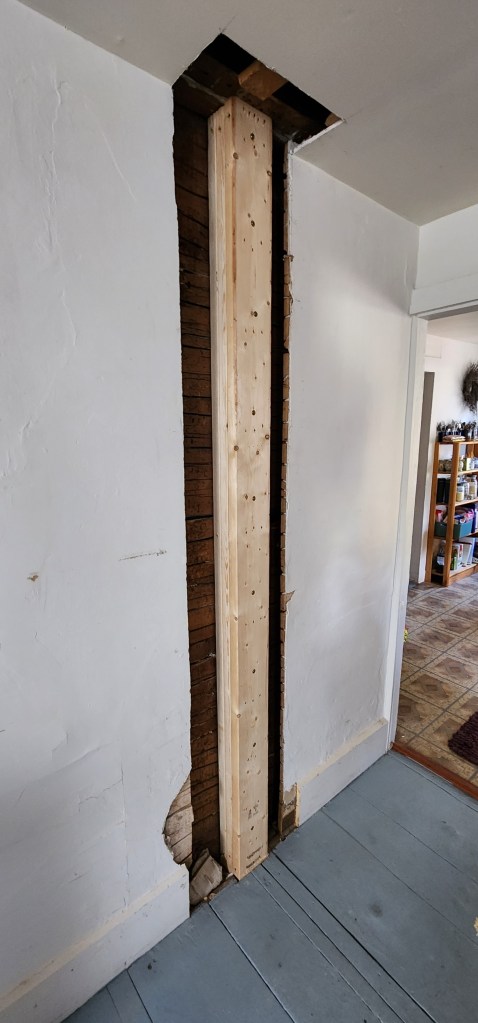
As these findings sank in, we realized our earlier option of just putting new shingles on the existing slope would have done nothing for real issues lingering underneath. Even without raising the back wall or consolidating the dormers in front, we would have had a larger problem waiting to erupt overhead. Living beside the ocean exposes us to many gale-force blasts. It’s a wonder the roof hadn’t gone years ago.
After taking some deep breaths, we appreciated what our contractor was telling us. Now, just exactly where was the center of the roof or the alignment down under? He did have some amazing laser tools to determine that.
We were really glad Adam was a pro, maybe more than the others working in town. He was definitely earning our trust and respect.

 Jnana's Red Barn