Let’s fill in some more blanks

Some people sit down in the depth of winter to peruse seed catalogs and dream of harvests. We’ll be doing some of that in our household, and you’ll no doubt sample some of the results here.

Some find it a good time to revisit highlights from the previous year or further back. Yup, that too.

The snowy months also offer delightful travel opportunities, and not just to warmer climes. Even if you stay close to a wood fire or the equivalent, taking time to sift through brochures can stimulate plans for trips long or short later in the year. Consider my upcoming posts based on my week on the waters of Penobscot Bay at the beginning of autumn in that vein.

Quite simply, retirement and winters aren’t a blank stretch in my life.

~*~

One movie I viewed as a kid in the Dayton Art Institute’s tapestry-walled auditorium left a lasting impression on me. I think the film was scheduled to be shown outdoors but this was the rain site. What I do recall is its presentations of windjammers racing along under full sails. I was still far from any actual encounter with the ocean or sailing, but from that point on I did realize I had no interest in a traditional cruise, or what I’ve seen as a floating nightclub. No, if I went out on a cruise, it would be under sail. Not that the option quite came in front of me.

Instead, the closest over the years were jaunts on ferryboats in the Pacific Northwest and then the Northeast, along with whale watch daytrips and, especially, my boss’ 32-foot sailboat in the Gulf of Maine.

One impression I gleaned from those outings is how differently a geography fits together when it’s experienced from its waters rather than its land. That awareness certainly came into play in my history research for Quaking Dover.

Being on the water filled in some blanks.

~*~

As a lover of maps, from childhood on, I’ve also learned how the mere fact of being in a place transforms the charts. A location becomes real when I’ve walked around in it. Or, as I learned in my time on Penobscot Bay, if I’ve walked around in a boat just offshore.

Listening to new friends in Maine presented a series of towns I could place only vaguely – Castine, Stonington, Brooklin, Islesboro, Southwest Harbor – along with related locations like Vinalhaven, Isle au Haut, Blue Hill, Swan’s Island (not to be confused with Swan Island in the Kennebec River), or Little Cranberry. I could nod along with a blank look. My week on the water filled in more of that comprehension.

Now, let me fill in the name of the ship in question here – the Lewis R. French – and the fact she was a schooner, a very special distinction, as I would learn.

And as you’ll see.
When it comes to a home, how did you settle on the ‘right’ place?

Two dozen years ago, in our previous homebuying round, I created a list of 20 definitive items we could rank on a scale of one-to-five, only to discover that the particularly hot sellers’ market and our price cap rendered the exercise useless. The harsh reality simply didn’t present us choices to evaluate. The best we could do was simply check off Yes or No. If a place passed, we then had to beat other bidders to the punch. Forget quality and personal style. Was it habitable in its current condition? Did it fit our needs?

For the record, we were not, then or now, seeking an idealized suburban house with a white picket fence and an immaculately manicured yard. As you can imagine from this blog, we were open to something funky or organic, what some would even define as “character,” a place that could breathe and grow with our lives.

In the end, we simply lucked out, as you see in the Red Barn postings from New Hampshire.

In our recent downsizing to the other end of Maine, we had a less pressured, more leisurely pace in the market. High on my checklist was walking distance of downtown, the health center, and the arts center, plus a view the ocean, even only a glimpse between neighboring houses, and a workspace for my writing and related projects, though that could be much smaller than before, now that I’ve largely moved away from paper.

Other participants had their own priorities, including a large garden with full sunlight. As for a kitchen? Let’s just say that potential can be a checklist item of its own.

Neighbors and security are largely a wild card.

And, three years later, after several false starts, we made a bid that was accepted.

What we knew was that the place needed a lot of remedial work. And, oh yes, it had lots of potential.

In our recent homebuying round, a right property hadn’t popped up to a consensual acclaim. Some dwellings were closer to demolition than restoration. Others had been renovated in ways that were simply puzzling – a prime memory was the placement of the only bathroom behind a master bedroom. One modest house had four, maybe five, stairwells, enough to leave me lost indoors – I’m still intrigued by the quirkiness though I can’t pick out the place now from the exterior. Let me also admit that passing on an 1820s’ residence I really liked was ultimately the smart decision. The last one had been owned by the publisher of an early newspaper here, though that wasn’t the only thing I liked; once the kitchen deficiencies were made obvious, I understood why I was in the minority in that case.

As for the winner of our quest, I must admit the house didn’t grab my attention, not until the larger vision was shared with me.

The listing had been on the market for the previous three years or more. It needed work, serious work, but it felt good inside, as others have told me afterward, even though the house is cold through much of the year, as I’ve even read in the archives of the local newspaper. A strong attraction is the natural light throughout the rooms. Our house inspector was impressed that the bones were good, especially the foundation – up to 18 inches thick in places. Were we up to the challenge of reviving the place? Life’s an adventure. I expected our low bid to meet rejection.

Instead, the seller accepted, clearing out most of our cash savings.

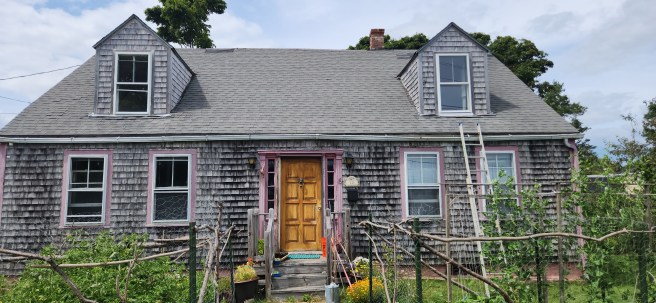
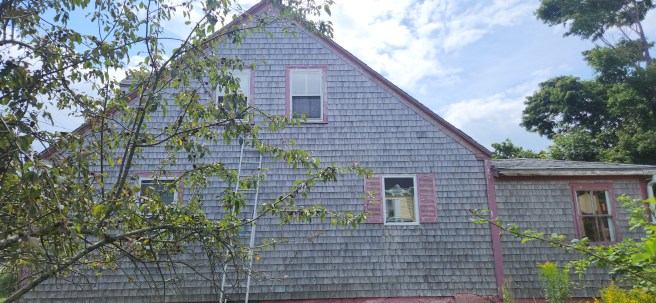
So here we with a classic cedar-shake siding full Cape dating from around 1830, although the real estate blurb placed it in the 1860s.

What has amazed me is the other participants’ envisioning of the renovations for this new venture. Not just the big, bold actions that inhibited my own thinking, but also many details that deliver a pleasurable, significant impact.

And that’s the beginning of this old house renovation story. As it unfolds, I hope you’ll pipe up with ways you’ve made your own dwelling a home a sweet home. Or, for that matter, of how your own projects required three times as much time and money than your best estimates presented.

Whatever the case, please enjoy the upcoming posts over the year. Not that it will be the only series here at the Barn this round.

Write about what you know, but best if it leads into what you don’t know

I’ve spent a lifetime writing – well, from my senior year in high school on.

I rather fell into a career as a newspaper journalist who worked mostly on the copy desk or a few steps beyond, with titles like news editor, lifestyles editor, makeup man (working closely with the production crew in what was called the back shop or, more politely, composing room).

My real dream was to have something more permanent as my legacy – books with my name on the cover and the spine. The fact was that as much as journalism engaged me, I yearned for a bigger picture than the daily deadlines usually reflected.

And so I spent much of my “free time” writing things that would never appear in a newspaper – poetry and fiction, especially, or even lengthy letters to friends and other writers. And, more recently, there’s been the blogging, which I hope you’ve been following.

Many of those years I despaired that my “serious” work would never appear as printed books, especially once I discovered how much effort was required to land even one poem in a small-press literary journal.

The persistence has resulted in eight books of fiction to my credit plus more than a thousand published poems and a few chapbooks.

The most successful entry has been Quaking Dover, a history of one of the oldest Quaker congregations in the New World.

~*~

As my diamond jubilee year wraps up, I’m reflecting especially on those eight books of fiction and the life that’s produced them.

You’ve heard the adage, of course, “Write about what you know.” But I’ve come to see how important it is to also write about what you don’t know, especially where it’s at the edge of your existing knowledge. I am among those who write as an attempt to make sense of something personal, which means being something of an explorer or discoverer or laboratory technician. A good writer, I’m thinking, wears many hats, at least of the proverbial kind. Let me confess I rarely wear a hat of any kind, though I should, considering the balding and sunlight and many skin cancers.

Drafting a story is work, even on those rare and exhilarating flashes when it seems to write itself and you’re flying too fast to worry about spelling or grammar or other details. But it’s not the most difficult part of the practice.

Revisions, I should emphasize, are everything. Or at least the hardest part, and the more essential part of writing in the hope of a readership. I find that in hard revisions I discover more of what I’m coming to know.

With my focus on Quaking Dover for the past three years, I’ve neglected my earlier books. Returning to them this year feels like a good exercise, for you, dear reader, and for me.

One of the regular weekly features here will be on things behind my books. The stories themselves already speak on their own.

Please stay tuned and tune in.

I hope this won’t be polarizing

Seems fitting in this presidential election year that we revisit what the Founding Fathers envisioned in crafting their new nation.

I was fortunate to study under and work with Vincent Ostrom at Indiana University. As a professor of political policy and administration, he led me in a close examination of the logic underpinning the Federalist, a series of historic papers that argued for the passage of the proposed Constitution. His resulting book, The Political Theory of a Compound Republic (1971), and later volumes presented a much different understanding of the workings of democracy in the United States than I had found in the more conventional, top-down perspectives. He dubbed the overlapping jurisdictions a polycentric system, or a “compound republic” in the words of the Federalist, and found in it flexibility as well as layers that ultimately enhance democracy.

Through the coming year, the Red Barn will present weekly excerpts from the arguments written by James Madison, Alexander Hamilton, and John Jay but at the time attributed to the nom de plume Publius.

Let me admit that it’s been years since I last opened my thoroughly marked up copy of the collected papers, a trade paperback I bought for $2.45 back in 1968. I’ll probably be embarrassed by some of my notes in the margins and perhaps also surprised by some of the phrases and sentences I underlined while overlooking more profound insights on the same page.

In this round, we’ll stick with the original text, apart from the titles I’m applying. The prose looks quite different to me than it did more than a half-century ago, even without all the recent political turmoil we’re seeing.

What is ‘home’?

The definition, like that of “family,” can be complex and elusive.

I’m looking at home as someplace much more than where I sleep at night or eat the majority of my meals. It’s more than a house or an apartment or even a tent, for that matter, even though for much of my life, my address has felt more like an encampment before I arrive, well, at what’s truly home.

The Biblical sense of sojourning matches much of what I’ve experienced, pro and con.

Think of a sense of comfort, for one thing, and belonging, for another. Not everyplace I’ve dwelled has measured up there. Rental units have always had limitations on how much you can personalize the space, even to the exclusions on painting the walls. And who knows what happens when the rents or lease go up.

As much as my native geography and its character are imprinted on my soul, the house I grew up in isn’t. How curious. As for family? I’ve now spent the majority of my life on the Eastern Seaboard, mostly New England. Four years in the Pacific Northwest were especially transformative. Yet deep down, I’m still a Midwesterner, though one now amazed almost daily by the movements of an ocean close at hand.

The place I’ve lived longest is Dover, New Hampshire, in an 1890s’ house that’s appeared often in this blog. As “home,” it had shortcomings, but it was where I built my own family, did some very serious writing and revising, ate marvelous food we had raised in our garden, delighted in some extraordinary neighbors (especially Tim and Maggie), delighted in the parties and guests we hosted, and thought I would spend my final moments within. Well, I almost did – but that’s another post or two. As I told the kids when we moved in, I would be in a pine box when I left.

Not that my plotline wound up following that course. It might have, actually, if my elder beloved daughter-slash-stepdaughter hadn’t whisked me off to the emergency room in time for a cardio-stent.

Back to the bigger story. As I retired from the office, it became clear we needed to downsize. I won’t go into details, but my elder daughter/stepdaughter (those distinctions blend for me but not everyone – room for many future blog posts) fell in love with a remote fishing village at the other end of Maine. And then, so did her mother. My introductions to the place were positive, but even though I had begun some intense decollecting and downsizing, and was well ahead of the others on that front, there was still a long way to go. Besides, I was in the midst of a major writing project and knew how long it would take to get back in gear if I packed up in the midst.

Even so, after a few furtive efforts, we bid on a property that had been for sale forever and were accepted. I was promptly dispatched to keep an eye on the place – essentially, as a writer’s retreat.

It needed, to put things succinctly, tons of work. But somehow, it’s felt more like home than anyplace else I’ve dwelled. As you’ll see.

Some things I’m anticipating in the year ahead

  1. Sitting beside our newly installed wood-burning stove on otherwise chilly mornings and evenings.
  2. Completing the second phase of our upstairs renovations along with moving into the back half up there, including my book collection when it comes out of storage.
  3. My second week on the water in the schooner Louis R. French.
  4. Revisiting my journals from the Baltimore years on.
  5. A magazine orgy.
  6. Renewed time with the Bible.
  7. Using my passport. We do live right next to Canada, after all.
  8. Events at the arts center.
  9. Continuing Quaker worship face-to-face rather than Zoom.
  10. Scallops in season as well as local blueberries, cranberries, lobsters, and crab.

Get ready to meet some crucial writers along my journey

You’ve no doubt heard more than one person boast that their life could be a book, perhaps even adding that it would make a fortune and lead to fame. Perhaps you even shuddered because this was somebody who doesn’t read books, somebody essentially uninterested that way. As a fellow writer once quipped, he could simply look at a page and tell immediately if the creator was a reader.

The fact is that good writers are also devoted readers. We are inspired by good models, informed by their content, and strengthened by their style and structure. They give us standards to measure up to, excellence to aspire toward, and frontiers to explore. They caution us against getting lazy or complacent.

As my diamond jubilee winds down, I find myself reflecting on novelists and poets and a few others who have accompanied me at some crucial stretch in my writing and editing practice. I’ve come up with a list of 50 plus one.

It’s a quirky list, with an emphasis on those who have been influences at one point or another. Sometimes just one book is enough to leave an impact. I’m not calling these “favorites” – much of my pleasure reading isn’t necessarily that original or elicit that spontaneous “Oh, wow!” reaction. Think of what I’m presenting as godfathers and godmothers of a work. These have served as touchstones or charm stones, elders, wilderness guides, guardian angels. They weren’t there to be imitated or copied but to provoke, definitely, and sometimes comfort.

Over the coming year, I’ll present one a week. They’ll run alphabetically – by first name, just to shake up expectations.

Feel free to name your own personal top writers in the comments as we go. If you’re a reader, one name will lead to another.

Onward!

Looking forward while looking back

Somehow, each year here at the Red Barn has taken on a special spin, despite the merry-go-round sequence of postings, categories, themes, and tags. Or maybe because of that.

While I keep looking forward to “retirement” of some kind, new material for this blog hasn’t let up.

Last year, many of my recorded dreams became a regular presentation, but I’ve run out of those. Previously, prose-poems had their run. Newspaper Traditions are now far in antiquity. And many of my poems are available at my Thistle Finch blog for reading or download. Yet I’m living in a newer, much different, world, lucky me.

Many of this coming year’s postings are shaping up as once-a-week series.

Now that the house renovations are actually happening (Huzzah! Huzzah!), you’ll be seeing that progression on Saturdays. I mean, how many times do you get to watch an old house be torn apart and rebuilt while the residents are still within it? As we were or let me say are.

My week out on Penobscot Bay in a historic schooner provided enough text and photos for a series on Sunday mornings. For me, it’s still dreamy. Hope you see it that way, too.

With a presidential election coming up, I’m returning to a clearer understanding of what’s at stake based on the Federalist papers through excerpts you’ll be seeing on Thursdays. It was that or some childish and more current quips of my own. I see this as more principled.

As a break in my Quaking Dover book reflections, I’m turning to a series looking at what’s behind my published novels. See that in contrast to “what they’re about.” That series of posts is set for Fridays.

Add to that is a series on Mondays, looking at authors who have influenced me one way or another. They’re not necessarily my “favorites,” but definitely ones I want to revisit in my years ahead.

Meanwhile, the Tuesday Tendrils, ten items about whatever strikes my fancy, will continue, as will the Sunday night Kinisi.

I promise you these posts will encompass another full year. Please stop by often, and leave comments, especially. I still think your contributions are the best part.

Happy New Year, dear readers.