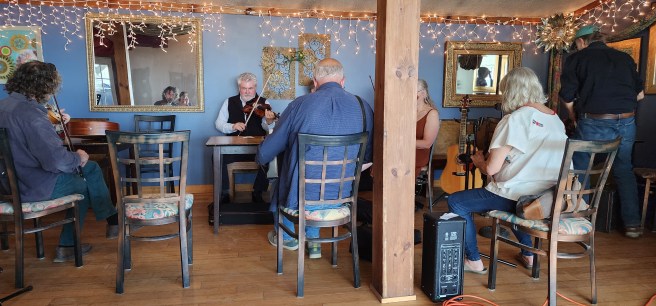
The second-Saturdays afternoon event at a local tavern is already full of fine memories, including a visiting famed Irish fiddler shown here. Its core is MICE, the Moose Island Contradance ensemble. That space was soon filled with other players.
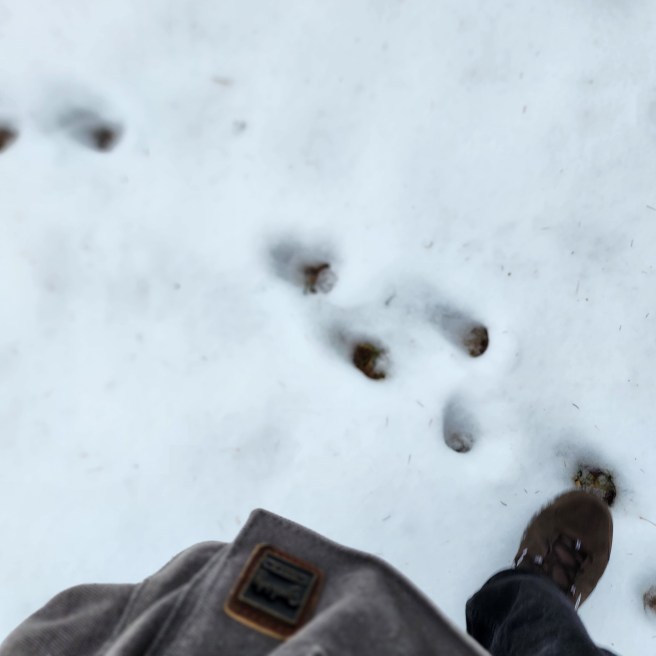
You never know what we'll churn up in cleaning a stall
The second-Saturdays afternoon event at a local tavern is already full of fine memories, including a visiting famed Irish fiddler shown here. Its core is MICE, the Moose Island Contradance ensemble. That space was soon filled with other players.
Back in New Hampshire, our veteran carpenter/electrician had proclaimed how fascinating he found the underpinnings of an old house – what people usually call a basement, though in New England, it’s more likely to be a cellar. I’ll explain the difference someday, if I haven’t already in an early blog post. Rick said probing around the underbelly gave him insights into the soul of the residence.
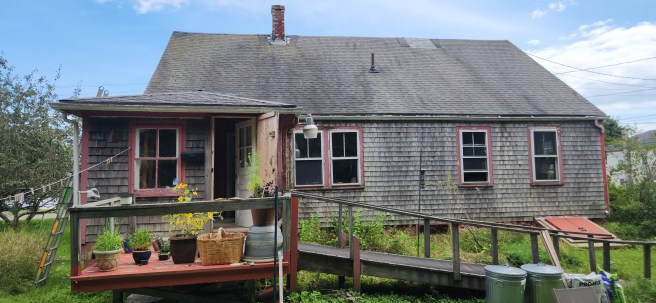
He would have been impressed by our new residence at the other end of Maine, a post-and-beam full Cape with a mostly stone foundation up to 18 inches thick.
From our previous homebuying experience, which landed us in an 1890s three-story New Englander, we knew we’d face some immediate issues. At our new address, the ones that we able to address all involved the cellar.
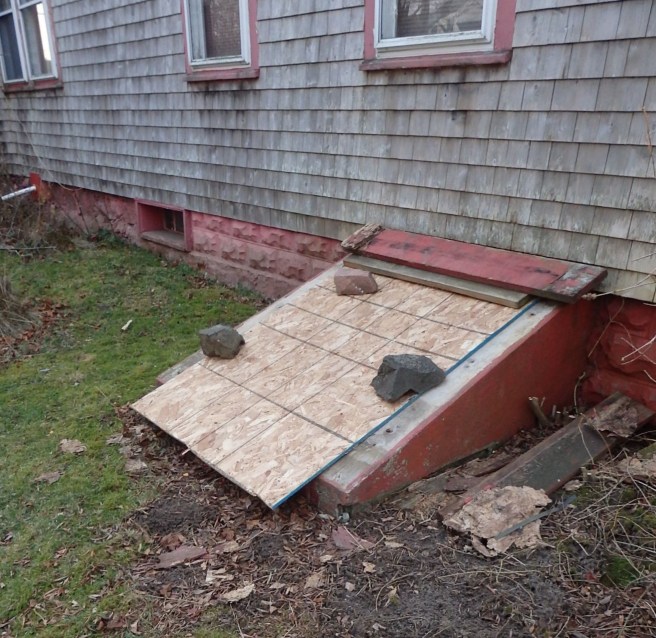
The major issue needing to be addressed was the condition of the roof, as the insurance company insisted.
Complicating the situation was our intention of raising the rafters themselves and changing the two dormers to gain more usable and much needed space on the second floor.
The big problem was finding a contractor to take on the project. You’ll hear more on that in later installments of this series.
We simply couldn’t afford to replace the existing roof cover only to rip it off in a year or two. So we were in an anxious limbo, one that intensified with every blustering nor’easter.
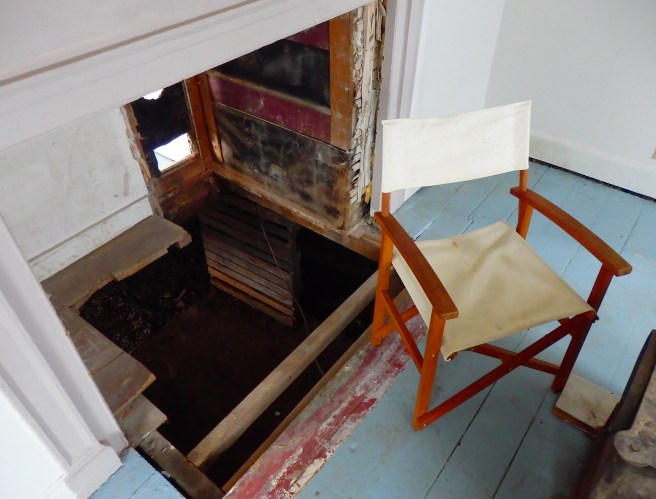
In the absence of someone willing to tackle the roof and its restructuring, we did eventually find a carpenter to address the serious floor sloping on the main floor. I do joke about being able to tell through my bare feet that I’m in an old New England house even if I’m blindfolded, so I’m not surprised our floors weren’t dead level. But structural sinking is another concern, and raising portions of the downstairs floor 5½ inches did cost us surgeon’s rates – or “away” pricing, as others told us later. It’s still not perfectly flat, but ours is an old house. For a view of that work, see Now Leveling Our Cape, posted March 8 of last year.
One benefit was that we can now use the washing machine without having it walk during its spin cycles into the cavity where the chimney had been and then crash into the cellar.
Maybe you remember the definition of a sailboat as a hole in the water into which your pour endless amounts of money.
An old house is a hole in the ground into which … as perhaps you already know.
Most of my literary writing has been done on the fly, amateur work on the side while pursuing a professional career in newspaper journalism. Early on, I was shunted from newspaper reporting to editing, with the advice that writers were more numerous than good editors. Was I really that good?
I can see now that stepping away from reporting allowed me the space to develop as a writer in ways I find more fulfilling.
My dream had been to be a fine arts columnist along the lines of Hub Meeker at the Journal Herald when I was growing up, or even as a more general columnist, as I was my senior year at Indiana University, but the reality was that such openings were few and far between. As I see now, I could have written freelance columns in my free time and offered them to my employers, showing them what I could do, but I needed to grow on other fronts as I worked myself through those early years. Much later, as one of my bosses said somewhat wistfully, “You have a life,” a very full one outside of the newsroom. Or workroom, in a wider perspective.
Besides, had I been writing a column, there would have been no energy for what I poured into the literary efforts instead.
My personal writing arose as an attempt to make sense of what was happening within and around me, often in chaotic times and remote locations. A college English teacher had left me with an appreciation for abstracting a detail to make it more universal, and thus more available for a reader to connect with personally, and I’ve seen that as a challenge for anyone writing literature. Unlike a news reporter, who is required to maintain an anonymous tone even when is or her byline is on the story, a literary writer has to be a more fully human presence.
In revising Quaking Dover, I discovered how difficult inserting myself into the text could be after one early reader suggested I develop the tone of a gently laughing curmudgeon narrator she sensed.
If only that weren’t my last book, one based on historical facts, I might have extended the perspective to my earlier novels.
In retrospect, I must admit that failing to concentrate on one stream of writing rather than many has been a mistake. I don’t lament writing poetry and fiction, but trying to span them can be seen as diluting the energy. Was it mistake, too, to not try breaking through as a columnist on the side when I was laboring as an editor? And ditch all the rest?
Nonetheless, my novels hew closely to what I encountered over a half century at fringes of American society or social consciousness, or how I’ve navigated through that to here. They also reflect my vision that a better way of life is possible, call it the Kingdom of God, if you will, but still more peaceful and just than the clasp of empire slash consumerism today.
In fiction, my stories are not just “me” who’s the protagonist. Sometimes, it’s “her,” instead. And sometimes that “me” is off to the side. As for others in the scene? They’re often composites of folks I’ve known, hopefully so disguised they won’t recognize themselves. How do you protect and respect their privacy, anyway? I’ve never wanted to be one of those authors whose family and friends hate what’s been done to them.
In the long run, you can tell me if that was a smart move or rather chicken.
~*~
Four of my eight novels spring from the first one that was published, though it’s no longer necessarily the starting point for readers, nor the endpoint. Another three are now also interwoven into one sweep. As for the eighth? Despite all the abstractions and switched genders, they’re ultimately semi-autobiographical and originate in an attempt to comprehend and remember what I could of some profound upheavals I’ve experienced. As has America and the rest of the world, in the background.
Here I am, about to reflect on those books over the course of this year and to share with you some of the personal encounters that underpin those stories.
While my poetry was written largely while having a full-time and often demanding job, the fiction came bursting forth largely in a break in Baltimore but then underwent huge revisions during weekends and vacations once I was back out in the workaday world based in New Hampshire.
My work was seen as experimental, though I now retranslate that as experiential. And once the novels appeared in ebook formats, I’ve welcomed the flexibility for revision and evolution, even if nobody else was noticing.
My self-imposed sabbatical in Baltimore was the source of a first-draft lode I revised intensely over the following decades. Hunkered down out in a suburban apartment for a year in my mid-30s … hmmm, a time that felt like midlife crisis or impending defeat … but with some unexpected savings I could live on for a year. (Having a company car turned out to be a huge benefit in the two years leading up to this.) And then?
I was newly divorced and then abandoned by my subsequent fiancée, laid off from a job that had exposed me to the emerging struggles of the American newspaper industry as a whole, and in the midst of a spiritual exploration that was leading me to unexpected frontiers.
Now that the novels have been out there for any who are interested, I’m feeling free to talk about many of the personal experiences that underpin them. Surprisingly, though, I find the process is far more secretive emotionally than I ever would have admitted.
… it seems to have been reserved to the people of this country, by their conduct and example, to decide the important question, whether societies of men are really capable or not, of establishing good government from reflection and choice, or whether they are forever destined to depend, for their political constitutions, on accident and force.
Alexander Hamilton in Federalist No. 1
 Winter snow makes the crest of Katahdin, Maine’s tallest mountain, visible from 90 miles away in Wesley, Maine. A clear sky helps, of course.
The view is from State Route 192 just off the heavily traveled S.R. 9.

Maybe you can still pick it out with less zoom and a little more context.
Last year, a spate of deaths altered my position in a greater hierarchy.
First, a cousin born a few months before my dad, passed, having reached 100. Shortly after his death in 2009, we had a fruitful exchange of correspondence answering many of my questions about my grandparents, which now appear as Dayton’s Leading Republican Plumber on my Orphan George blog.
Also participating in that exchange was my dad’s youngest sister, who was halfway between him and me in age, as it turned out. She, too, died this year, shortly after her husband. They were the last of the generation in my close linage. So I’m now the eldest male in my grandfather’s descendants.
The year also had a series of deaths in Dover Friends Meeting, including a former clerk, a cherished elder (bishop), a fine minister, a very dedicated longtime treasurer, and a prominent social activist. That leaves me as the oldest surviving clerk of the congregation but living a distance away. The collective memory shrinks, in effect.
What I’m left facing is the reality that there’s no longer that umbrella of older, wiser figures over me, sheltering or guiding me. Instead, that’s now my role in reverse. Frankly, I feel inadequate.
It’s a responsibility, all the same. And a debt.
Living as far north as I do, just a hair below the 45th parallel halfway between the north pole and the equator, I’m starting to keep an eye out for the Northern Lights on clear nights through winter. Moonlight, clouds, precipitation, and pollution all block viewing, but our remote location means that many of our nights can be visually crisp and rewarding for those who bundle up.

They haven’t quite matched anything I’m finding in my field-guide books.
How curious that he should lead the parade. When my own poetry practice was taking root, back in the early ‘70s, I was largely unimpressed compared, say, to Bob Dylan. I didn’t pick up on the gay dimensions, either, only the rage of Howl. In fact, though I had some poetry courses, I wasn’t blown away by much of anything until I encountered Anne Sexton and Sylvia Plath’s searing despair. Everything was essentially head, not heart.
Over the years, my opinion of Ginsberg changed. I came to appreciate his lines that stayed close to their source of inspiration and the ways his poems faced current events. While much of his artistic voice is seen as an homage to Walt Whitman, I find his work is much more in the stream of the lives of the prophets in the Bible. I’ve come to love a masterful, righteous rant for justice, which his poems often are. (Just see my Trumpets of the Storm series, starting with Primary Care at my ThistleFinch blog).
I’ve also come to admire the seeming ease with which he presents an observation – his definition of New England as famed for red leaves comes to mind.
His 1973 collection, The Fall of America: Poems of These States, has been the volume I’ve returned to the most.
Despite his role as an avatar of drug highs or gay rights, he strikes me increasingly in his native Jewish robes more than in those of the Tibetan Buddhism he avowed. Maybe for that, you should read the book The Jew in the Lotus by Rodger Kamenetz.
Yeah, here we are already, with one author leading to another. But first, where is my set of Whitman?
 Jnana's Red Barn