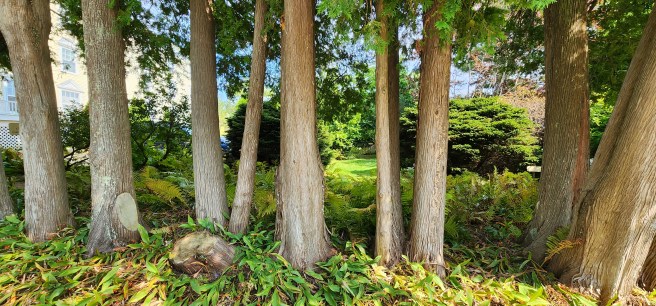
Can a location be a fictional character, too?

In my big writing projects, landscape and geography have formed a major thread.

It’s most prominent in the novel that became Nearly Canaan, which is outwardly more about tensions with an unstable spouse, the trials of career ambitions, and a sequence of three locales that culminate in volcanic explosion on all fronts. Perhaps raising a personified landscape to the fore would have been too melodramatic, but it was an option I’m now seeing I overlooked. You know, the fantasy genre.

Even so, places are a primary ingredient in my fiction and poems.

My four years in the desert of the Pacific Northwest were a revelation. I felt myself on the brink of everything I had hoped for. It seemed embodied in the landscape, including the ways the Indigenous presence resonated in the earth itself.

And then everything exploded and I was, essentially, exiled from Eden.

By the time I could hunker down to collect the debris, I was on the East Coast. I had also lost the extended elation of feeling that my big breakthrough as a poet was about to happen.

I’d say I’ve leaned toward celebrating the good and lovely sides of life – a hopeful optimist, though I loathe that term – but I finally recognized in later revisions the importance of acknowledging the ugly, too, and the overwhelming desecration that’s occurred across this land and the globe despite what I saw in the better sides of the hippie alternative.

~*~

I am a visual person and even considered a livelihood as a painter or graphic designer or architect back when I was in high school. Being named editor-in-chief of the Hilltopper ultimately changed all that. Well, much of my journalism career included selecting and cropping photos and designing newspaper pages. My visual art training wasn’t neglected altogether.

From early childhood on, I loved maps. Hiking and primitive camping in a rogue Boy Scout troop abetted that awareness. Growing up in flat Ohio, I imagined mountains. Even a bump on the horizon, say Mount Saint John in neighboring Greene County, seemed vast, at least on our bicycles. An ocean was inconceivable. The mountains I experienced were the Appalachians, especially a stretch of the Appalachian Trail we Scouts backpacked between my fifth- and sixth-grades. Those magnificent and dreamy heights didn’t have the craggy snowcaps that had captured my imagination, but they did introduce the sensation of being somewhere near heaven and looking down on the world, the way God would. (At least as I would have seen it then.)

Add to that history and historic places. Old log cabins and their unique smells are among the memories imprinted within me. I probably read the entire shelf of Landmark Books’ profiles of famous people in sixth grade, if not third.

In the middle of my sophomore year of college, I transferred from my hometown to the Bloomington campus of Indiana University, where I had hiked and camped in the surrounding hilly forests, but this was a more distinctive locale than I realized in my leap toward a degree.

I mention all this because I’m seeing how much a specific spot on the map has been an element of my poetry and fiction.

An important twist came when I was living in the yoga ashram in the Pocono mountains of Pennsylvania and our teacher, an American woman, returned from her first trip to India. She said the reason Hinduism has so many deities is that many of them reflect the unique vibrations – as she said, vibes – of the different locales.

Thus, it’s not just how a place looks but also how it feels with your eyes closed. Maybe even how it smells.

I hope I’ve conveyed that in my writing.

Subsequent relocations took me back to Ohio and Indiana, on to the mountains and interior desert of Washington state, and then, in exile as it felt at the time, eastward to Iowa, another corner of Ohio, and finally Baltimore and the year of intense keyboarding I’ll describe later. After that, I headed north to New Hampshire and now an island in Maine.

So here we are, wherever.

Castine thickens the plot  

If you’ve been following my Red Barn, you know about the 400th anniversary celebrations of Dover, New Hampshire, as the third oldest permanent European settlement in New England and the seventh oldest in the continental USA.

That history does underpin my book Quaking Dover, after all.

As I point out, that “permanent” adjective can become a real ringer, in contrast to “earliest.” “Oldest,” for both the town and its Quaker Meeting, can also be defined as “continuous.”

Don’t be surprised to hear me admit that I keep learning a lot more after researching and writing the book. Some of my newer findings will be posted here at the blog later this year. I’ve already shared the experience of visiting the Pemaquid village site in Bristol, Maine, a settlement that interacted with Dover’s early years.

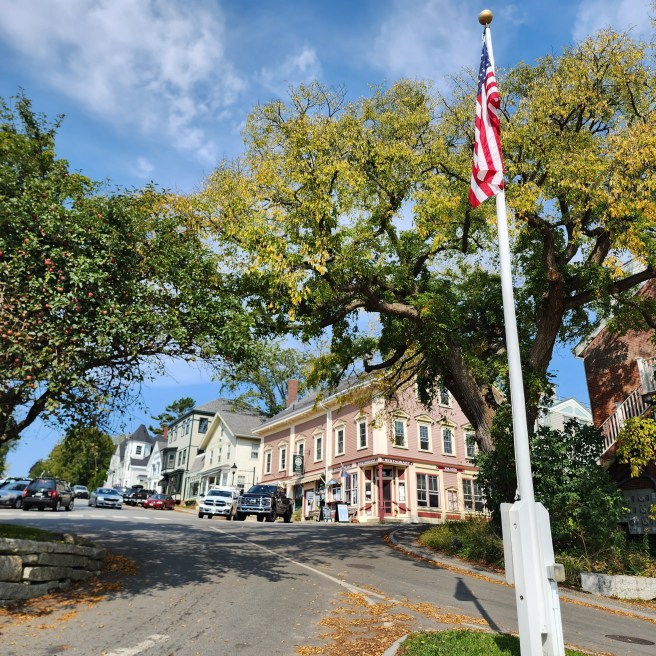
Castine as seen at the landing.

The Castine development at hand arose while killing time between the Common Ground Fair in Unity, Maine, and my setting sail a day later. Or, more accurately, boarding ship with a buddy from Vermont for our first overnight in the vessel before casting off and hoisting the sails the next morning. Literally. Peter joined up with us for a night at the Airbnb before he and I ventured off together. That left us with a day to fill. On a whim, I suggested a land excursion as an alternative to the Farnsworth American art gallery or the transportation museum down the coast. Peter was game, and besides, he knew the town and accompanying waters.

Our destination was the town of Castine, which I had heard of as the home of the respected Maine Maritime Academy and as one of the eastern Maine towns that surrendered without a shot during the War of 1812, along with Eastport and Machias.

He drove, freeing me to observe the winding scenery on the eastern side of Penobscot Bay. It was less upscale and less developed than the U.S. 1 corridor linking Searsport, Belfast, Camden, Rockland, and Rockport – more “real” Maine, if you will.

Coming into Castine, however, a sign jolted me: Founded 1613.

What I read soon after that pointed out that Castine was settled before the Plymouth Bay colonists we know as Pilgrims started building in 1620. (Remember, they never called themselves that, but rather Separatists and the like.)

The claims made it sound like Castine was the oldest European settlement in New England.

Still, it didn’t show up on the lists I examined nor on those that Dover’s celebration committee referenced. The problem is just how many, if any, settlers remained in Castine between the many invasions and changing of flags from French and British to Dutch and American over the years.

Still, looking at the murky history prompted me to revise some of my thinking about Maine’s past.

For one, Castine was occupied by the French during the years of fighting when English settlement was erased all the way down the state to a toehold at Wells and York and on to New Hampshire.

That also had me looking at the French and Indian wars through Canadian lenses. That point of view presented the village of Norridgewock along the Kennebeck River as a French settlement, the headquarters of Jesuit priest Sebastien Rale, including a church he erected in 1698. The English, on the other hand, considered it a Native encampment.

Rale worked to ensure French control of the region, with events escalating into what is known as Father Rale’s War, at least in English versions where he is sometimes presented as the commanding officer in the attacks. Native accounts take more credit for their own leadership and skill.

The conflict culminated in the destruction of Norridgewock in 1724, including the death of Rale, a chief, and nearly two dozen women and children. French control of much of Maine faded in the aftermath, much earlier than I had believed. English settlement did, in fact, resume much earlier than the 1763 Treaty of Paris that ended the final French and Indian War.

At that point, Castine – named for Baron Jean-Vincent d’Abbadie de Saint-Castin, a 1667 arrival – was turned over to the British. And how!

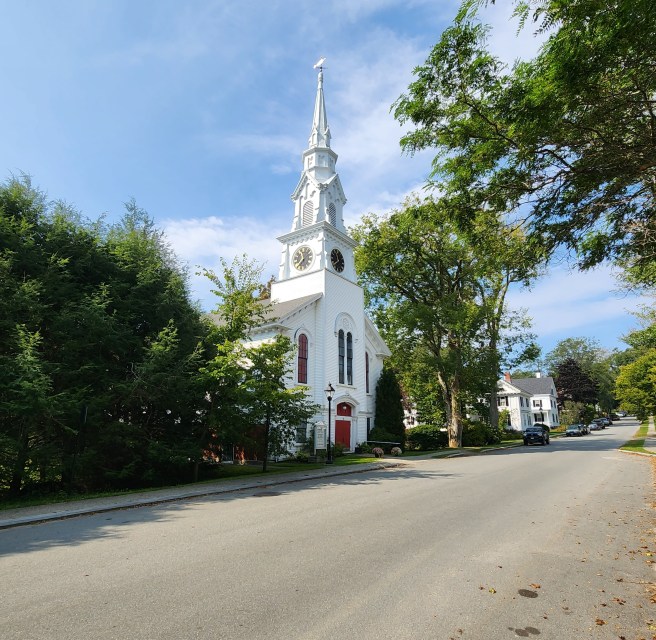
The Common, with the Unitarian church at the left.
Congregational church.
Birthplace of the Maine Maritime Academy.
Post office.
Side street.

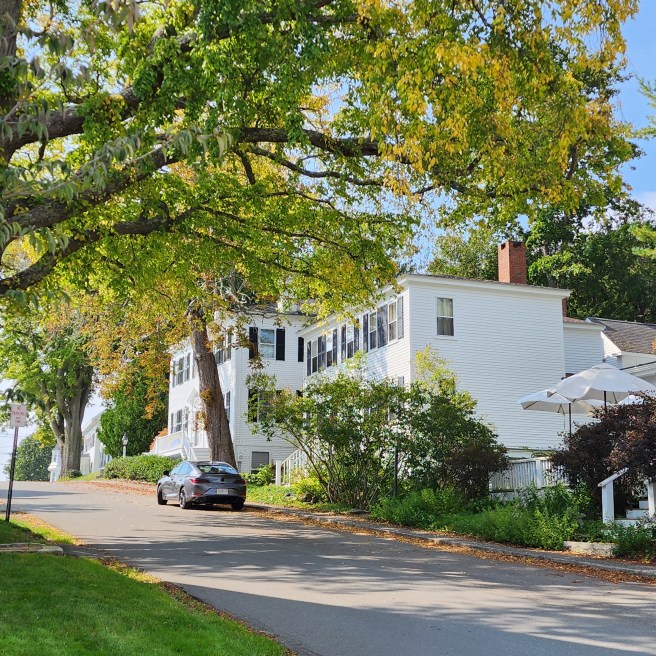
An influx of Massachusetts colonists of Puritan and Pilgrim cast gave the town a distinctly Yankee character that remains, perhaps more than anywhere else in Maine.

The down dock is an active place.

I love the town
with its Yankee Puritan flavor unspoiled
contrary to old-money haven Bar Harbor

Here’s what bugs me about ‘The Summer I Turned Pretty’

For reference, I’m focusing on the Amazon Prime video series, not the earlier books.

  1. Pop songs as a running commentary or an alternative dialog. This isn’t opera.
  2. The lack of positive male role models.
  3. The maudlin playing of the brothers’ mother’s death, especially after she’s gone. It definitely reduces her to a two-dimensional character.
  4. The fact it wasn’t filmed on Cape Cod, contrary to the story. The color of the water is wrong and the McMansion is so out of place, ultimately. Even the beaches are wrong. Where are the lobster boats?
  5. The way the story keeps evading the richer possibilities of polyamory or outright incest, which it keeps skirting. Instead, if the projections are correct, season three is going to veer off into one brother or the other, but not both together. That’s why I’m thinking I’ll be tuning out.
  6. Superficial treatment of so much.
  7. The flashbacks feel like a riptide. Just where are we at this point?
  8. The presence of a commercially published novelist as a major character. (I would object if she were a successful painter or actress or other fine artist for that matter – it’s simply rather incestuous creatively.)
  9. The way our Ugly Duckling’s mother, the writer, has so many lines of wisdom. She could be speaking in paragraphs.
  10. The difficulty I have in following slang, even when it’s the difference between “big bitch” and something else as an equivalent of beloved girlfriend.

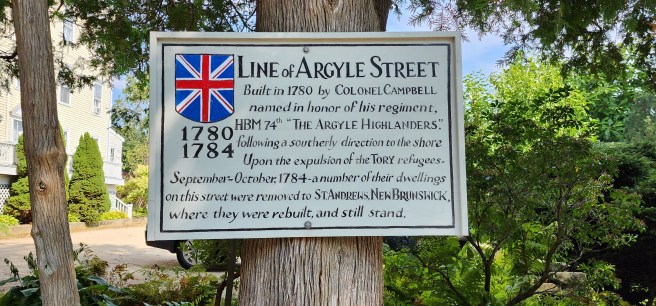
Argyle street

This marker in Castine, Maine, reflects an often overlooked side of the American Revolution. Some residents who had opposed the revolt were forced to leave the new country.

Many of these Loyalists packed up their houses, walls and all, and rebuilt them in settlements in New Brunswick, Canada, near where I now live. Their descendants are active on both sides of the border, as I’m learning.

Acid test short-story master: Andre Dubus (1936-1999)

Short fiction is something of stepchild when it comes to literary respect in America. Novels get the serious attention, and the bigger royalties, yet as I discovered once I opened a collection by Andre Dubus, “Finding a Girl in America,” a short story can deliver much more than a rambling bigger tale. I quickly devoured two more of his compilations.

I came across his work too late for it to influence the early versions of my novels, but I deeply appreciated his craftsmanship and freshness. Though I’m far from the no bullshit, Cajun/Irish Catholic in a wheelchair in a dilapidated New England mill town character he was, the directness of his writing and his first-hand knowledge of blue-collar life in the Merrimack Valley resonated with me. I lived upstream of Dubus for 13 years and then just to the north, and there’s nothing fictional in his stories, from my perspective.

Before I had read any of his tales, bits of quirky encounters others had with the author, including the sharpness of his teaching had floated my way. Especially telling were the free weekly sessions in his home after an errant car had left him, in his words, a cripple sound much livelier than anything he had probably been doing at the now defunct Bradford College across the street from a friend of mine.

After I started blogging, one follower, an English professor, commented that he liked how much my posts reminded him of Dubus. I won’t go that far but did feel honored, all the same.

I do need to add his son, Andre Dubus III, to my TBR pile.

Schooner or later

Ships come in all sizes and shapes, and people aware of the differences see vessels that float quite differently than the rest of the population. Well, it’s like looking at birds and then birders.

Living beside the ocean I had learned to differentiate a sloop from a schooner, or so I thought. Both have triangular sails, with sloops having just one mast and schooners, two or more.

Not to be confused with square-riggers, the kind of tall-mast ships most people envision from history. Or so I once did. You know, Old Ironsides, the USS Constitution, or even the Mayflower, however much smaller.

As for triangular sails, like those on sailboats. Not quite accurate when it comes to schooners. There’s something called a gaff … creating the hip-roof look of a schooner’s sails.

The Bowdoin of Arctic exploration fame.

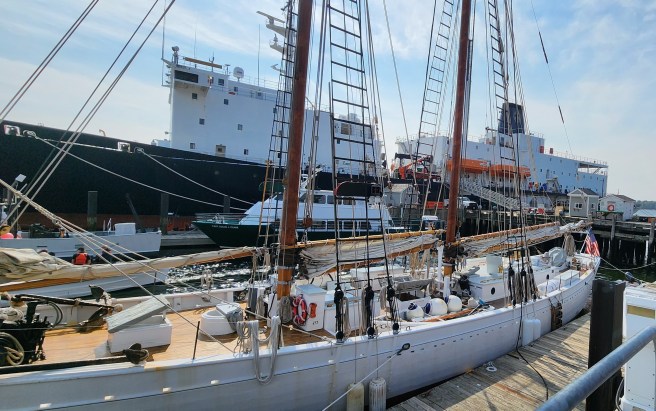
My closeup introduction to a schooner came in a side trip earlier in the day I would step aboard one for my virgin voyage that will inform later posts. To kill time, so I thought, my buddy and I headed off to Castine, then a hole in my inner map of Maine, apart from references by friends.

And that’s where I was introduced to the Bowdoin, now named for the college of the same name but more importantly a historic vessel used by Donald Baxter MacMillan in his Arctic expeditions. Quite simply, she was designed to withstand incredible freezing – and did. I’m now wondering how the crew did, under those conditions.

That said, she was a schooner. I had seen one docked in Eastport, but this time I had a curator at hand to explain the distinctive parts.

Emphatically, it is not a square-rigger.

Schooner, as Dutch, it’s not SHOONER, after all, as my New Amsterdam Dutch-descendant Peter could easily point out, yet from deference, hasn’t. (Do I get points for noticing?)

Typically, a crew of 2½
two men and a boy
no cook?

an average life of 25 years

for a wooden ship
(owned in shares
spread the risk and profits)