Ships come in all sizes and shapes, and people aware of the differences see vessels that float quite differently than the rest of the population. Well, it’s like looking at birds and then birders.
Living beside the ocean I had learned to differentiate a sloop from a schooner, or so I thought. Both have triangular sails, with sloops having just one mast and schooners, two or more.
Not to be confused with square-riggers, the kind of tall-mast ships most people envision from history. Or so I once did. You know, Old Ironsides, the USS Constitution, or even the Mayflower, however much smaller.
As for triangular sails, like those on sailboats. Not quite accurate when it comes to schooners. There’s something called a gaff … creating the hip-roof look of a schooner’s sails.
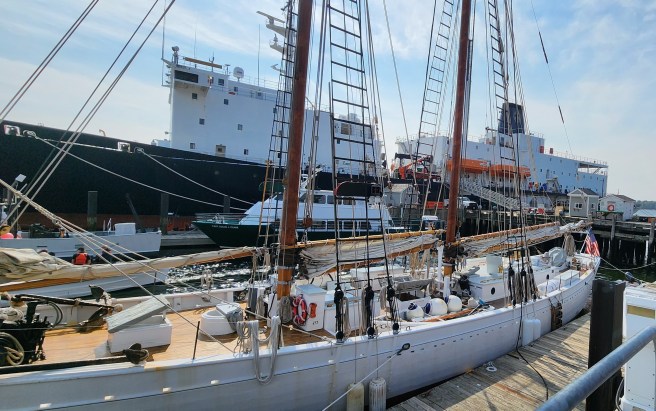
My closeup introduction to a schooner came in a side trip earlier in the day I would step aboard one for my virgin voyage that will inform later posts. To kill time, so I thought, my buddy and I headed off to Castine, then a hole in my inner map of Maine, apart from references by friends.
And that’s where I was introduced to the Bowdoin, now named for the college of the same name but more importantly a historic vessel used by Donald Baxter MacMillan in his Arctic expeditions. Quite simply, she was designed to withstand incredible freezing – and did. I’m now wondering how the crew did, under those conditions.
That said, she was a schooner. I had seen one docked in Eastport, but this time I had a curator at hand to explain the distinctive parts.
Emphatically, it is not a square-rigger.
Schooner, as Dutch, it’s not SHOONER, after all, as my New Amsterdam Dutch-descendant Peter could easily point out, yet from deference, hasn’t. (Do I get points for noticing?)
Typically, a crew of 2½
two men and a boy
no cook?
an average life of 25 years
for a wooden ship
(owned in shares
spread the risk and profits)

 Jnana's Red Barn