
Edmunds Township
You never know what we'll churn up in cleaning a stall
Edmunds Township
It’s one of those days when I can’t put two and two together as one.
The random notes in no particular order continue:

I get to sample the results of many experiments around here.

My first encounter with concrete and minimalist poetry came as an art exhibit in the late ‘60s. Maybe I already knew of otherwise traditional verse presented typographically to represent a visual image on a page – a vase or bird, perchance – but this time, the words themselves took on an independent visual wonder. Think of Robert Indiana’s famous LOVE as a cube of giant building blocks.
The writer I most appreciate in this field is Aram Saroyan, the son of a famed Depression-era novelist. Aram came to fame at age 20 with a one-word poem:
which became a source for right-wing scandal when it won a $750 award from the National Endowment of the Arts. As conservatives charged, it wasn’t spelled right and it wasn’t a real poem anyway. Things got ugly.
Others, me included, find it a vibrating both in the thought and the image. If that silent “gh” adds something to the sense of the word, either as illumination or as featherweight or even carefree, why shouldn’t two intensify the sensation?
It revives that wonder and puzzlement we’ve all felt, but many writers, I think, more keenly, when we first encounter many quirks of the English language but then later glaze past.
In this vein, Saroyan also has a playful
as another entry.
His small collection, Pages, has traveled from one side of the continent to another with me. A downside of these works is that they don’t work at an open mic or featured reading. They really do belong to the page.
For my own ventures along these lines, check out Sun Spots and Drumming at my Thistle Finch blog as well as the weekly Kinisi entries here at the Red Barn.
Where do fruit flies come from
even in the dead of winter?
So who was Louis Robbins French?
Father of the three sons
who built this in South Bristol, Maine

The French is 101 feet overall, 65 feet on deck, with 19 feet of beam, as the brochure proclaims. She draws 7.5 feet with a full keel. A proven vessel in all conditions, she is a nifty and quick sailor, having won the Great Schooner Race many times. The French has also participated in recent Tall Ships gatherings in Boston. It spent part of its life based out of Lubec just south of Eastport.
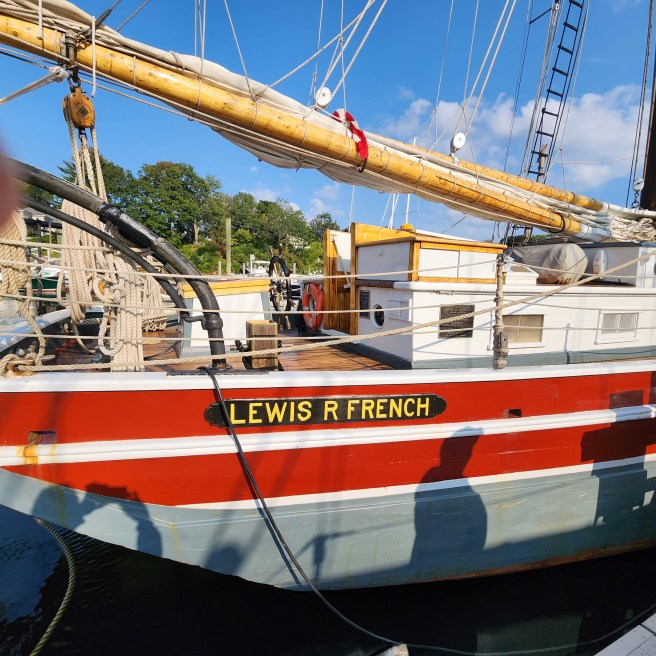
the French was largely stripped and gutted
and rebuilt for passengers
what’s left?
As my buddy Peter grinned at me at the end of our week:
“Your first love. You never forget.”

That’s Moose Island Contras Etc., a very fine traditional country dance band with a very fine caller. We do have fun around here.
With a sense of despair regarding the roof project and our lack of a contractor on the horizon, we went ahead and set about erecting raised garden beds for what would be my third summer of dwelling here. We would try to leave some space for a contractor to get at the house, should we ever, ever, find someone.
During one of the inevitable conversations with passers-by while installing the garden and its fencing, a trusted neighbor mentioned that she had just had some carpentry done by a former student, someone who had returned home after living and working away. She gave us his name and phone number, and an introductory conversation followed.
Yes, he could do the project, and he thought in could start at the end of August. I was startled when he said that was the upcoming August, not a year off. Could it truly be?
Naturally, there were delays while he wrapped up some other commitments, but we did find ourselves in a stunned state of disbelief when work finally began in earnest at the beginning of this past October. We finally had a contractor who not only showed up on the morning he promised, but also on the dot of the hour.
He hit the ground running, methodically, precisely.
At the heart of our big project is a new roof on the house. Not just the asphalt shingling, which itself has needed replacement – we could have found someone to do that – but the actual shape of the supporting rafters themselves. To gain much-needed interior space, the walls on the second floor are being raised. That structural work’s the complication. And how, as you’ll see.
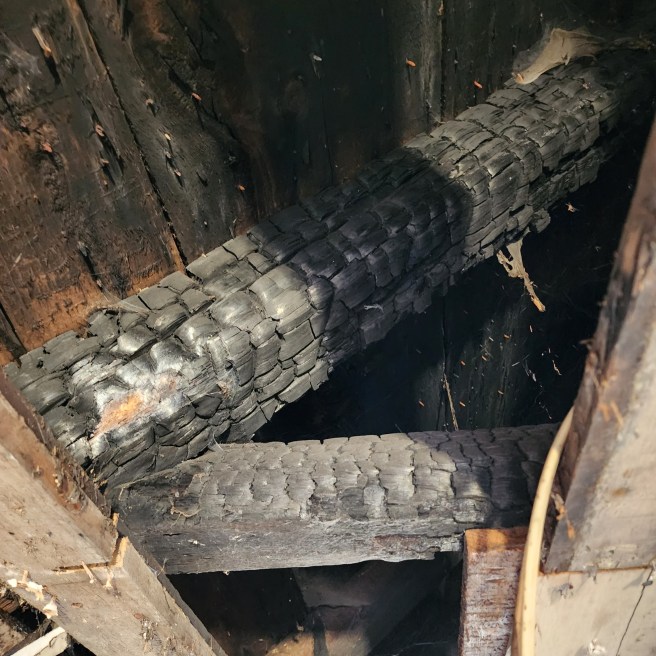
When we were considering making an offer on the house, we were told to check out the rafters for signs of charring, a consequence of the 1886 fire that destroyed the canneries, wharves, and downtown. Sure enough, ours was one of the homes suffering damage though left standing.
A few weeks before starting on the renovation, our contractor stopped by with his mentor slash consultant for a closer look. More concerning, from their point of view, was the lack of a ridge beam. The rafters from each side were simply mitered together. In addition, they were further apart than current coding would permit.
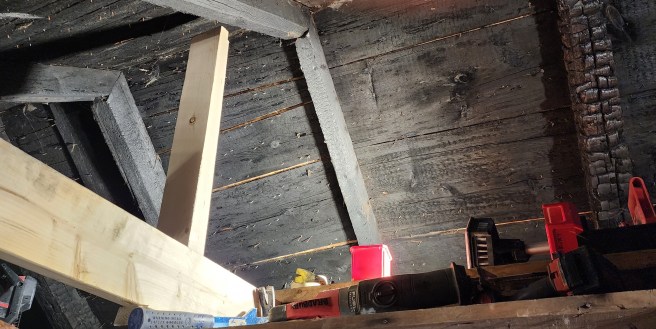
Our project would be taking place in two phases – the back half of the roof last fall and the front half in the spring. Without a ridge pole, there was nothing to hold up the remaining half and nothing to support the new raised framing.
You’ll discover where that leads.
My professional life didn’t follow the conventional course, where the goal was to land on a major metropolitan daily. If not the New York Times, then the Washington Post, Chicago Tribune, Los Angeles Times, or the down the line from there. What were also called “destination” newspapers, with decent pay and more focused work in contrast to the sweatshops in smaller communities, or what are now called markets.
I had some near misses, but my route instead led me into places that remain largely unexplored, at least as far as literature or public awareness are concerned.
In my case?
Curiously, my professional locations before Baltimore all infuse my fiction. Strangely, I’ve never written about Dayton, where I grew up, or the places later, at least as fiction. Poetry is another matter altogether.
 Jnana's Red Barn