Or more accurately, the bastard son of a Frenchman in Haiti.
Yet, despite the iconic honor given his name, few have seen his legendary work in its full glory.
I’m speaking, of course, of John James Audubon, in the anglicized version of his name.
While I had viewed his work behind glass framing in art museums, nothing prepared me for my hands-on encounter with the four folio print volumes. That happened in Indiana University’s rare book Lilly Library when a librarian interrupted to ask if I would help her return two of the volumes to the cart so she could take them by elevator back to the stacks.
Yes, they really did need two people to move. As I’m seeing now, the books measured about 29½ inches by 39½, otherwise known as double elephant paper, the 435 prints being the same size as the original drawings.
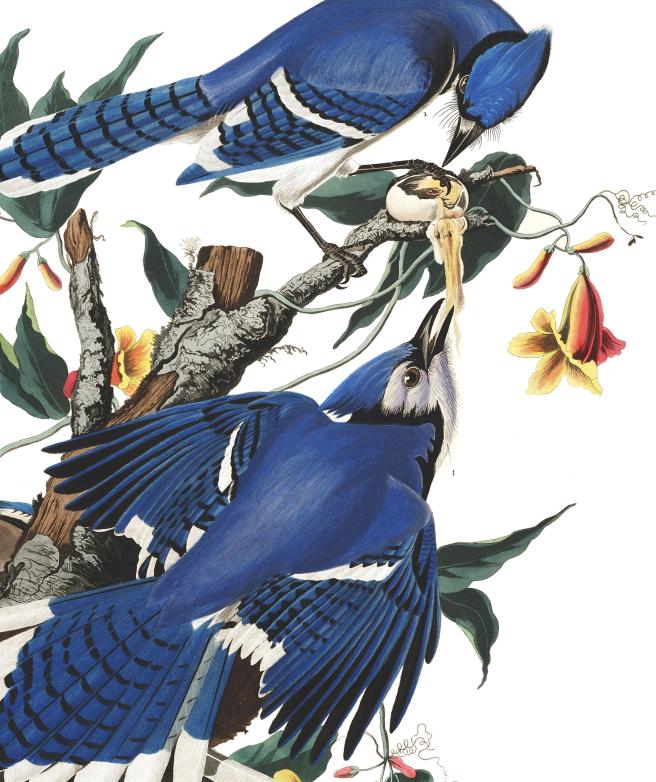
We decided to take a peek and were both blown away. It was as if the birds had been pressed full-size onto the plate. You could actually see the veins in each feather. And that was, it turns out, a copy of the original. Oh, yes, and each species was presented full size, with some favored vegetation.
As for the color? Unbelievable. You have no idea how much is lost through any glass.
We both admitted it was too much for a single viewing.
Now, for ten more facts.
- As an 18-year-old, Jean-Jacques Audubon was sent to Pennsylvania on a false passport to avoid conscription into Napoleon’s army.
- A feud originating during his research in Kentucky closed off American support for young Audubon’s work. Instead, his backing came from England, where subscribers underwrote the classic Birds of America.
- One bookseller claimed it would never succeed because the book took up an entire table to view and would render other volumes useless.
- A reduced-size two-volume collection, a gift from my younger daughter, has me appreciating the radical design and style of many of the images. There was no way, after all, to approximate the original color, yet any approximation opened other dimensions.
- He worked from actual specimens he had shot and killed, arranged in lifelike settings.
- He did create a controversy regarding the smell of turkey vultures, or what some of us call buzzards.
- Some of the birds he discovered remain a mystery.
- He’s known mostly by copies of copies or even additional copies, each time diluting the impact of the originals.
- He had nothing to do with the national Audubon Society or its Massachusetts and New Hampshire spinoffs.
- He’s buried in New York City.

 Jnana's Red Barn