Singing together without masks at last

As we came together in a shared physical space after Covid, we continued to wear masks as a safeguard against resurgences of the virus. Choirs were, after all, a major source of contamination.

We even gave several concerts donned in special masks that gave us extra breathing room. But they did muffle our sound and diction while also fogging our glasses.

What a relief, then, when our director agreed about a month before our last set of concerts that we could go without the masks, if we individually desired.

What a difference it made! We were clearer in tone and lyrics, and our sound projected better. Our ability to hear each other also improved. It was like being unshackled.

It was like declaring the pandemic over, though we knew the virus was lingering.

What single move gave you that ah-hah! Breakthrough as we came out of the Covid onslaught?

As a reminder from the dominant side

The ruling Puritans in New England had reasons for opposing the Quakers, something I need to remember in the midst of my Quaking Dover arguments, They don’t get much sympathy in their objections, at least from my audiences.

As Dover First Parish historian Donald R. Bryant put it, “The Quakers did not conform with the orderly practices of the Puritan churches. They would not join in fellowship, and met among themselves, propagating their own beliefs. Many of them did not do this quietly, but in a manner that was disturbing to regular church members. They were apt to interrupt a meeting or a preacher, or to even interfere with the proceedings of a court. They insulted church order and disturbed the peace. Their conduct was described as ‘indecent and provoking.’”

Some of these points still sting as I look at today’s political and social polarization.

Urban deer, oh dear

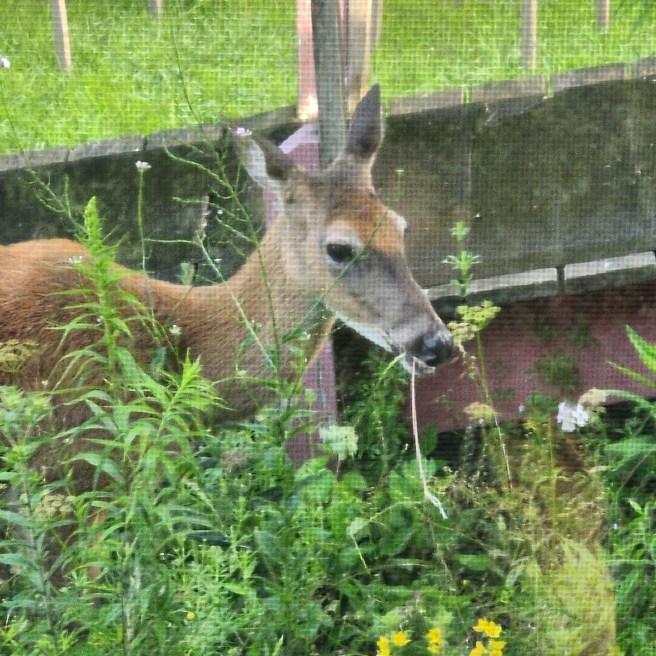
Eastport – centered on Moose Island – is one of many small cities being overrun by deer. You may have met some of the culprits here at the Red Barn.

Here are some random bits as a result.

  1. In the Wampanoag language, they’re known as “the ones with wet noses,” for the way they investigate the world around them.
  2. Why do fawns have white spots? I suspect it could be a good opportunity for a storyteller to develop. Along with the question of why fawns eventually lose them.
  3. They like apples. Man, do they. Some will dance on their hind legs in reaching for the branch overhead.
  4. They can destroy a garden overnight.
  5. That said, they’ll eat just about anything. One even swallowed a spigot on our bird feeder.
  6. Speaking of which, a bit of cayenne pepper in the feeder seems to repel them. As the adage goes, better late than never, regarding some lessons.
  7. They’ll eat out of your hand if you’re patient. Not that I advise that.
  8. Bucks get bumped out of the circle as they come of age.
  9. The most we’ve counted in our small yard at one time was ten.
  10. We’ve had an albino in the north end of town. I first thought it was a goat in the night.
Here’s a shot from our dining table. Or hers, as well.

Now for our storm door out front

Are you ever caught up when you own an old house? Or is it like a personal sailboat, where you pour copious amount of money into a hole in the ground or the water?

The latest item to join our home maintenance to-do list is the front storm door, which detached from the frame a few weeks ago. It was too heavy and awkward to go back in, and apparently some shifting had warped the angles. It hadn’t been closing completely, and the last time I tried, bingo! We were in trouble.

It wound up, as I said, coming off altogether.

Oops!

We do want to get that fixed before winter hits, though. The front door itself is rather leaky.

Yet part of me is thinking maybe that can wait till I’m dead.

Damn, I do miss being able to call maintenance back when I was living on Yuppieville on the Hill. Back before I so deliriously remarried.

One commute I can’t complain about

Some Sunday mornings, my drive to and from the Quaker meetinghouse a half-hour from my home is a meditation in its own right.

Even in fog or snow, it can be refreshing.

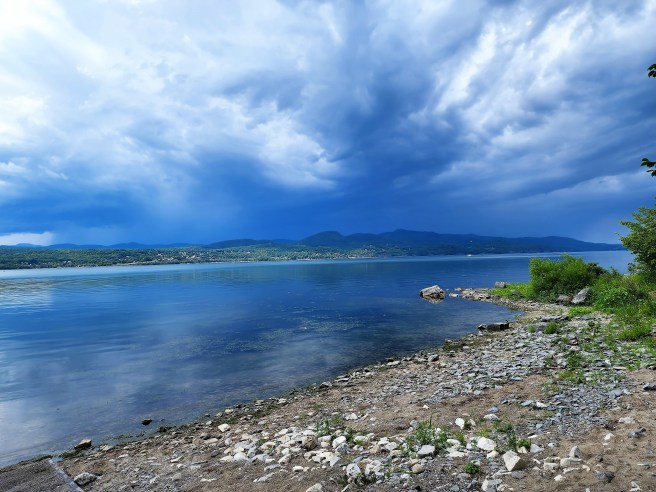
Much of the road is through forest, plus stretches along Passamaquoddy and Cobscook bays and their tributaries. The route also passes through a tribal reservation and a national wildlife preserve, which does sound a bit exotic though I take it as routine.

Eagle sightings are common, and I have had to stop for deer or turkeys in the middle of U.S. 1. Once I even spotted a moose far ahead on the pavement.

A radio program of classical choral music on a CBC station that comes in quite clearly is often also an element, depending on my mood.

Do you remember the freedom you felt when you first learned to drive? Some mornings, especially when there’s no other traffic, that elation returns.

While I’m tempted to proclaim “What could be more glorious than this!” I will also note many of the scattered homes I pass resemble junkyards – poverty in Washington County is a constant – so there’s a reminder of that reality, too. I suspect there are more dead cars and trucks here than people.

As an added touch, there are no traffic lights, either.

Among the many mysteries of adult life

I never understood how some people with a demanding career and a family or committed relationship found time to conduct an extramarital affair on the side.

I mean, just a primary relationship deserves more attention than it usually gets. Don’t they mix their communications? Which one said what or their preferences? As for names?

And yet some get away with it. Even habitually.

On the other hand, I doubt they would understand all the hours I’ve put into writing, either. What else am I missing? Dear?


Sawyer Mills usually get overlooked

The town’s textile mills don’t get a lot of attention in my book Quaking Dover, in part because I haven’t found a lot of interaction between the emerging industry and the town’s Friends. Indeed, the Quaker Meeting was seriously aging about the same time the thriving mills transformed the town into an industrial power.

Dover’s conventional histories, on the other hand, have good reason to focus on the big brick mills along the Cochecho River, world famous for the quality of their calico and their stunning print designs and execution.

You might be surprised to learn, though, that they were in operation much earlier than the legendary cotton mills at Lowell, Lawrence, and Manchester on the mighty Merrimac River.

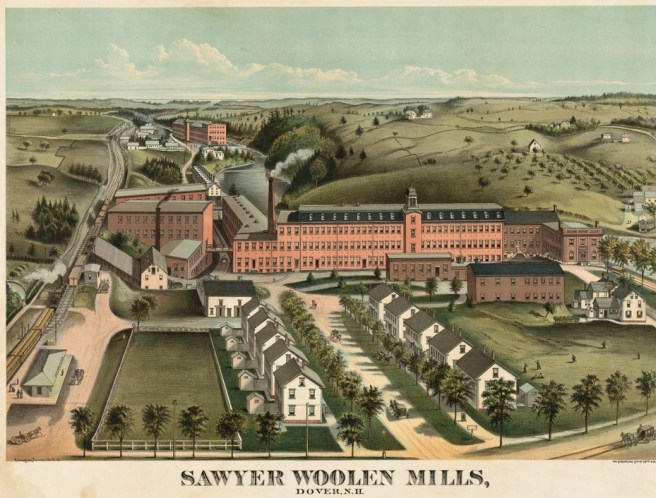
Largely overlooked, as one Friend reminds me, are the woolen mills on the Bellamy River south of Dover’s downtown and only a few blocks from the Quaker meetinghouse. These operated from 1824 to 1899 and were often innovative, employing up to 600 workers before being sold and continuing till 1954.

They were renowned especially for their flannel and were, at stretch, the largest woolen mills in the Granite State.

Today the mills and their historic housing have emerged as a charming residential district.

While there were some Sawyers in the Meeting, I’ve not yet found any connection to those owning the mills.

Based on the naming of some of their children, those were apparently Methodist.

I’ve been meditating for more than 50 years now

Well, I haven’t been living as a monk in a Himalayan-mountain cave any of that time, but it does sound more impressive that being a “meditator” or someone who practices in a contemplative religious tradition that long even when it’s only once or twice a week.

The thought came to me in Quaker worship the other Sunday morning, the center of what has remained my spiritual discipline and community after the yoga-based version faded away over the years – even my rising before dawn to sit cross-legged in front of a small altar and its candle before I tackled poetry and then took off for the paying job for the rest of the day.

~*~

While I can no longer park myself on a cushion on the floor in the Asian style but rather settle in much more loosely on an old meetinghouse bench – do not call it a pew – the bigger change has been in the focus of my sitting.

The goal of the yoga exercise was to transcend, leaving behind mundane awareness altogether. Somewhere you might encounter your past lives, even. If not that, then a natural high, as an advanced version of a drug trip. At least an awareness of an altered state of consciousness that might even address authentic ethereal reality.

Instead, in the Quaker vein, what I’ve found is a time of being mentally and emotionally renewed and even gaining clarity into my daily engagements.

Or, as one quip goes, some of the best barns in New England were designed during Quaker Meeting. In this case, meaning the hour of shared and mostly silent worship.

~*~

The half-century mark also takes me back to my first Summer of Love, detailed my novel Pit-a-Pat High Jinks, a book that has scenes triggering the erotica filter, should you try to order a copy.

While I was preparing to live in the yoga ashram to our south back then, I experienced my first summer with a daily exposure to the outdoors, including swimming in mountain lakes, often naked, Upstate New York. It was a time of great struggle, discovery, growth, and redirection for me.

And at the end of all this, at the closure of our hour of silent worship here in Maine, one Friend (aka Quaker) voiced an insight from a Native perspective that when it comes to time, the focus is on the past – it’s the only one we can know. The future is the one behind us, rather than ahead. Not that there’s that much ahead for me in this lifetime.

~*~

Still, it’s was a kind of day that had me wondering, can life be any better than this? (Even with those aches et cetera of aging.)