The town’s textile mills don’t get a lot of attention in my book Quaking Dover, in part because I haven’t found a lot of interaction between the emerging industry and the town’s Friends. Indeed, the Quaker Meeting was seriously aging about the same time the thriving mills transformed the town into an industrial power.
Dover’s conventional histories, on the other hand, have good reason to focus on the big brick mills along the Cochecho River, world famous for the quality of their calico and their stunning print designs and execution.
You might be surprised to learn, though, that they were in operation much earlier than the legendary cotton mills at Lowell, Lawrence, and Manchester on the mighty Merrimac River.
Largely overlooked, as one Friend reminds me, are the woolen mills on the Bellamy River south of Dover’s downtown and only a few blocks from the Quaker meetinghouse. These operated from 1824 to 1899 and were often innovative, employing up to 600 workers before being sold and continuing till 1954.
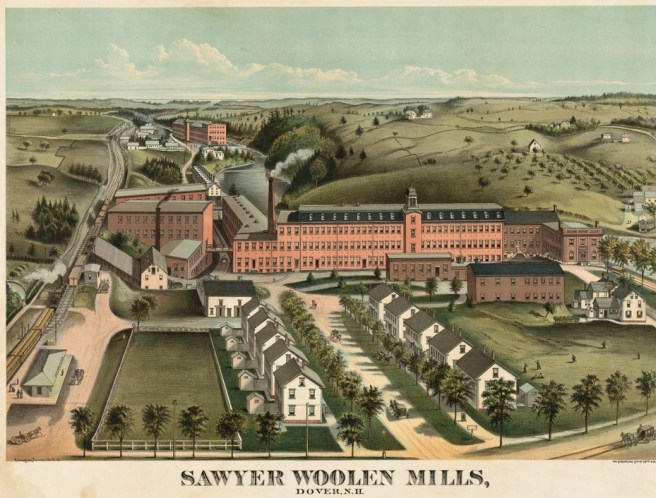
They were renowned especially for their flannel and were, at stretch, the largest woolen mills in the Granite State.
Today the mills and their historic housing have emerged as a charming residential district.
While there were some Sawyers in the Meeting, I’ve not yet found any connection to those owning the mills.
Based on the naming of some of their children, those were apparently Methodist.

 Jnana's Red Barn