This free opportunity might look crazy, really

Offering the ebook edition of my new book, Quaking Dover, for free might look crazy, but let me put it into perspective.

Books get lost in the outpouring of new publications these days. Yet for publicity, nothing beats word of mouth, especially when it comes to getting folks to pick up their own copy.

In the old days, I would have sent my paper editions to potential reviewers, but there was no guarantee that would lead to any results. I know, having picked up many free books as a newspaper editor that way, as well as my experience with my first novel, Subway Hitchhikers.

So let’s cut to the chase. Smashwords.com has an annual promotional sale this month, and I’m participating by offering my latest book for free, hoping that if you like it, you’ll give it a brief review on my page there along with five stars. Maybe you’ll even want to give paperbook copies as gifts as a result. Either way, I get a much-needed boost. We’re back to word-of-mouth.

But first you have to download it. Just go to Smashwords and follow through.

Honestly, it might even leave you prepared to order more of my ebooks once you’re comfortable with the process.

Is it a deal?

Now, for our big whirlpool

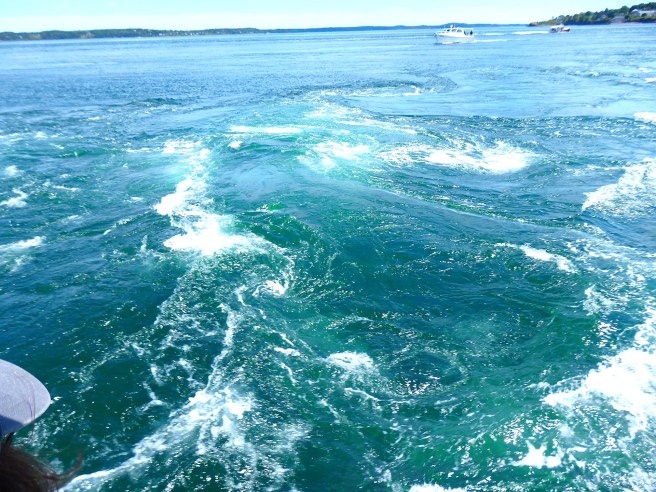
One of Eastport’s travel attractions is the “Old Sow,” the world’s second biggest whirlpool or the biggest one in the Western Hemisphere.

~*~

Before you make reservations to come see it, let me point out a few things.

  1. Its intensity varies greatly, depending on the gravitational tides cycle. It’s best about three hours before high tide, especially around the new and full moons when 40 billion cubic feet of water flood through the half-mile-wide passage to Passamaquoddy Bay.
  2. Its swirling diameter can reach 250 feet or drop 12 feet into its vortex, but it’s also likely to appear as a series of boiling countercurrent piglets and eddies.
  3. Most of the time, it’s not particularly visible from land. It is, however, a regular feature on Butch Harris’ whale watch runs. And even then, it will likely be a disappointment if you’re expecting to see a big hole in the water.
  4. It remains, nonetheless, a hazard to small boaters and has claimed lives, most notably in 1835 when a mother watched from shore as a two-masted schooner was sucked down with her two sons. The young men were never seen again.
  5. Another account, from the late 1800s, tells of two men with a barge loaded with logs, that went under and the bodies never found.
  6. It’s closer to Deer Island, New Brunswick, than Eastport, Maine, in part a consequence of public works construction of a causeway to the north during the Great Depression that pushed the current eastward.
  7. The name likely derives from the mispronunciation of “sough” as “sow” rather than “suff,” reflecting a “sucking noise” or “drain.” Or even “grunting.”
  8. The phenomenon arises from a unique funneling of powerful currents over a sharp trench on the seafloor, with water rising abruptly from 400 feet to 119 feet. It then intersects other trenches to thicken the action.
  9. The upswell brings nutrients and small sea creatures from the depths to the surface.
  10. The channel’s ferocious currents can run six to seven knots, a special hazard for divers as well as small boats.


Free, this month only

Do you read ebooks? If so, here’s an offer you really can’t pass up.

For the month of July, the digital version of my history Quaking Dover is being offered for free at Smashword.com’s annual summer sale.

The paperback edition has been selling very nicely, thank you, but I do want to share the excitement during the city’s 400th anniversary and, well, here’s one more opportunity to get in on the story. Yes, little Dover is older than Boston, New York, or, well, any other city along the northeast coast other than Plymouth and Weymouth, Massachusetts.  (Bet you didn’t know that!)

For details on obtaining this limited-time offer, go to the Jnana Hodson page at Smashwords.com.

It really is quite a tale.

A 17th century herb garden

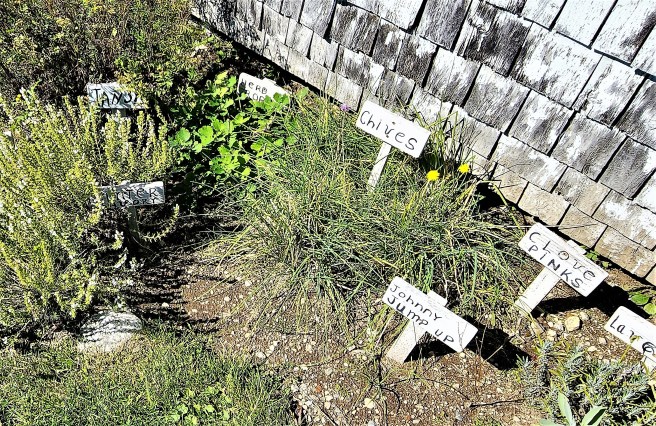
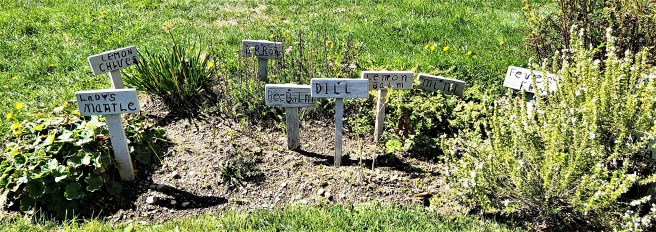
Well, this is how it looked last September.

The English colonists knew their herbs and spices, as shown in the Pemaquid state historical site’s garden. The selection includes bee balm, betony (lamb’s ear), celandine, chamomile, chives, clove pink, crane’s bill, dill, evening primrose, feverfew, Johnny jump up, lady’s mantle, lavender, lemon balm, mint, parsley, sage, savory, tansy, tarragon, thyme, and yarrow. Many of these were grown for their medicinal applications.

We never had much more than salt and pepper back in the ‘50s, at least as I recall as a kid.

Dover and Hampton were largely overlooked in Quaker histories

In the conventional telling of the early Quaker movement in New England, the focus soon centers on Rhode Island and Cape Cod. One was an independent colony; the other, in Plymouth, slightly less harsh than Massachusetts Bay to their north.

In contrast, the three northern Meetings – Salem, Hampton, and Dover – are largely overlooked or dismissed as agricultural and poor.

Well, a historian goes where the records are, and those three northern Meetings were largely underground before 1680, when religious toleration came to Massachusetts-governed districts.

Arthur J. Worrell’s Quakers in the Colonial Northeast is slim pickings when it comes to those three Meetings, and Carla Gardina Pestana’s Quakers and Baptists in Colonial Massachusetts helps rectify that with her concentration on Salem, but her references to Hampton and Dover are few and often cryptically sketched as “New Hampshire and Maine.”

Well, Dover served both sides of the New Hampshire-Maine line, and for decades, it was the only Quaker presence in Maine.

As I keep calling out: Hello!

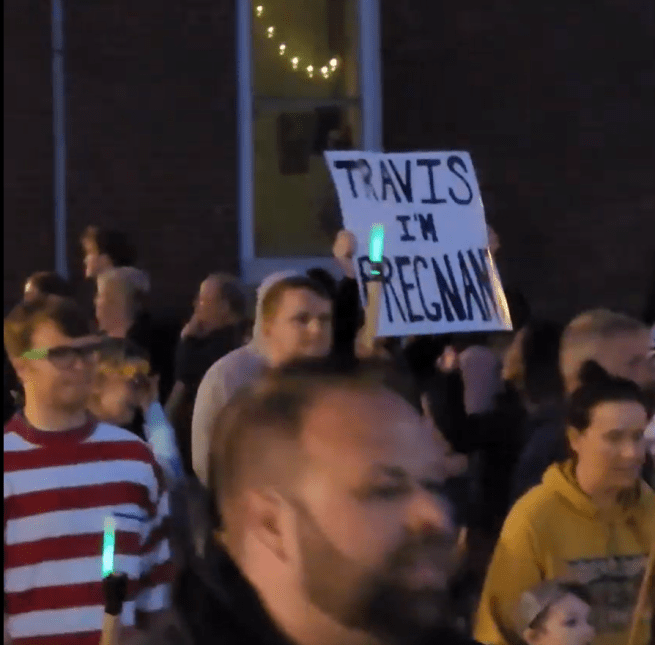
Hey, Travis!

The annual torchlight parade is largely children, some accompanied by adults. It’s brief, but lots of smiles.

This year included a young woman carrying a big sign, and it still has me curious.

The words elicited an immediate laugh, and an assumption that they’re good news. She certainly seems happy, and we want to be happy for her.

At that point, though, I feel a writing prompt kick in.

Who is Travis? What’s the status of their relationship? Is he even somewhere in the crowd? Is she one of the Navy wives who came to town for the Fourth of July celebration and then joined their spouses for the cruise back to home port? Could this even be an attempt at shaming or is it instead her way of sharing the good news with family and friends, too?

What am I overlooking?

What’s your take? And which storyline would you develop?


As a professional historian friend said after one of my presentations

New England history is all through Harvard. And then Yale and Williams College.

Except, of course, a few mavericks like me. (Even though, humbly confessed, I’m not a historian.)

Well, you do have another opportunity to see why he said that if you register promptly for my free Zoom presentation from Cape Cod at 12:30 Sunday afternoon ( https://bit.ly/QuakingDover ).

Here’s hoping to hear from you there!