expanse of granite
mirrors
blaze in blue
water
You never know what we'll churn up in cleaning a stall
expanse of granite
mirrors
blaze in blue
water
I’ve loved the phrase, “island garden,” even before we relocated to Moose Island, Maine.
The resonance comes in a classic book of that title by poet Celia Thaxter from her efforts on Appledore Island at the other end of the state. Her volume is illustrated by the great American Impressionist painter Childe Hassam, an addicted summer visitor. He made some stunning paintings on the island.
My wife and I did make a pilgrimage to the site, which once included a hotel considered by many to be America’s first artists’ colony. Nowadays, you do need permission to land there – we arrived on a research vessel as guests of the University of New Hampshire, which shares a major ornithological center with Cornell in what had been a World War II watchtower and bunkers.
Moose Island, in contrast, connects to the mainland by a causeway – no need for a ferry – but it’s still an island, an element that grows in awareness the longer I’m here.
Celia’s text often laments the arrival of garden slugs on the previously uninfected island, a pestilence we certainly understand, even before relocating from New Hampshire.
Alas, we do have those slimy destructors here. Apparently, Celia was unaware of the advantages of using seaweed as a mulch, one that repels the offenders in both its fresh and dried states. It’s something I’ve previously posted on. And something I need to reapply here.
While her garden was mostly flowers, ours skewers more toward edible items. And that adds a further layer of offenders, as you’ve been seeing here: deer. The ones with voracious appetites.
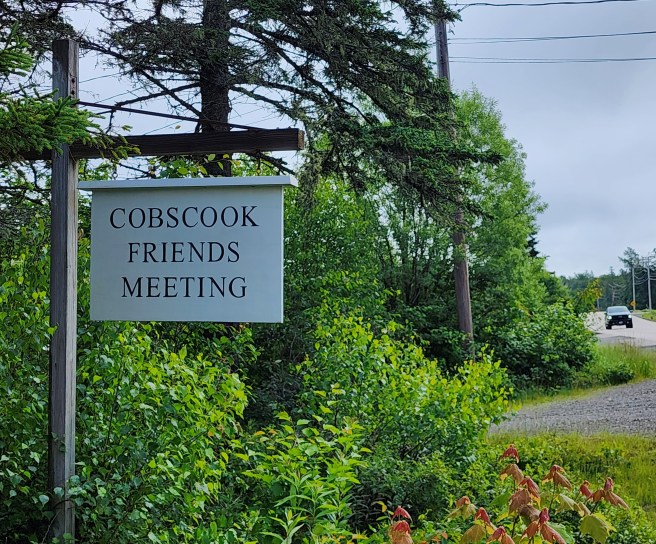
As a small, rural Quaker fellowship, we’re especially happy to be worshipping together in one space every Sunday again, at least through the summer and early autumn.
Covid, of course, had us connected only by Zoom through much of the Covid onslaught and after that, coming together in a physical space on alternative weeks only. We do live at distances from the meetinghouse, so winter weather can often be a challenge.
Not so summer. We’d love to have others join us in our hour of mostly silent centering, beginning at 9:30 on Sunday mornings. The meetinghouse is in the woods along Maine Route 189 in Whiting – on the way to Lubec and many great outdoors trails.
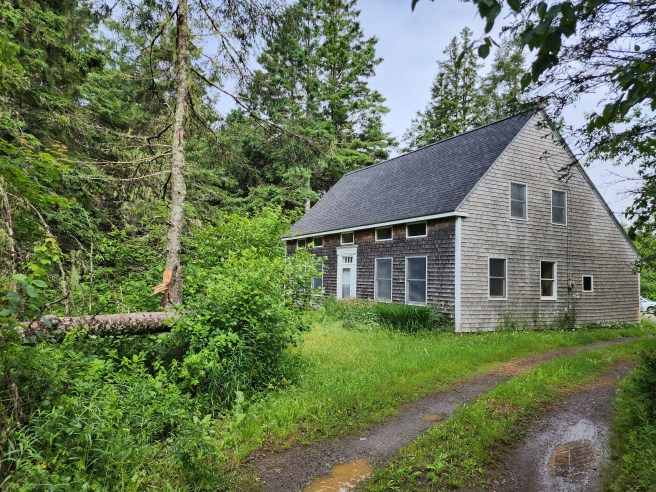
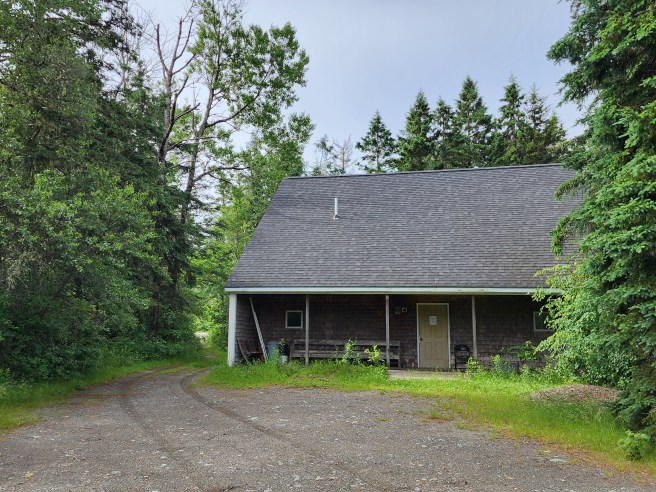
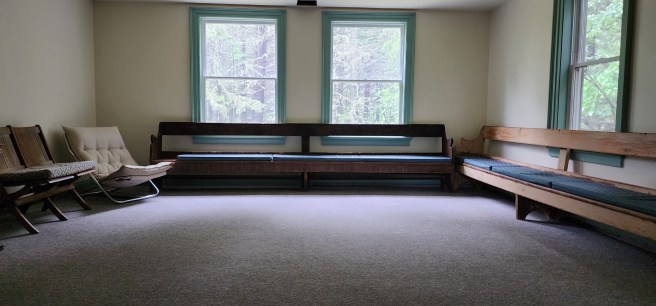 If you meditate in some practice, you’ll fit right in – and if that seems foreign, it’s still a great time for personal reflection. I always find it renewing.
In New Hampshire, Hampton is often touted as Happy Hampton, at least in summer, reflecting its long, broad, honky-tonk ocean beach and the rock concerts at the casino. Let me warn you it can be pretty crowded this time of year. Inland a bit, it’s also known for the Hampton Tolls on Interstate 95, which can be a major travel delay.
In the colonial era, Hampton was renowned for its saltmarsh hay and related agriculture.
It was also the center of the colony’s other Quaker Meeting, one at least as old as Dover’s, as far as I can tell.
As I was researching my book, Quaking Dover, I kept wondering what happened to the Hampton Friends over time. And then I discovered that, like Dover, Hampton had small, neighborhood worship groups, or “preparative meetings,” that came together once a month to address their joint affairs and personal conduct. The monthly sessions rotated among the meetinghouses under the Monthly Meeting’s care, in Hampton’s case including Amesbury, Massachusetts, which became home to the celebrated poet John Greenleaf Whittier.
Amesbury continues, while Hampton fell away long ago.
Since the boundary line between New Hampshire and Massachusetts kept shifting in the colonial era, sometimes reaching down to the Merrimack River – or Merrimac, as Massachusetts insisted – I feel safe in saying New Hampshire had two Monthly Meetings, while the Bay colony had only one, at Salem.
Either way, it could be a rich story in the telling.
Even though we live a block from the ocean, we’ve been perplexed by the selection of local seafood available in the region’s markets. Or more accurately, it’s lack.
The bigger supermarkets have been a disappointment, and the smaller ones, quite limited.
The best overall selection we’ve found, especially for local catch, is Earle’s SUV that shows up on U.S. 1 down in Machias on selected days. That’s an hour away.
For crab, clams, and scallops, it’s Betty’s seasonal shack in Pembroke, about 20 minutes from home.
Other than that, it’s meant going directly to the fishermen, if you know where they are.
Finally, we’re feeling upbeat. The reopening of Quoddy Lobster’s dining operation, just a block from us, includes a fresh seafood counter.

New owner Look Lobster, a fifth-generation family company in Jonesport, has already invested heavily in the Eastport site by rebuilding the pier for straight-from-the-boat deliveries. Last summer it became my go-to place for fresh retail lobster, especially for anything over a pound and a half.
Now that the end-of-the-street site is serving traditional lobster plates for the first time since Covid, it won’t be long before the outdoor picnic tables by the sea are soon packed with devoted fans. The place, a very popular destination both among tourists and locals, was much missed.

As a newspaper editor, I was often startled in looking at coverage from the other side when something I was affiliated with was subject to a story. Or even more startling, when I was quoted and seeing how it looked it print.
It was like working in a restaurant kitchen and shipping dishes to the dining room and then, on a night off, going in for a celebratory dinner.
Seeing a report through the readers’ viewpoint really could be eye-opening. It’s not the “names-is-news” philosophy that many small-minded editors and publishers pursued, either. That approach could be even more boring than reading the phone book. Remember those?
The backbone of most of American newspapers has been the way they connect with their local communities. As one wise editor once told me, it should be news of local interest, rather than just happenings in the place itself. I spent much of my career trying to open parochial outlooks to an awareness of the wider world, both directions, and I do believe that can happen and even be exciting.
When I was calling on daily newspaper editors across the Northeast as a syndicate features field representative, I was surprised by how few of the papers gave a taste of a unique nature of each of the communities. Many of the editors thought of local news as city council and school board meetings plus high school sports scores. As I argue in my novel Hometown News, the real stories – the kind that come home – are found elsewhere and require more reportorial digging. That’s one reason I’ve long advocated local columnists (real writers, not dilettantes, though skilled amateurs are welcome). Few papers had even that much.
When former U.S. House Speaker Tip O’Neill famously proclaimed “All politics is local,” he understood those roots.
~*~
A decade after I’ve left the newsroom, I’m directly experiencing that again, or more accurately, its lack.
In the past 20 years, the number of people employed in newsrooms at American papers has dropped about 60 percent. That leaves far fewer people to write about what’s happening or even be aware of what’s going on at the grassroots level where they live. Much of the nuts-and-bolts editing is being done in clusters far from the paper itself, removing another layer of local nuance and understanding.
In my case, in my participation in events celebrating the 400th anniversary of the founding of Dover, I’m seeing the local paper is doing far less coverage than I would have expected. Not after the family that owned it for generations finally sold out to a media conglomerate.
That disconnect isn’t just print media, either. New Hampshire Public Radio no longer originates any content in the Granite State, as far as I can see. Two decades ago, appearing on one of its shows would have been a natural for a local author like me.
Quite simply, it’s disappointing and a bit scary.
AT AN EVENING EVENT, not especially Quaker. Maybe I’m off on a book tour or readings. Whatever, I’m in an amber-lighted room with others and eventually realize she’s on the other side. We eventually approach, exchange a few words. Hesitantly, I ask if she’d be interested in a late dinner, and just as cautiously, she replies in a muted affirmative.
We go to a small, upscale, modernistic place – again, soft lighting. The service, however, is atrocious. It’s late, they have my credit card, and the food just doesn’t come. We don’t know what to do. We’re hungry. Demand the card and leave?
The waiter, apologetic, finally shows up with my card. We stay, I assume.
This was disturbing enough to wake me two hours earlier than I’d planned to get up. Was jarring enough I couldn’t go back to sleep.
IT STARTS OUT WITH THE KISS, I presume. And somehow leaps from the chemist to her, who now wants to travel with me on a journey. We’re at yearly meeting, after agreeing to coffee or late dinner to talk things over and perhaps catch up. Maybe she invited herself to my room after. What I remember is the intensity of her snuggling up to me, seductively tender, cooing, yielding.
FLASH IN THE BIG, MULTILEVEL MALL: much taller, but definitely the type: intense blue eyes, freckles, full and almost purple lips, golden-blonde hair. The constant potential around the corner, the unexpected encounter of some intense part of my past: someone I loved powerfully or served who nonetheless betrayed me.
HER WANTING to reunite with me.
I wasn’t having it.
Not after this long.
So far, so good. The deer haven’t yet pushed the garden fence over or managed to get in despite the chicken wire.
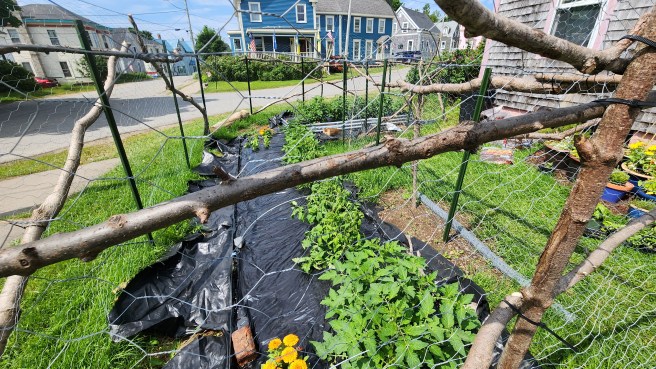
That, in itself, gets a lot of the locals coming by to take a look at my fortifications and then talk, as well as a number of summer folk. Eastport is a pedestrian-friendly village. Others are in vehicles that slow down and roll down their windows.
Beyond that, many are also avid gardeners who admire what’s growing and then advise us while introducing themselves. Some have even left packets of seeds on our front-door steps.
Strangers have also come up to me downtown to say how much they like what we’re doing. As I acknowledge, my wife deserves most of the credit.
Either way, it’s one more positive small-town aspect of living here. You’re simply engaged with life all around you.
Nor have I mentioned how heavenly the buttery fresh lettuce tastes or how much a sugar-snap pea vine can grow in a day.
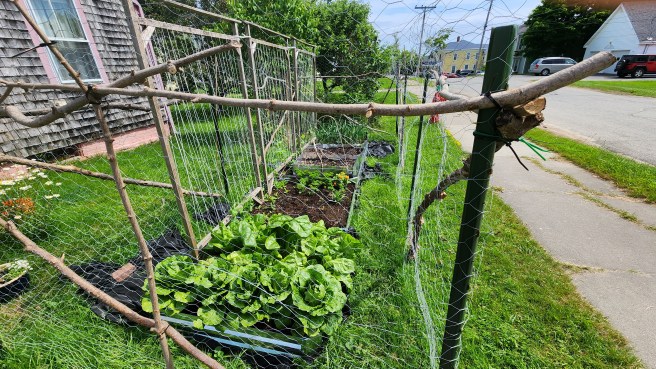
The fact that all this is in our front yard does, no doubt, make the garden more public, but it is where our best sunlight falls. Folks around here are practical and take that all in stride.
Speaking of practical? It’s that much less lawn I need to mow.

I’ll let others swing out on that rope.
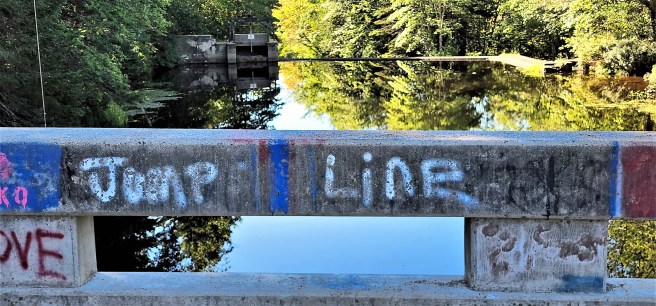
As it says on the bridge.

You can even just sit in one of the little basins in the fish ladder and let the water rush over you.
 Jnana's Red Barn