Coming to Colonial Pemaquid’s state-maintained historical site in Maine, I wasn’t prepared to find this.

It was far more than the wooden palisades found across much of early New England. It looked to me far more like something out of Scotland or a Monty Python movie.
This wasn’t even a reproduction of the first fort there, but rather the second.
The first was Fort Charles, built 1677 after the village had already been destroyed. That fortification was overrun and destroyed by the French and their Native allies in 1689.
Most of the usual attention to warfare between the English colonists and the Natives focuses on King Phillip’s war, which heavily impacted southern New England. Much of the heaviest toll, however, happened in the decades after that when the tribes allied with the French to the north. Those outbursts afflicted northern New England, including Dover, New Hampshire, for decades later.
That’s where Pemaquid, fortified to hold the Maine at the edge of English claims in the New World, comes into play with my story, Quaking Dover.
Dover was often on the frontier of English settlement, a thin ribbon along the coastline but barely reaching inland and thus nearly impossible to defend, at least much north of Boston.
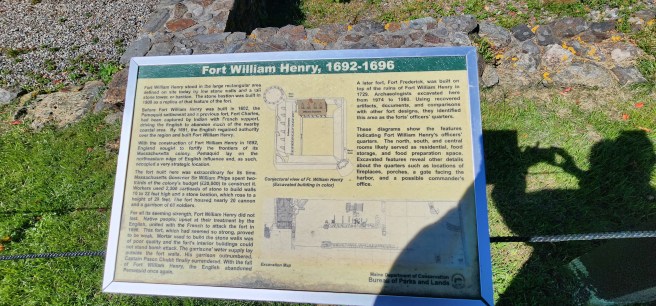
Once the English did reclaim this stretch of Maine from the French, the New Englanders built a new, second fortification, Fort William Henry, erected in the large rectangular area defined on the site today by low stone walls and a tall stone tower, or bastion. The stone bastion you see was built in 1908 as a replica of that feature of the fort.
As Maine’s online documentation explains, before the second Fort William Henry was built in 1692, the Pemaquid settlement and the previous fort had been captured by the French and their tribal allies, driving the English to abandon much of the nearby coastal area. By 1691, however, the English regained authority over the region and built Fort William Henry.
(I am fascinated by the tenacity of those who kept returning despite the costly odds.)
As you will find, with the construction of Fort William Henry in 1692, England sought to fortify the frontiers of its Massachusetts eastern district. Pemaquid lay on the northeastern edge of English influence and, as such, occupied a very strategic location.
The fort built here was extraordinary for its time. Massachusetts Governor Sir William Phips spent two-thirds of the colony’s budget (£20,000) to construct it. Workers used 2,000 cartloads of stone to build walls 10 to 22 feet high and a stone bastion, which rose to a height of 29 feet. The fort housed nearly 20 cannon and a garrison of 60 soldiers.
(Note that the costs were born by the New Englanders, not the British Crown.)
For all its seeming strength, Fort William Henry did not last. Native people, upset at their treatment by the English, united with the French to attack the fort in 1696. This fort, which had seemed so strong, proved to be weak. Mortar used to build the stone walls was of poor quality and the fort’s interior buildings could not stand bomb attack. The garrison’s water supply lay outside the fort walls. His garrison outnumbered, Captain Pasco Chubb finally surrendered. With the fall of Fort William Henry, the English abandoned Pemaquid once again.
(If this were fiction, I can’t imagine what to do with a name like Captain Pasco Chubb. Especially as an Englishman.)
Well, that’s an official account, one I for now I find no reason to quibble with. What does change my earlier perspective, however, is Fort Frederick, erected in 1729 and dismantled in 1775 to keep it out of British occupation in the Revolutionary war.
It never faced hostilities with the Natives, which seriously makes me reconsider a much earlier reoccupation of Maine by English settlers, something I had largely ruled out before 1763, the end of the French and Indian wars. Now see that’s not quite accurate, though it still seems to apply Downeast, where I now live.
So much for these confessions of an amateur historian.

 Jnana's Red Barn