There’s a good reason Dover Friends didn’t have a meetinghouse before 1680

Or keep minutes, that we know of.

The Quaker Meetings in Salem, Hampton, and Dover were all in Puritan-governed colonies, and thus officially illegal at the time. Religious toleration around 1680 came with a change New England governance and a royal governorship in Massachusetts.

With it, Salem has claimed to have the first Friends meetinghouse in America, though it was built about the same time as the one on Dover Neck, just south of today’s St. Thomas Aquinas high school. And Third Haven on Maryland’s Eastern Shore may be a tad older than either one.

Now, if we only had documentation, we might find the honor of being first in New England belongs instead to Dover.

Strike up the rubber band

AT AN OPERA IN A LARGE SHED, Aida without costumes. Then a student orchestra rehearsing Beethoven in a smaller hall across a field. We rush to our seats on the second tier but wall-pillars block our view, except for a small hole like an airplane window. Turns out there’s a 7 p.m. movie before the opera. We snuggle a bit and speak in Spanish using questions rather than exclamation marks. Bueno? Bravo? Etc.


AM SURPRISED TO SEE THERE are nearly as many theaters/concert halls around as meetinghouses and steeplehouses. Or is it the other way around?


WE’RE USHERING AT MUSIC HALL, which is more like a sports arena. Is our Third Wheel there, too? A late dash to our seats, which are on the other side of the hall, a remote part of the gallery. Good seats, we were promised, if we can get there before the next piece, a long symphony, can begin.

The first stairway’s closed, for safety reasons. By this time, we’re carrying 18-speed bicycles. Curiously, we now need to go DOWN, having somehow gone up one flight too many.

I’m cast in the role of “organizer” or “enforcer” – the one responsible for getting everyone in gear, and guilty if they don’t make it on time.

But she keeps stopping to talk, tie a shoe, whatever. By myself, I would have made it on time.

The “hurry up” enforcer being the only one stressed out!

Other Music Hall dreams included one of seats with great acoustics but no view of the orchestra.


THE GRANDMOTHER HAD A DREAM I was singing a Schubert leider, text by Goethe – said my voice was quite lovely and my diction, flawless. Highest praise, even if a dream. My German is still atrocious.


WE’RE STANDING IN A CROWDED downtown when the kid notices a uniformed band making its way up the street (which is downhill from us). It turns and marches into a vacated 5’n’dime store, which has folding chairs set up in four quadrants (angled toward a center). A group of teens, supporters of the band or maybe members out of uniform, are jumping up and down, hugging each other, etc., obviously quite elated by some battle of the bands contest that’s about to start, once the others show up. These kids are also huddling, a group prayer seeking blessing.

The band now plays “Jerusalem, Jerusalem, my happy home,” very nice tune and lyrics; I somehow remember both, and in totality.


MAKING MUSIC WITH MY BOSS and his sidekick kind of just off downtown Dayton, lower Salem Avenue or just before First Street or Memorial Bridge.

They bring their guitars to my apartment (yellow/amber) and are ready to tune up.

Sidekick’s impressed when I hum a perfect 440 A but then my violin strings won’t hold, keep coming undone.

Outside again, I go into a shady alley to take a pee, maybe.
 

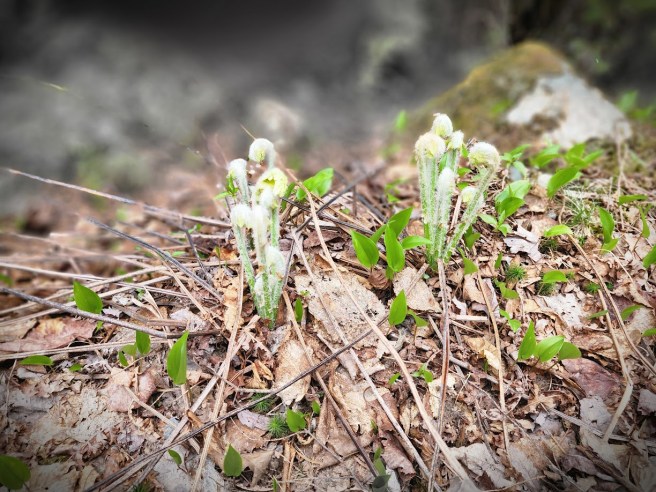
You may have noticed I’m fond of ferns

I don’t remember them being common in the woods when I was growing up in the Midwest, but I’ve become fond of them since. I even devoted years to developing a fern bed beside our “smoking garden” patio at our home in Dover. At least now we’re surrounded by fabulous ones in the wild here.

Oh, yes, I’ve finally tasted fiddleheads in the springtime and like their taste almost as much as asparagus.

Here some additional facts.

  1. They predate the dinosaurs. One variety, the cinnamon fern, looks the same today as it does in 70-million-year-old rock fossils.
  2. They don’t have flowers or seeds and don’t have leaves. Those lovely green fronds are actually branches fused in one plane.
  3. They reproduce via spores rather than seeds. Spoors usually look like small dots on the undersides of the fronds. A single plant can drop millions of spoors on the ground, but few find favorable conditions.
  4. Some species are parasites, growing not from the ground but on decaying tree trunks on the ground or in pockets overhead.
  5. Their roots descend from rhizomes, a below-the-soil, horizontal stem that can range from very thin and creeping to thick and stocky.
  6. Some plants survive up to 100 years.
  7. Bracken ferns can live without any sunlight.
  8. Most ferns are resistant to cold but many also thrive in tropical zones.
  9. They make lovely houseplants that require little care. They do, however, need higher humidity than is commonly available, especially when the furnace is running.
  10. They can remediate contaminated soil and remove some chemical pollutants from the air.


Perhaps one of your family lines runs through Dover Friends Meeting

We get the occasional inquiry from someone researching a family genealogy and wondering if they were part of Dover Friends Meeting.

Records for early Dover are pretty scanty, including both First Parish and the Quakers.

Family registers in New England Quaker Meeting minutes have never been indexed, unlike William Wade Hinshaw’s ambitious volumes for Pennsylvania, New York, Virginia, the Carolinas, and Ohio or the subsequent multivolume project for Indiana.

Well, Dover’s births, marriages, and deaths compiled for publication in the early 1900s can now be found online, for those so interested.

Also, I should point out that the Puritans never called themselves such and did evolve into today’s Congregational and Unitarian-Universalist denominations. First Parish is heir to that stream.

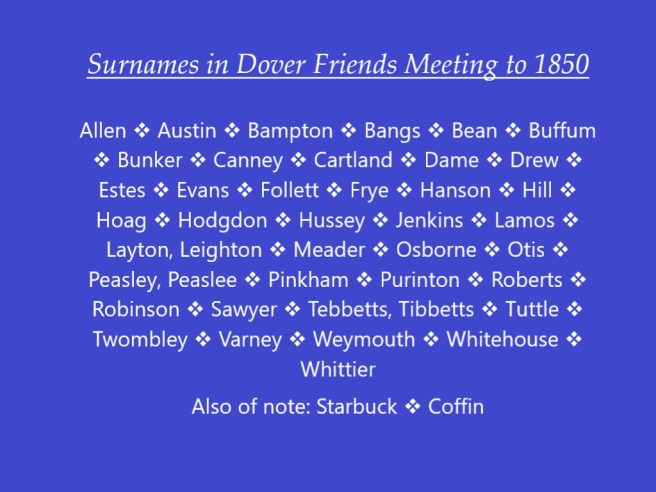
On the Quaker side, connecting the dots from the Dover Combination signers as an early census, the court convictions for non-attendance at public worship, and the Friends Meeting’s records from 1701 and 1703 on hinted at the foundation of Quaker membership in the early years. A survey of online family genealogies helped immensely in filling in the general body, though I take many of those details with a grain of salt.

So here’s the core of the historic Friends community around the Piscataqua watershed:

Ring any bells?

We’re becoming a port of call

Eastport has the deepest natural harbor in the continental U.S., but getting here requires going through Canadian waters. As a consequence, especially in the aftermath of 9/11, there are far fewer boats than you might expect during much of the year.

My first year up here, we had some impressive superyachts but no cruise ships. After seeing some celebrated floating hotels overshadowing Key West and then Portland, Maine, I would consider that as a blessing. From the water, the QE2 looked bigger than the Queen City of Maine’s downtown.

One of the newer trends, though, has been a revival of smaller cruise vessels of 200 or so passengers, and last summer we had a handful of those. Apart from the fact that they blocked some very popular mackerel fishing from the pier, they were a welcome addition to the downtown.

Bar Harbor, at the other end of our Downeast Region, has decided it’s become too popular as a port of call. Some days in summer have had two visiting cruise ships that drop off thousands of tourists on the town’s narrow streets and neighboring Acadia National Park. The local reaction has been to impose a limit, and that may be sending some itineraries our way.

This year it looks like we’re getting up to 11 ships, 16 visits in all, most of them in the autumn foliage season.

Here’s what I’ve found.

  • Pearl Mist, May 8 and again September 11.
  • Holland America Line’s Zaadam, May 22. The largest of the ships, with a maximum of 1,432 passengers plus staff, the 781-foot long vessel has more people than Eastport’s year-round population.
  • The 520-passenger Roald Amudsen. After a visit last September, the icebreaker expedition ship returns on September 15 on its four-ocean bucket-list voyage from the British Columbia across the Arctic Sea and down to Antarctica.
  • Star Pride, 212 passengers, October 2 and 6.
  • Viking Mars, 944 passengers, October 5.
  • Seven Seas Mariner, October 12.
  • Insignia, October 17, 21, 24, and November 8.
  • Viking Star, 944 passengers, October 19.
  • Ocean Navigator, 220 passengers, October 26. A return after spending two weeks in April at the Breakwater preparing for its summer season on the St. Lawrence and Great Lakes.
  • Le Bellot, October 30.
  • Le Dumont, November 10 or so.

It will be interesting to see what the infusion of visitors in the fall shoulder season will do to the town. Things really slow down after Labor Day.