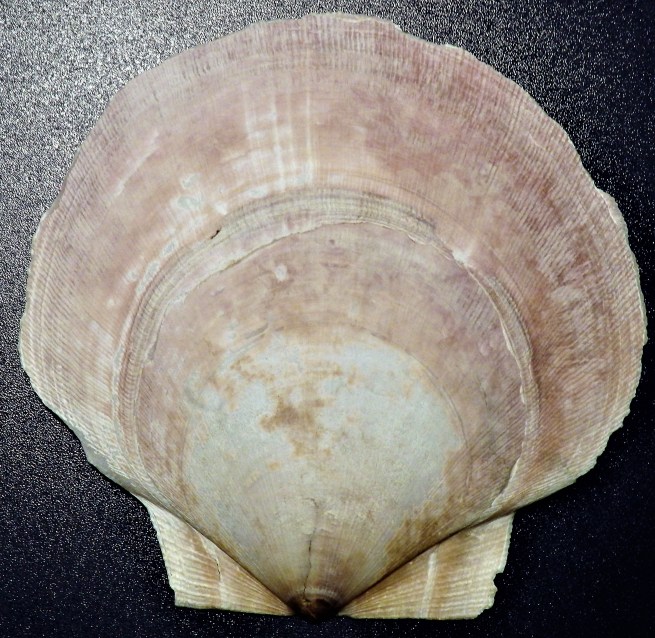
There’s not a lot of meat in one of these, but what there is will be treasured by many seafood lovers.
This time of year, I hear the puttering motors in the chill air before the sun’s even up as the fishing boats head out to drag the depths for scallops. No matter how low the thermometer reading or how bad the weather, the vessels venture by, or attempt to, intent on catching their daily limit of ten or 15 gallons a day in a season that runs no more than 50 or 70 days but may close earlier, depending on the sustainable harvest in each of the regulated zones.
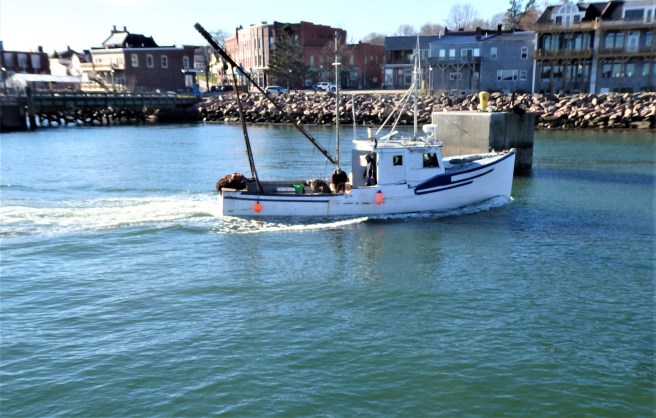
Rigged with a boom for the heavy chain net that drags the seafloor for scallops, this vessel returns to port with its harvest.
A day not out on the water of the bays around Eastport is a day’s income that’s lost for the season. The economics of fishing are precarious enough.
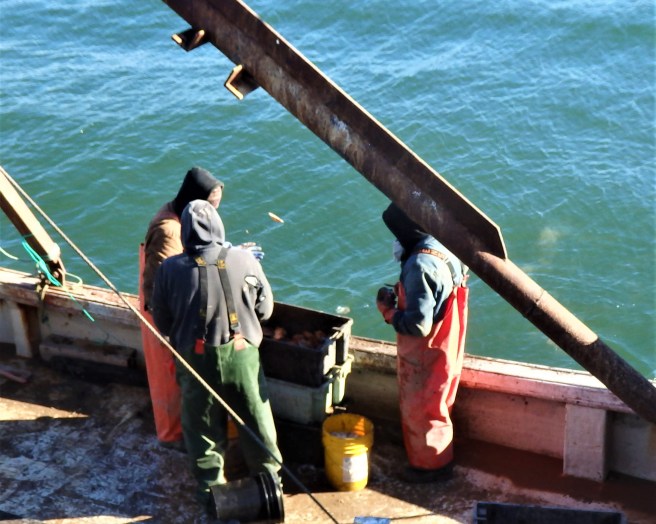
These intrepid fishermen shuck their catch onboard, tossing the shells overboard, which provides grounding for the breeding of more, and then return to port with their precious harvest, often well before noon.
A shell flies toward the water as these fishermen quickly shuck the precious bivalves onboard.
The licenses are coveted and even the size of crews is limited by state law.
Come summer, many of the boats, with their rigging reconfigured, and their crews will have turned their attention to lobster.
Other important harvests here are urchins and clams.
What workers impress you the most when they’re out in bad weather?
This morning, as so many Christians celebrate the birth of a divine baby, I find myself reflecting on another child who intersected my life many years ago.
Not my beloved stepdaughters, who arrived later, but a Kenyan introduced to me during the AIDS outbreak.
Along with a plea for help.
As clerk, I was able to respond, that first year without the approval of the Meeting, which has fortunately followed. We’ve all been enriched as a consequence. In fact, I find myself viewing much of the world through her lens.
As I wrote to her, years later, through one of our more or less annual letters:
It’s been more than a few years since I’ve communicated with you, but you have been on my heart and mind all along, plus those of many other American Friends. You’ve met a few of them, and I’ve felt comfortable leaving you in their embrace, though I haven’t forgotten about you. Far from it. When they bring news of you, we’re always heartened.
Through all of this, you’ve been an inspiration to me. You have what we call grit, or courage, and a lot more. When I was working as a newspaper editor, I had a shortcut to two of your portraits on my computer desktop, yes, right there in the newsroom, and when things got especially rough, like I was about to do something unQuakerly, I’d click on it, and your smile and determination kept me going on the right track. Thank you, simply for being you.
Once, when a Nigerian official was walking through our office, he stopped by my desk and I told him I knew somebody very special in Africa and brought up your triumphant face.
His reply? Yes, she’s Kenyan, and he grinned in appreciation. I guess being Kenyan is something special.
We do live in a small world!
You have many reasons to be proud. And, yes, we Quakers can be proud (for the right reasons) as well as humble. (You can ask me about the humility part later, if need be.)
I feel very deeply you have greatness ahead of you, though it will never be easy. What I do know is that Jesus will always be at your side, as he has been through your hardest sufferings, even though you weren’t necessarily aware of it.
Now, take a deep breath! And, as we Quakers say, Mind the Light!
Or about 4½ pounds, purchased from a dragger docked at the Breakwater pier, where the crew of three was busy shucking the morsels from their shells. After dining on these two days straight last Christmas, we agreed we have a new holiday tradition. Unlike ones you would purchase at a market, these have no water added, and that means you can get a lovely sear when sauteing them in a bit of olive oil and butter. Do I need to add they taste heavenly?
My Dover history project has taught me how slippery much of the material – especially the early parts – can be. What comes through is often fragmentary.
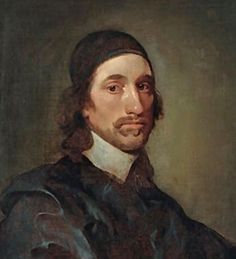
Did Edward Hilton actually look like this?
There’s the very enigma of Edward Hilton, for starters, just trying to prove he was here from 1623. From the circumstantial evidence, I’m convinced that he and Thomas Roberts definitely were, and besides, there are no rival hypotheses regarding their arrival. But that’s not rock-solid documentation doesn’t appear until retroactively. Maybe some of it, taken to London, survived the big fires and plagues and will resurface. Don’t hold your breath.
I’ve seen some of the early charters and patents and, for all of their descriptive prose, find them baffling. The layers of landholding are just the beginning.
What, for instance, did William Fiennes – the eighth Baron Saye-and-Sele – and Robert Greville, the second Baron Brooke, receive in compensation when they relinquished their proprietorship of the New Hampshire province to Massachusetts? And for that matter, how did the Massachusetts Bay colony arrange the transaction?
I would even like to see the details on what Edward Hilton had received when he earlier sold his proprietorship – again, just what did he possess? – to Lords Saye and Brooke. His reason, according to one source, was a sense that the Massachusetts authorities were preparing to seize the Piscataqua and his defense would have been inadequate. Saye and Brooke had clout, as well as a colony in Connecticut named after themselves: Saybrook.
There are also questions of how the “governors” and ministers of the province were selected prior to Massachusetts’ control of New Hampshire.
Just trying to decipher the script and text requires an expert, perhaps even an antiquarian lawyer. And how many of the documents remain, anyway, in the mother country or the New World?
Fellow blogger Mark Everett Miner touches on some of this when he remarks, “It is thought that William Hilton was somewhat educated as he wrote several competent, if poorly spelled, letters.” They are, however, quite convoluted. Here’s an excerpt from a 1633 letter to John Winthrop:
“There arived a ffishing shipe at Pascataque about the 15th of this p’sant moneth where in is one Richard ffoxwell whoe hath fformerly lived in this cuntery he bringeth nuse yt there were tow shipes making ready at Barstaple whoe are to bring passingers & catell ffor to plant in the bay he hath leters ffor mr wearom & divers others at dorchester wch hee intends to bring hr to the bay so soone as posible he can like wise he heard ffrom mr Alerton whoe was making ready at Bristole ffor to come ffor this cuntery other nuse he bringeth not that I can heare of onely mr Borowes purposeth to come ffor this cuntery ffrom london & soe desighring you to convey thes leters in to the bay wth what conveniency you can desighring the lord to blesse you in your lawffull designes I humbly rest …”
How do you make sense of such surviving documents?
In Dover, First Parish records don’t pick up until John Pike set down his memories, beginning with his arrival as minister in 1677. Still, as later minister and historian A.H. Quint observed, “There are no extant Dover church records before Dr. Jeremy Belknap’s ministry,” beginning in 1767, “except that he copied into a record book a list of baptisms and of members, commencing in 1717. The town records are also very defective during the period of Mr. Pike’s residence.” He adds, “This is due partly to the Indian troubles, and partly to the Masonian difficulties.”
By the time Samuel Bownas first visited Dover, the Meeting’s earliest minutes had already been lost – in a barn fire, according to oral lore.
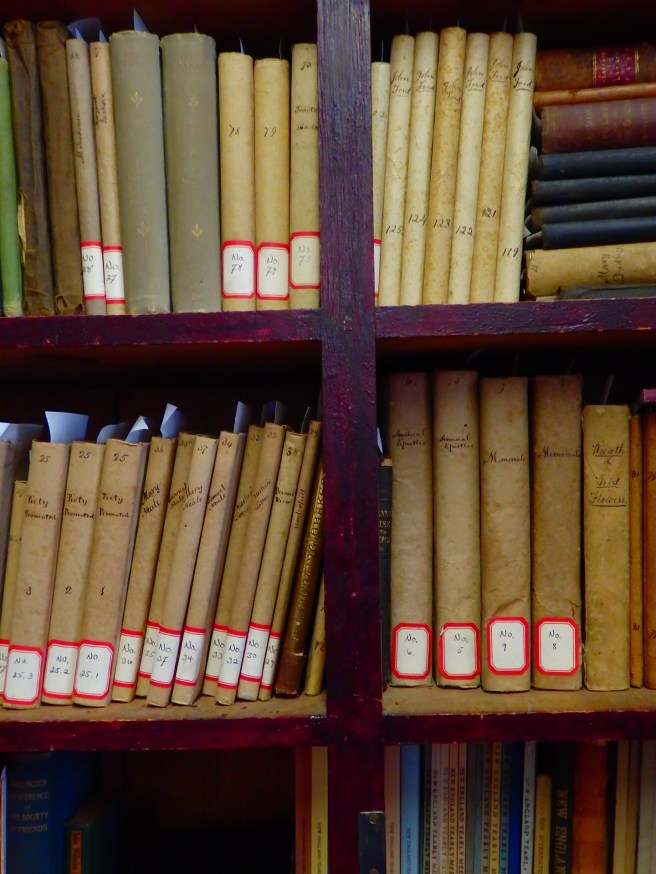
Old volumes in the Dover Friends library tell mostly about Quakers elsewhere. These rare books do not circulate.
In Quakers in the Colonial Northeast, Arthur J. Worrall notes, “The clerk was the most important of the persons active in meeting affairs.” While his examination focused on the yearly meeting level, he remarks, “Clerks had been appointed before 1700, but we know little about their activities. Their note-keeping was careless at best, and … it was not unusual for a clerk of many years’ standing to lose his copy of the minutes.”
One consequence is that we are unlikely to learn much of Dover Quaker life in the early years from the Yearly Meeting books.
Dover’s surviving records begin with the women’s minutes in 1701, with a gap from 1785 to 1814, and the men’s minutes, from 1703. Its vital records stretch back to 1678 but, curiously, were not begun until 1787.
Missing, of course, are the accounts of the early persecutions by the Puritan authorities, the reactions to the Waldron incarceration of Natives or their later attack on the village, or even the early leadership of the faith community.
For family genealogists, the Quaker sources are among the best available family records in America before the 1850 Census, the first to name everyone in a household. The Friends minutes, however, name only those families in good standing as members. Even so, they can be very useful in framing a family overall.
New England records were never comprehensively indexed along the lines of William Wade Hinshaw’s six-volume Encyclopedia of American Quaker Genealogy, covering Pennsylvania and New Jersey, New York, North Carolina, Virginia, and Ohio, or its seven-volume companion by Willard Heiss, Abstracts of the Records of the Society of Friends in Indiana. But Dover Meeting’s surviving family records were serialized from 1903 to 1909 in the New Hampshire Genealogical Record, the Official Organ of the New Hampshire Genealogical Society. Its editor and publisher was Charles Wesley Tibbetts, an attorney. I haven’t been able to determine if he is a direct Quaker descendant, but his kin were prominent in the Meeting.
Dover’s surviving records are preserved in the New England Yearly Meeting archives in the special collections at the University of Massachusetts Amherst, where they can be accessed by researchers and readers. As I already mentioned in an earlier post, a truly close examination of them would add much to a more thorough history of Dover Friends – a list of clerks, for instance, or the Revolutionary War volumes of discipline – but the results would likely be too arcane for my intended audience.
Still, if opportunity ever presents itself, hunkering down for several weeks in Amherst might be revealing.
Other things I would also like to see:
A fuller presentation of the Devon folkways, without the Virginia overlay in David Hackett Fischer’s Albion’s Seed.
A history of Salem, Massachusetts, drawing on the culture clash that runs through my own book. I suspect that much of the witch trial hysteria originates in those differences, abetted by a “perfect storm” of related factors. Likewise, the Salem Friends Meeting and its successor at Lynn need a bigger profile.
Ditto for Hampton Friends, morphing into today’s Amesbury Monthly Meeting.
A major overview of Quakers in Maine. Again, the fragmentary nature of the surviving minutes would require amplification from court records, deeds, and genealogies.
As I’ve said, she’s one of the world’s great cooks. Middle-Eastern, Italian, Mexican, French, German, even Vietnamese, Thai, and Indian, she does them all and with flair. Me? Let’s look at some of the more regular things I’ve delighted in.
Anything over charcoal – lamb, peppers, flatbreads, steaks and chops. It never really figured in my life before her. Usually, they were more like sacrificed offerings.
Roast chicken any number of ways – thyme or rosemary lead my list, but Thai and even Indian now come close behind.
Asparagus under a poached egg – ditto for spring dandelion.
Strawberry or blueberry clafoutis. It’s just one of her many creamy desserts that wow me, often with our own berries.
My annual birthday bash of prime rib and Yorkshire pudding, which she says is one of the easiest things ever.
She’s quite fond of pork. One year we even had a whole half-pig to play with, cut up to her specifications. I think I’ve already told that story.
Homemade yogurt. It’s almost like ice cream.
Pho or banh. Vietnamese staples.
Chowders. Sometimes using lobster stock from leftover shells.
Souffles. They taste as heavenly as they look. Even after they deflate.
Now that I’m done bragging, what’s some of your favorite home cooking?


 Jnana's Red Barn