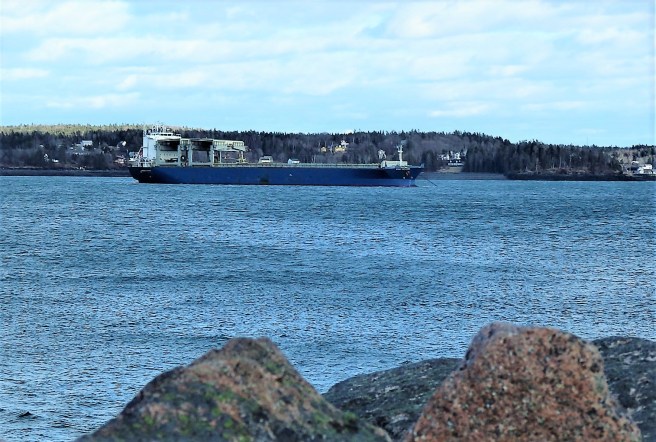
While washing dishes one night shortly after moving to Eastport, I noticed strange lights between a neighbor’s house. So I went upstairs with my binoculars and still couldn’t make out much, other than it appeared to be a ship. Or maybe two. It definitely wasn’t one of our fishing boats. Here’s how one of the big freighters looks in daylight.
This ship sits at anchor while awaiting the harbor pilot to board and direct the critical final moves to the Eastport’s commercial terminal. I do have to wonder how the skipper can see anything ahead from the bridge so close to the stern.
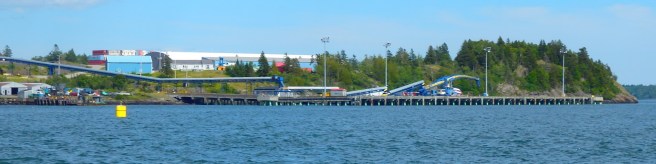
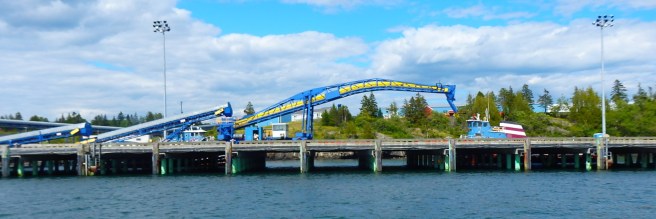
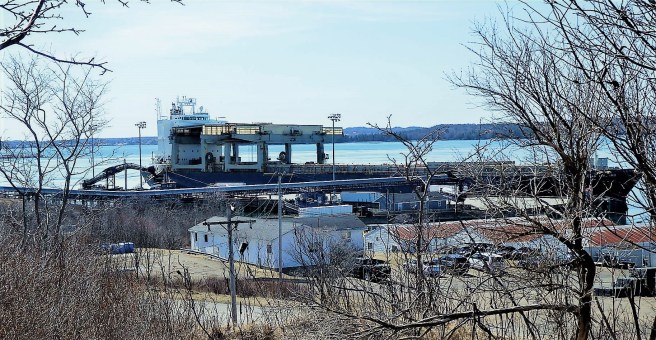
The Breakwater downtown isn’t the only important pier in town. The Eastport Port Authority also operates the Estes Head Cargo Terminal around the curve to the south. The 55-acre, high-security site includes warehouses, an aerial conveyor, and two berths. It’s where the big barges and oceanic freighters pull in.
The cargo terminal from the water.There are even tugboats.
It’s also the deepest natural harbor in the continental U.S., with the Breakwater close behind.
The name of the ship, its cargo, and its destination will be reported in the shipping activities log on page 3 of the next edition of the Quoddy Tides.
Most of the shipping these days is exports of wood pulp for paper production, though recent cargo has included delivery of giant blades for the wind farm electrical generators in Hancock County. .
Seems a shame they can’t drum up more business, try as they might.
you have no idea how long since I even allowed myself the luxury of dreaming like this, it’s very healthy, I’m told, hmm, as plane tickets to Dallas! (naw!) (just kidding!) security deposit on a new apartment, so I can move from this one; then use the returned deposit here for some of the foregoing, cunningly
I’ve mentioned my bewilderment at the failure by the Church of England to serve its communicants in New England during most of the 1600s.
As well as the fact that Dover’s First Parish could have been the first Baptist church in America, beating Roger Williams in Providence, Rhode Island, by a year.
What perplexes me is that I find nothing in New Hampshire before almost 1800, although there was a church in Boston, a place where Friends struggled.
The fact is that the Baptist tradition originated as a liberal movement. We’ve seen threads of that continuing in Jimmy Carter and Bill Moyers.
In my research, I kept coming across fleeting references to Baptists during the years before the American Revolution, but curiously not much outside of Rhode Island to indicate ongoing activity in New England. They were not singled out like the Quakers as great dangers to social or godly order, even though they were still outlawed and ridiculed. Did they meet secretly, perhaps even at times other than Sunday morning? None were hanged in Boston, for one thing. In New Hampshire, they had only three congregations by 1770 – Newton, founded 1755; Madbury, adjacent to Dover; and Weare, which had a strong Quaker presence. Still, as I sense, theirs is a crucial history yet to be written.
Considering all the furor around minister Hanserd Knollys’ brief tenure in Dover, just before he began preaching definitively Baptist doctrines, as well as the support he had, I keep wondering about his legacy in the Piscataqua settlement. Somehow, he set off an unorthodox flame in the community, at least by Puritan standards.
Curiously, as I considered the matriarchal role in the continuing nurture of a faith tradition, the path led back to Thomas Roberts and his wife, Rebecca Hilton. This time I chanced across not their Quaker impact but rather a Baptist one.
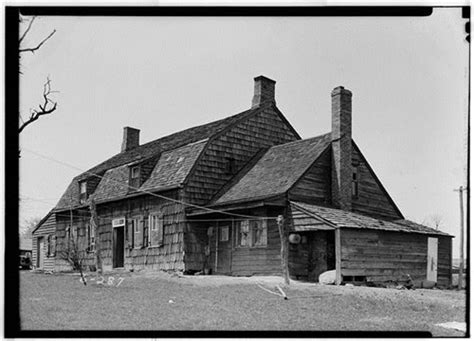
Hugh Dunn Sr. built this house in New Jersey after moving from the Lamprey River and Dover in New Hampshire. He was one of the original settlers of Piscataway and a founder of the Baptist church there.
Their daughter Esther – also recorded as Hester and Easter – born around 1625 and one of the first English children in New Hampshire, married John Martin (also Martyn) around 1645 in Dover. He descends from Mayflower arrivals in Plymouth Bay. After a round of public service, they relocate to Oyster Bay on Long Island, perhaps among those who flee to avoid persecution, but in 1666 move on to New Jersey shortly after the British seized it from the Netherlands. Joined by Drake, Dunn, Gilman, Hull, and Langstaff families from New Hampshire, as well as other Baptist New Englanders, the name Piscataway soon sticks to their New Jersey community, reflecting their Piscataqua roots. Theirs was perhaps the seventh oldest Baptist congregation in America. The colony itself came under Quaker proprietorship in 1675, assuring religious liberty. Think about all that the next time you’re driving along the New Jersey Turnpike and see the signs for that exit.
That’s the last I find of Baptists in New Hampshire until a Scammon from Stratham on Great Bay – a surname that appears early among Friends – weds a Rachel Thurber of Rehoboth in southern Massachusetts in 1720. Resettling in Stratham, she struggles for 40 years, making one conversion, before moving on to Boston and being baptized into its second Baptist church.
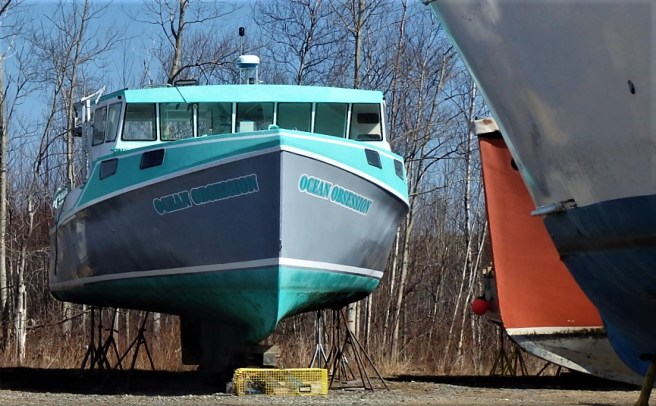
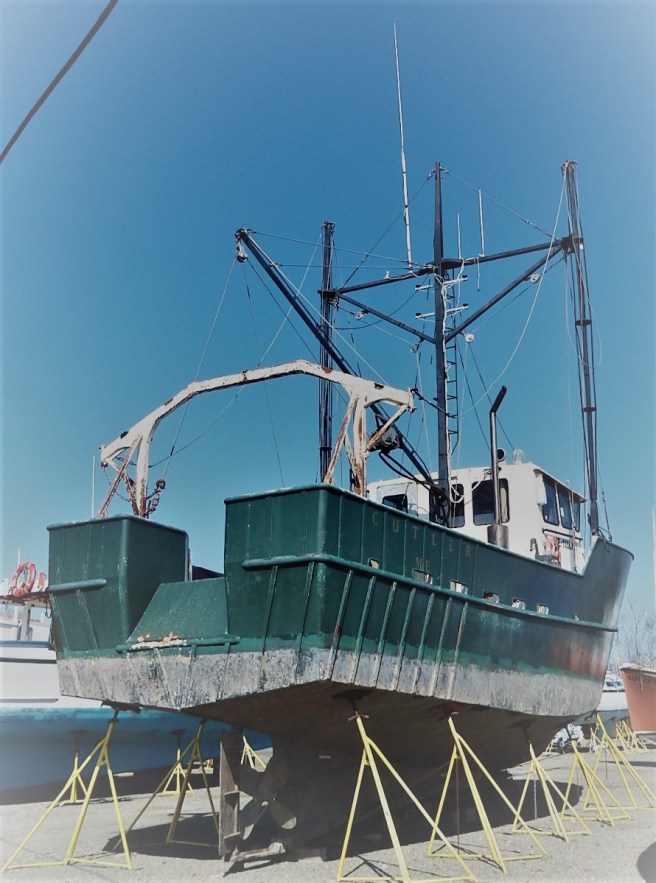
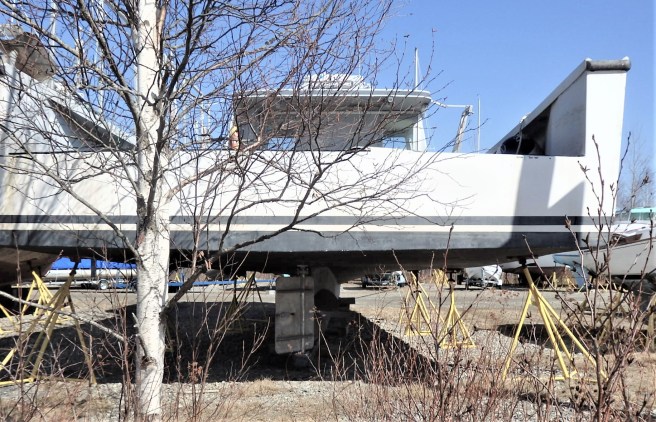
As I was saying?I wonder about all the different shapes and their reasons. This one’s obviously meant as a workhorse.And in profile.Can’t help thinking of a ’66 Chevy every time I see this.
If you’re anywhere near Dover, New Hampshire, on Nov. 5, feel free to stop by the Quaker meetinghouse for the official Quaking Dover book release party.
The meet-and-greet event takes place at 7 pm at 141 Central Avenue and is free and open to the public. As a Covid precaution, we will be masking.
Copies of the book will also be available for purchase and author signing.
In the meantime, it’s release date is coming up on Saturday. Check with your local bookseller to order a copy.
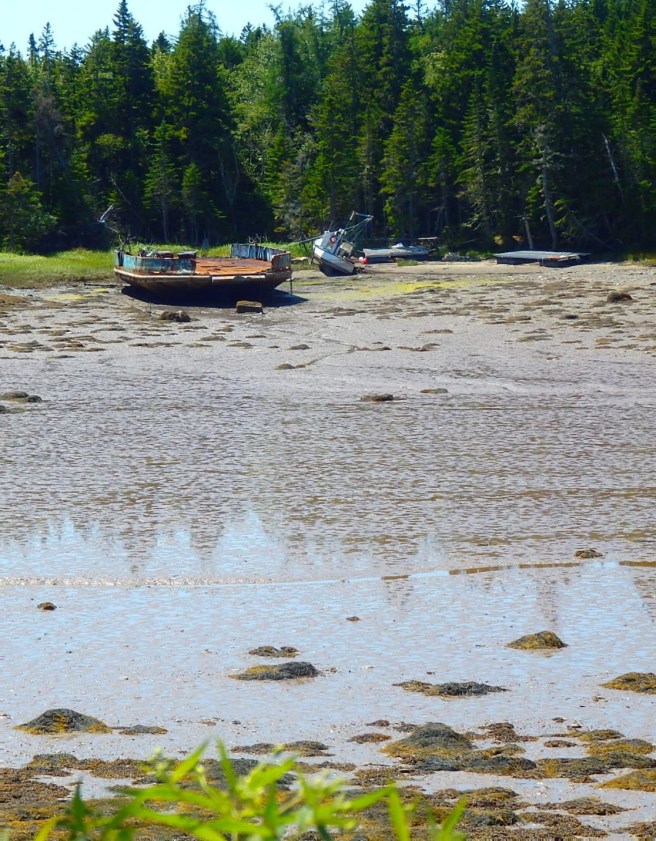
I do wonder about this scuttled auto ferry seen from a trail at Roque Beach State Park. It’s far from any center of population, and there’s no remaining top structure.
As seen at low tide.
Was it scavenged before being abandoned? Or even after? Did it fall victim to fire? Or a storm? Somehow it was run aground along what’s now thick forest.
“Quaking Dover is a delightful and informative read. Thanks for your good work!” Beth Collea, Dover
“Truly interesting. I truly appreciate all the work and careful thought and interpretations you put into it.” Canyon Woman, New Mexico
“I really like your voice. It’s engaging, light, and easy to read.” Jim Mastro, science fiction author
“Love it!” Susan Wiley, Sandwich, NH
“I enjoyed your conversational writing style – sharing the research that you did — and confidentially whispering (in your writing style), ‘This is what this finding means and how it should be interpreted.’ … To ascertain what really happened you checked primary documents, read previous accounts of Dover, New Hampshire – triangulated your sources and showed us readers how you reached your conclusion. A very enlightening read — well researched, well written.” Joe Clabby, author of A History of Eastport, Passamaquoddy Bay, and Vicinity

 Jnana's Red Barn