There’s even an old gray wizard and his conjuring book

My favorite – and least expected – story from Annie Pinkham’s historical sketch of Dover Meeting includes a profile of Ambrose Bampton, who appears in Whittier’s “Snow-Bound” in the couplet, “We stole with her a frightened look / At the gray wizard’s conjuring book.”

Friends carefully avoided anything smacking of superstition, yet Bampton (1717-1790) had a local reputation for possessing “certain powers of disclosing the unknown and declaring the coming of future events with remarkable accuracy. To him resorted farmers who had lost their cattle, matrons whose silvers spoons and other treasures had disappeared, or maidens whose sweethearts were among the missing.”

Known as the Sorcerer, he may have been a continuation of traditions handed down in Devonshire, England, possibly through his mother, Hannah. “The meek-spirited old man received them all kindly, put on his iron-rimmed spectacles, opened his conjuring book, and after a season of deliberation, gave the required answer without money and without price,” in Pinkham’s telling.

Devon, a county southwest of London, is the origin of many of Dover’s early settlers.

Once, when a group of young people came to him for advice, he said to one of the girls,

“If ever thee marries anybody, thee will marry me.” She replied, “I would marry the devil first.”

A clue to her reaction might be hinted at in a notation that at the time of his death, he was said to weigh 400 pounds. I have no idea where Whittier had him already gray at this point.

The girl was a Quaker, Rebekah Austin, the daughter of Nathaniel Austin and Catherine Neal. Contrary to the prediction, she wed in 1745 with Simeon Hill in the manner of Friends. But five years later, as a widow, she did in fact marry Ambrose, again in a Quaker service. He had left First Parish and rejoined Dover Meeting. She predeceased Ambrose in 1802.

Ambrose’s father, John, was a member of Friends by 1705, so there were Quaker threads to build on.

Besides, I look at him as one more confirmation of my sense that some Friends are far more psychic than we’d let on.

~*~

Check out my new book, Quaking Dover, available in a Nook edition at Barnes & Noble.

Welcome to Dover’s upcoming 400th anniversary.

My messenger bag

I get a lot of compliments on my gray messenger bag. It goes almost everywhere with me, containing my reading glasses, cell phone, camera, and emergency meds, as well as maps, notebook, and often reading. This is yet another of those accidental shots when I’m recharging or handling the said Olympus.

Looking ahead to the year 2050

I’ve been part of a study group that’s been trying to envision a sustainable future for our small corner of the globe.

It’s been an exciting exercise, actually, looking for ways we can enhance what we have in conjunction with neighboring communities.

But it’s also terrifying, when we look more broadly.

Nine billion population, up from one billion when I was born. Can the globe really carry that load? I’m doubtful, but maybe.

Let’s start with increasing urbanization. I was blown away by the fact that 75 percent of Britain is considered urbanized today.

Add to that global warming. The regions where population is booming will be scrambling for food and water. Yes, water becomes essential. As well as ways to earn a livable income.

Now consider the automation of many jobs, something that points toward income readjustment, which is being largely ignored in public discussion.

Get political, and Republicans are in utter denial about all this, something I find deeply troubling. Engage, intelligently, will you? The future of humanity is at stake. Or are you really dinosaurs, just looking only for your next meal?

According to the projections, I’m in a good place to survive this – or at least my descendants are. Yeah, the ocean will be closer to our doorstep, even if we are higher than the downtown we adore. Still, the directions on the charts point to a lot of turbulence ahead, especially desperation and violence.

Here, in these workshops, we’ve been looking at the enhanced value of tourism, seeing our place as a pocket of natural wonder. As much as I love that projection, I doubt things will be that easy.

Will Florida actually be off the map by then, along with all of its reactionary politics? Or maybe those partisans will still be denying global warming would ever happen.

Where do you see the world in just 30 years?

Or even in just six, 2030?


It doesn’t always have to be spectacular

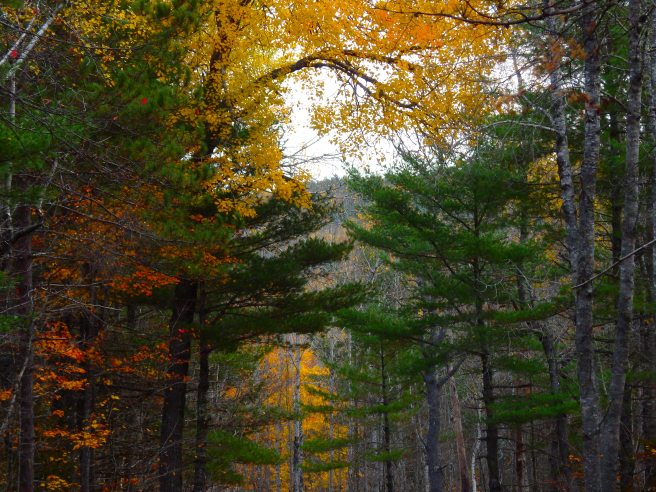
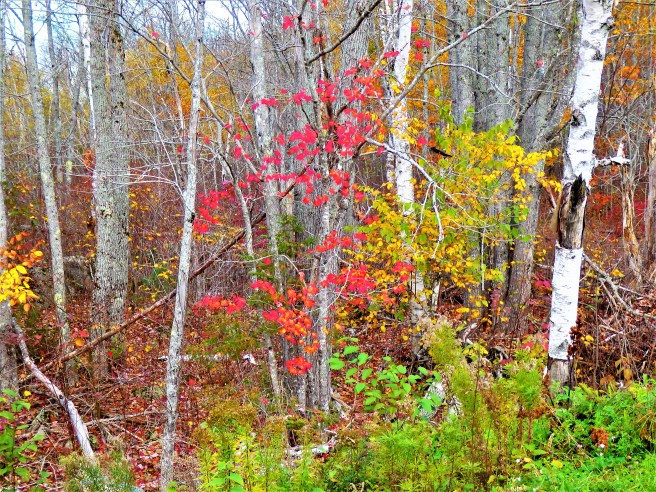
A fringe of intense red in swampy ground is often a vanguard of the changing foliage.

Let me be honest and admit that the most amazing fall foliage I’ve seen was in 1970 in the Susquehanna Valley of New York and neighboring Pennsylvania. I’m not sure how it would stack up today, if I had a way of reviving the actual color, but the experience was unlike any before or since.

I was fresh out of college – free of being cooped up on campus and indoors. I had my own wheels and a job that had me free by midafternoon, when the angular sunlight was kicking in. And the local forests blended the species of New England with those of the middle Appalachians. What I had known before was Ohio and Indiana, without the big foothills that propped the forests up before my eyes like giant canvases or, from the crests, arrayed them below me like vast quilts punctuated with villages and farm fields and meadows.

I suspect another major factor was a killing frost by late September, which would intensify the color and make, officially, Indian summer. With global warming, that frost has been delaying until all of the leaves have fallen.

All the same, living in New England for nearly half of my life now, I recognize how profoundly the autumn change strikes the region. My in-depth reflections and accompanying photos from New Hampshire are found in the archives of my Chicken Farmer blog. Do go there, if you can. The posts and slideshows appear in the New England Spirit category from August through October 2013.

What I’m now encountering is Coastal Downeast Maine, with its own variations. The forest is largely evergreen, which of course stays green. But it does provide a solid background for the deciduous trees as they change.

Having written that, I encounter an early morning drive across stretches where everything is perfect. The foliage is prime, a full range of the palette, nothing holding back. The temperature’s still chill, so maybe they’ve already had that hard frost up here. Better yet, the sunlight’s brilliant buttery and straight-on, rather than overhead, illuminating the leaves from the side facing me.

It reminds me of other “oh, wow!” epiphanies in northern New England that no doubt would equal or even surpass the year further south that set the standard.

So here’s a taste of how it happens around here.

The trees don’t all change color at the same time.
Evergreens do provide a strong background.
A few dramatic splashes.
It’s not always the panoramic view that counts.
On the other hand, when you’re faced with this at a bend in the road, how can you not be awed?

Favorite canines from a non-dog lover

Eastport is filled with dog walkers, even more than Dover was, and their perspicacity in making the rounds umpteen times a day amazes me. What else do they do with their lives?

Don’t count me as a dog lover. I grew up having cats. You never step in their poo or take them for walks. And now, rabbits. Ditto.

That said, here are some dogs I’ve had to deal with, one way or another.

  1. Grimm. The one in Mike Peters’ comic strip. I had a small role in getting it rolling. Still love the caustic humor.
  2. Rin-Tin-Tin. A frontier mascot in a TV series we watched back in the black-and-white days of TV. Gee, how could I forget Rusty, orphaned in an Indian raid, much less the fact his dog was a then-exotic German shepherd or their home was a U.S. cavalry outpost? I always wanted a pair of gloves like the lieutenant’s.
  3. Lassie. Another TV star. Gee, when’s the last time you saw a collie? They used to be everywhere, in no small part because of this show.
  4. Silas. Our neighbor’s German shepherd back in Indiana. He appears in my novel, Nearly Canaan.
  5. Sal. The big pit bull my younger daughter and her roommate rescued from a shelter. An amazing animal who had one unacceptable quirk. This story ends sadly.
  6. Our neighbor’s Irish wolfhounds. They would hang over the six-foot fence separating our yards and howl mournfully. Maybe they knew their lives were doomed to be short, a problem with huge dog species.
  7. Blue. Maybe you know the song? “I had a dog and his name was Blue, bet you five dollars he’s a good dog, too.” Get me the Kleenex.
  8. Pluto. The mopey Disney cartoon character, not Roman mythological ruler of the underworld. Back to childhood, naturally.
  9. Simon and Schuster. A pair of basset hounds walked around here by an aspiring writer and her dutiful partner.
  10. Snoopy. Back to the funny pages, we have Sparky Schultz’ classic and patient observer of human folly. I didn’t appreciate him until he was nearing the end of his run. I think Mike Peters’ wife had a role in opening my eyes here.

Honorable mentions to Fang in Harry Potter or Toto in Wizard of Oz. If only I were a fan of those works.

And then there’s Argus, Odysseus’ faithful canine in antiquity, despite the fact the Greek hero hadn’t fed him for 20 years. Oh, for such loyalty anyway! Some commentators note a contrast to problems our hero will face with his wife.

Tell me about your dogs. Please!