What is the magical connection of deep red wine and dark chocolate? Or of steak and ripe red tomatoes?
Month: October 2022
A touch of Philadelphia, too
Business opportunities lured some Dover Friends to more lucrative destinations within the changing economy. With their many Quakers, Lynn, Massachusetts, and Philadelphia, especially, beckoned.
As a widely repeated quip goes,
Friends went to Pennsylvania to do good, and they did very well, indeed.
Among those who went to Penn’s Fair City was Lydia Brown Hanson’s nephew Moses Brown (1793-1878), who left Dover in 1815 to join his brother Jeremiah in the domestic textile trade. Moses, I should emphasize, was not the famed Rhode Island Quaker. These were the sons of William Brown and Abigail Peaslee, whose daughters Lydia, Alice, and Anna all married under the care of Dover Meeting. The brothers’ move to Pennsylvania came the year after the first textile mill in Dover was built – were the Browns selling its fabrics?
In Philadelphia, Moses had the good fortune to marry Mary Waln Wistar, a descendant of a socially prominent Quaker family, and their son Thomas Wistar Brown was born in 1826.
Described as a successful dry goods merchant who never went to college, T. Wistar Brown became a self-taught scholar and patron of education. A long-time manager of Haverford College and for 25 years its board president, he gave the college three professorial chairs and much of its old library and books, among his many philanthropic endeavors.
His profile calls him a quiet man of strong faith and convictions – including a refusal to succumb to the use of the telephone and automobile. As a young man he had followed Abraham Lincoln on horseback on the way to the first inaugural, and he saw Lincoln’s Vice President, Hannibal Hamlin, spattered with mud after a hairbreadth escape from an assassin’s bullet. During the Civil War he escorted the wife of his cousin, General Isaac Wistar, through enemy lines to visit her husband at Fort Monroe.
He was also a founder, with other Quaker businessmen, of the Provident Mutual Life Insurance Co. of Philadelphia.

When he died in 1916, the Evening Post of New York in a long tribute said of him: “There was a blend of the stoic in his Christian resignation; he saw much and suffered much, gained much and lost much. He was one of the last of the old generation of Quakers who inherited from their forefathers discipline and patience, silence, and self-control. He faced life with quiet fortitude.”
He is buried with his wife, Mary Farnum, and other kin in the T. Wistar Brown Cemetery, now managed and used by Dover Monthly Meeting.
At times I do wonder if the City of Brotherly Love is reflected in the naming of some of Dover’s streets – Arch, Chestnut, Locust, Maple, Spring, Central, Broadway (from Broad) – as a result of the Philadelphia connections. A number of the city’s other streets carry Quaker family names, including Hill Street, named for a Varney and Hill land development partnership rather than its inclines.
~*~
Check out my new book, Quaking Dover, available in a Nook edition at Barnes & Noble.
Welcome to Dover’s upcoming 400th anniversary.
Some of my favorite food flavorings and spices
In my relocation, I’ve often been on my own. And that means fully recognizing my tastes in food, rather than relying on my wife’s memory of what delights me.
Let’s go.
- Real vanilla. And yes, I now know there are differences between Mexican, Madagascar, and Indonesian beans, which are really orchids. These are quite distinct from that artificial stuff, by the way. And for the record, I’m not a chocolate guy, but if you must, make it dark or white but not in-between.
- Butterscotch and toffee. I’m a sucker.
- Butter or olive oil. As my wife says, quoting others, fat carries the flavor. One, though, is better than the other in the cardio category.
- Garlic. Onions and I don’t get along, but this alternative is glorious, especially in the ones we’ve raised. It even saved our marriage.
- Leeks. Ditto.
- Miso. I’m fond of Japanese cuisine, OK?
- Rice vinegar. As I was saying?
- Sesame oil. Ditto.
- Rosemary. Maybe it’s the way it goes with lamb and other Greek dishes. Or simply the way we grow our own.
- Fresh, coarse, ground pepper. Anything wrong with the basics? Well, we could add parsley or basil here, if we wanted.
What would you add? Or maybe subtract?
Point by point
“I looked out in the yard and seen a magnificent eight-point buck eatin’ apples.”
Wild ones, fallen from the tree between us.
“And the velvet was gone from his antlers, right?”
“Yep.”
With only a flash a few days earlier, I had noticed something different in its bearing. Like being a kid no more but a handsome young prince. One with a shiny sword ever so proudly.
At first, I thought the ‘Mariner’ was a redundancy
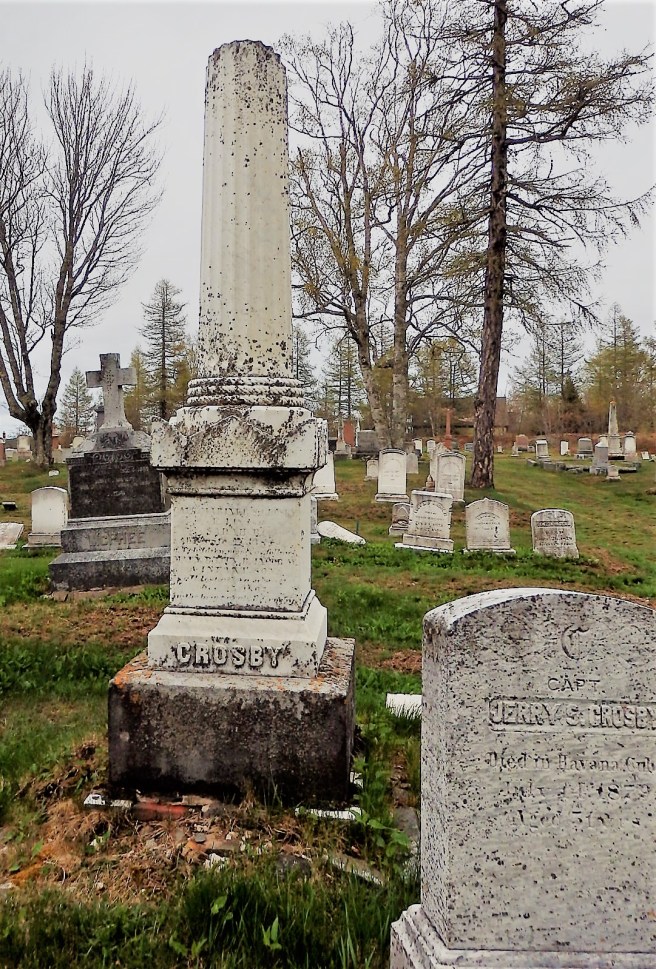
Capt. Mariner S. Crosby. Given his Christian name, it was inevitable that he would take to the sea. That’s what struck me the first time I wandered through Hillside Cemetery.
The second time I went to the graveyard, I was looking for that marker but couldn’t find it. Back home and at my computer, Find-a-Grave led me to the rest of the inscription, which is admittedly rather worn away, as well as some additional facts.
What I found was this:
“Lost at sea with his family and the Brig Sarah B. Crosby,” named for his wife. She and the four children, one of them an unnamed infant, are then listed on the white memorial – Jacob W., Mary B., and Lucy B.
The date of their demise is uncertain, “around Oct. 25, 1867” – in season for a hurricane or some other vicious storm, although a fire in a wooden ship can’t be ruled out.
I trotted back to the cemetery for a closer look. Here it is:
The Chamber of Commerce website reveals more:
“Mariner Crosby was the master of the brig ‘Maria White’ in 1852 and the schooner ‘Mary Jane’ in 1855. From 1861-1863 Mariner was the master of the barque ‘Charles Heddle,’ also built by C.S. Huston,” in Eastport. Around the corner from me, actually. “Mariner’s last command was the brig ‘Sarah B. Crosby,’ named for his wife, which was built in Pembroke. He commanded this vessel from 1863 to 1867 when the vessel was reported overdue. Mariner, his wife Sarah and four children, as well as the crew and passengers, were lost at sea without a trace.”
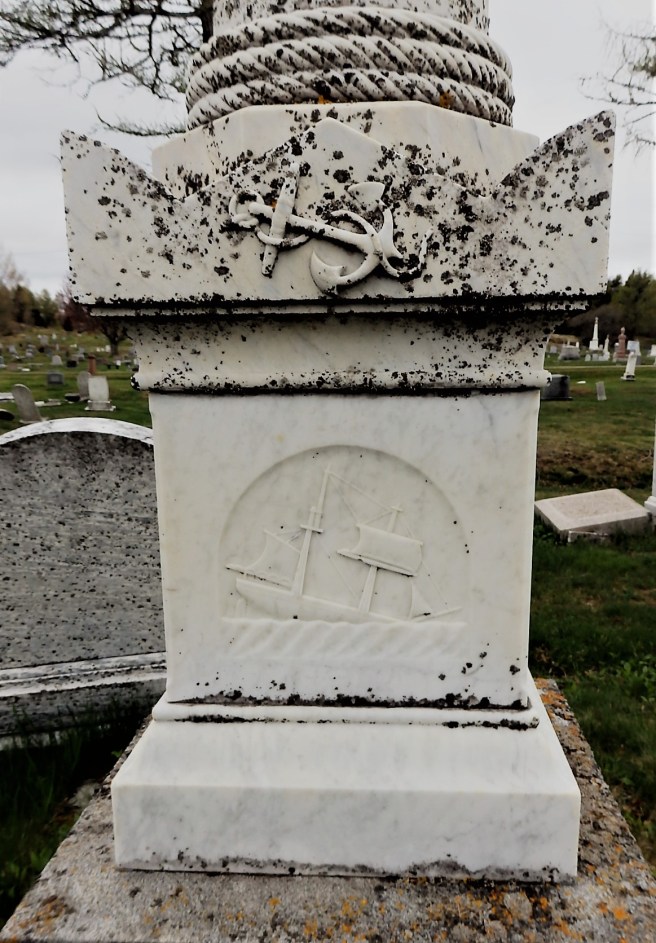
We’re not even told where the ship was bound, much less about its cargo, passengers, or crew. And a brig did require significant manpower to manage the massive square sails.
The two-masted 316-ton “Sarah B. Crosby” was built in Pembroke by George Russell in 1863 and then based out of Portland, bound for ports such as New York and St. John, New Brunswick.
I started to investigate and found a bit more.
She knew the travails of the sea, having wrecked at treacherous Sandy Hook, New Jersey, on March 1, 1865, with the passengers and crew safely removed. And then, after being abandoned, she was reclaimed and repaired, with shipments of coal from Halifax, Nova Scotia, later in the year.
On March 19, 1867, the New York Herald carried this notice: “Brig Sarah B Crosby (of Portland), Crosby, Measina, Jan 27, with fruit to Lawrence, Giles & Co, passed Gibraltar Feb 16; has had heavy westerly gales, with snow and hail, and split sails. Mar 13, latitude 41 30, longitude 65, spoke ship Michigan, from Liverpool for London.” (Measina, a mystery unto himself, was first mate. They would have been just off England at the time this information was relayed.)
I would like to know more in general about wives and children traveling with captains. It turns out to have been common, with a significant number of the children being born at sea or spending a large part of their childhood there. Wives were partners with shares in the business, whether they went abroad or stayed ashore. They even learned navigation, but did not interfere with the cook aboard ship. There were strict lines of authority. Beyond that, what were Sarah’s views and experiences? Was she even related to the 1841 Robert Bates house a few doors up the street from me? She was only 33 or so at the end; there’s no age for Jacob, though Mary would have been around 11 and Lucy, only seven.
While Mariner grew up in Eastport, the son of a Nova Scotia immigrant, Sarah was the daughter of a hotelier in Calais, Maine, best I can tell. Her father came from Massachusetts; her mother, New Hampshire. Mariner Crosby and Sarah E. Bates were married in Eastport February 12, 1855, by the Baptist minister Nathaniel Butler, of note himself. We have no idea how they met.
Mariner came to the sea naturally. At least two of his four brothers were also sea captains. Not just sailors or first masters but skippers.
Capt. Jerry died in Havana in 1879.
And Christopher Crosby led the racing yacht “Coronet” that defeated the “Dauntless” in a famed trans-Atlantic race in 1897. He went to sea at age 17 and was skipper by the time he turned 19. Yes, born to the sea.
And that’s as much of their story as I’m able to find, all prompted by one name in stone.
Kinisi 128
once, maybe only once, as in upon a time
she sent fruit
bitter with old women resenting the upstart
so who was the witch?
Witchcraft in New England before the Salem hysteria
Something I pretty much skip over in my history of Dover is the Puritan authorities’ close examination of the bodies of the early Quaker women missionaries for any signs revealing them to be witches, from 1656 on.
That was down in Boston, for one thing, and I’ve seen no indication of similar actions along the Piscataqua watershed in New Hampshire and Maine, the center of my new book.
But it has come back to haunt me.
Much of my argument regarding the readiness for a significant portion of the Dover population’s joining Quakers has to do with the ways they differed culturally from the Puritan majority in the Massachusetts Bay colony and Connecticut. What David Hackett Fischer terms “folkways.”
For example, in all of their fearful piety, what made the Puritans so morbidly curious about the naked female flesh, anyway? And just what, exactly, were they looking for? This gets weird, doesn’t it? I’m not sure I want specifics, as in details, much less in those parading through Salem, Massachusetts, these days in preparation for Halloween. I’ll have to admit that part leaves me feeling queasy.
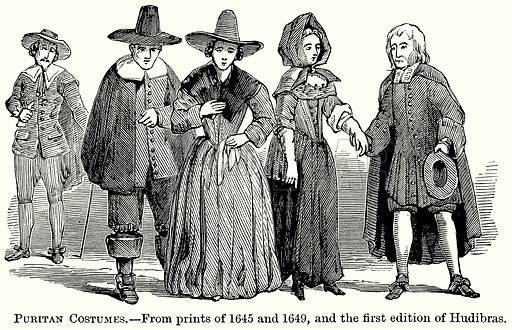
Just consider the stereotypical presentation of witches in pointed hats and black capes and then recognize how much that resembles the dress of Puritan women in New England at the time. As for flying on brooms? How strange! Just how did that conflation happen, anyway? Put another way, witches didn’t dress differently than anyone else. As for the brooms? Every housewife had one.
Well, maybe that points to the male authority role in all of this, something I’m perceiving as a gender power play.
Back to the Quakers. As historian Arthur J. Worrall explains, “Two groups of Quakers arrived in 1656. The first, led by Anne Austin and Mary Fisher, came to Boston in July. The Massachusetts government promptly imprisoned them for five weeks; after checking them for signs of witchcraft, they expelled them in August. A second group of eight Quaker missionaries came to Boston two days after their expulsion,” aboard the Speedwell.
“Massachusetts imprisoned this group for eleven weeks and expelled them also, after the clergy had examined and debated with them.”
For perspective, Fischer notes that from 1647 to 1692, the Puritan colonies accounted for ninety percent of the accusations and eighty-five percent of the executions for witchcraft in English-speaking America. That is, almost ALL of them.
Moreover, “In England, every quantitative study has found that the recorded cases of witchcraft were most frequent in the eastern counties from which New England was settled.” Specifically, the Puritan heartland, in the motherland and then in the New World.
“Even white magic was regarded as a form of blasphemy. In 1637, for example, Jane Hawkins was punished for selling oil of mandrakes in Boston. Many other magicians and sorcerers were treated in the same manner.”
So just what defined a “witch,” anyway? Anyone who drew on folk remedies? Or even a midwife who knew more than she was supposed to?
Fischer goes into ways the Puritans’ Calvinist teaching and likely their earlier folkways combined to make them especially fearful.
As I observe, Salem itself was a cauldron of controversy from early on and a place where the Puritan invasion clashed with the existing population. Like Dover, the Puritans were latecomers there.
I’m still curious about the zealot ferocity of the Puritan outburst at the time of the infamous mistrials in Salem, 1692, in a perfect storm that may have fused an outbreak of hallucinogenic ergot in rye, a clash between traditional ways of examination versus newer ones, a gap in the governorship and jurisprudence, and a drive to curb the influence of the now well in place Friends by attacking their servants instead. Many, many other factors, perhaps even the weather, likely also come into play. All of the other angles I’ve heard point in the same direction.
One of the overlooked aspects in all the controversy is how the witch persecutions in Salem solidified the collapse of the rigid Puritan reign in New England. In a way, the old guard overplayed its hand and had to bear the consequences. With widespread revulsion at the executions and their abuse of the court system, a new strand of teaching and emphasis emerged in the Congregational churches. In another century-and-a-quarter, many of them would even become Unitarian, a far cry from the Puritan orthodoxy.
What makes witches so romantic for so many today?
Did the accused “witches” have their revenge in the end?
Too many zeroes for zero
as I repeated through hazy defaced New Jersey and New York via Fort McHenry Tunnel just before afternoon traffic congealed, Singing along, too, just see what you’ve done? all your fault, baby (ask me about the Greek who got a banker’s check from France with a few too many zeros which the local bank cashed so he abandoned his Dairy Queen and fled home with several million in his pocket and the FBI on his tail . they couldn’t find him but our reporter did . good old Gus.) Carnally encased desiring a conjunction of such calculations
This sight caused a shudder
When I was last in Dover, 18 months ago, the downtown was booming with construction. But on my return a few weeks ago, when I first glimpsed this rising over Central Avenue, I thought a skyscraper was going up and I’d somehow missed the news.
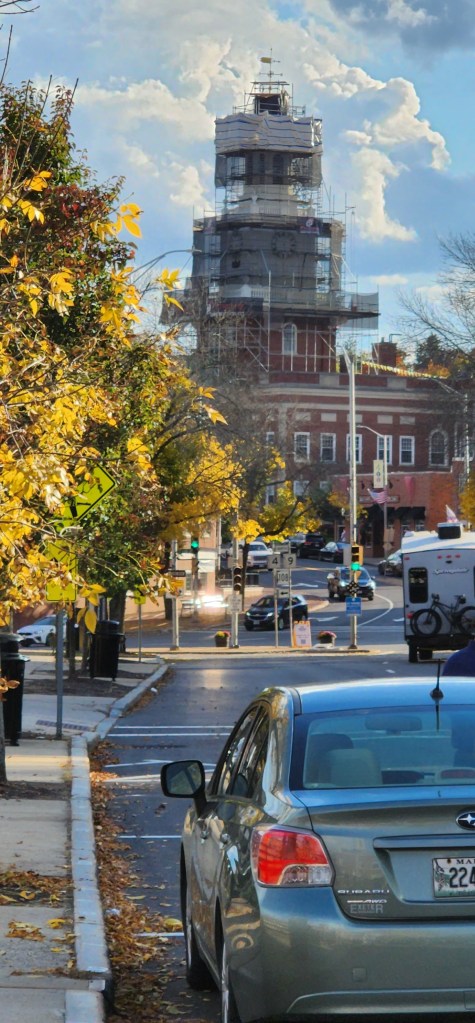
A second look, though, had me realizing it was the clock tower on city hall, getting spiffed up for the city’s big 400th anniversary next year.
Well, it kind of look likes a space rocket about to take off, too.
Banners proclaiming that event are already along the major streets.
Obviously, some lawyer’s dream get-out-of-jail-free card
Came with the product.
Warning:
Do not use this product if you are
- A child under the age of 12.
- Immobile or incapacitated.
- Diabetic or insensitive to heat.
- Anyone who cannot clearly understand the instruction and/or operate the controls.
It’s the last one that really rings out.
 Jnana's Red Barn