The best poem I’ve ever read in nearly six decades of the New Yorker is one that wasn’t even presented as one of its two weekly poetry selections.
Instead, it appeared recently within a theater review, where the play under consideration reminded the critic “of the late poet Essex Hemphill, a master of frank desire whose smart, life-hungry speakers toss of lines like these:
I am lonely for past kisses, for wild lips certain streets breed for pleasure. Romance is a foxhole. This kind of love frightens me. I don’t want to die sleeping with soldiers I don’t love.”
A bit later comes a couplet from a different Hemphill poem:
I am beautiful. I will endure.
~*~
My, how I admire the directness of those lines, their acerbic observations unencumbered by literary aspirations.
Yes, he skirts the imagist realm of so much of my own verse but somehow, to my eyes, averts any preachiness that can come from the subjects he’s examining.
What hits me the most is the clarity and intensity of his self-examination.
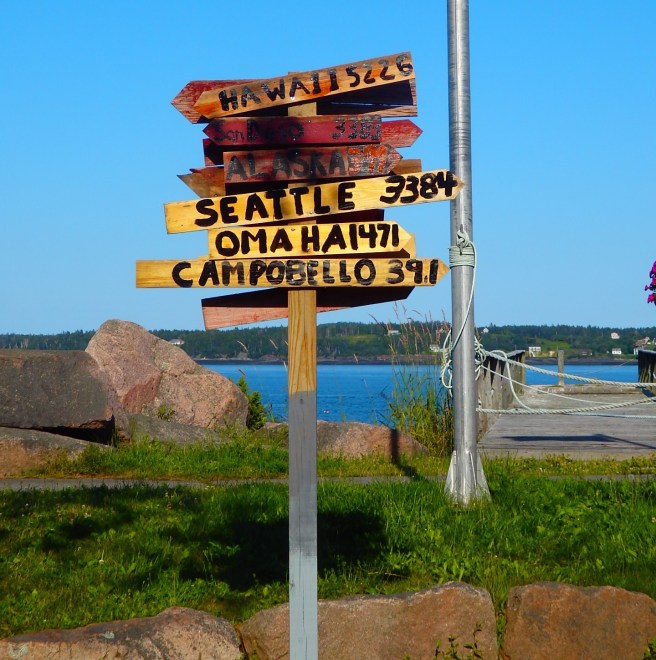
While driving from Eastport to Lubec, kind of in the neighborhood, as it were, I got to thinking about how far you could get from one point to another in the same hour elsewhere. Sometimes, it led to a lot more options.
When I arrived in the Granite State 35 years ago, I expected to be spending a lot of my time in the mountains to the north, but that never really materialized. I’ll blame my quest for love, usually found down in Boston, in the opposite direction, back before I met the woman I adore.
Contradancing soon claimed a lot of my social attention, with regular events across the state, across the border in Maine, and especially in Concord and Cambridge, Massachusetts. Add to that all of my time hunkered down in my literary endeavors or Quaker activities, even before I started singing in an incredible choir weekly in Watertown, just outside Boston, or swimming laps daily once I’d retired from the newsroom.
Whatever the character ultimately is, I found sufficient nurture and inspiration to do some good work. Gee, that’s starting to sound like Garrison Keillor.
Each of the six states, by the way, has its own character despite the overall New England identity. In general, those New Englanders are friendlier than their reputation for aloofness contends. It’s just that they’re more reserved – respectful of your privacy – but open up with a sparkle, for the most part, given a hint.
So here’s what I learned while residing in Manchester and then Dover.
New Hampshire isn’t as archconservative as I had expected. Not that it doesn’t have a lot of blockheads, but the place was definitely shifting, especially along the border with Massachusetts.
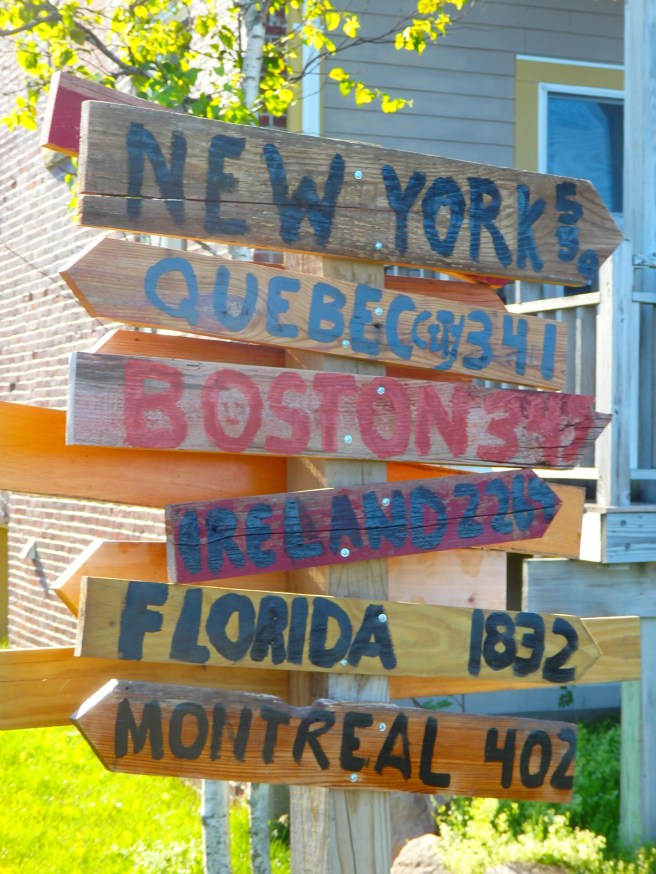
A large portion of New Hampshire residents have roots in Quebec, and others in Ireland, providing a significant Roman Catholic presence. Both reflect the textile-mills workforce in the 1800s. But other ethnic minorities have thrived, too.
At heart, the population is largely blue-collar in outlook, generally practical, but these days, half of them come from other states, especially Massachusetts.
Some of us used to joke that the stereotypical New Hampshire male had a Harley and his wife or girlfriend had big hair. That wasn’t far off the mark. Add a snowmobile, more than downhill skis or hockey skates.
Agriculture isn’t a major economic factor. There aren’t many large commercial farms these days. And what farming exists is typically diversified.
There are relatively few large employers. The commute to Greater Boston and back each day is huge – that’s where the paying jobs are.
That also means few deep pockets for the arts and charitable action.
It’s the most perfect test market for presidential candidates we have. Forget trying to find the ideal demographics, this delivers.
Avid Red Sox and Patriots fans abound, with Celtics and Bruins supporters close behind. Keeping up with the teams’ developments is socially important. College sports, on the other hand, hardly matter.
It might not have a sales or income tax, but you still have to pay for public services somehow. And so your property tax or apartment rental rate will be a whopper.
On one hand, they’re proud of having voted for the candidate and want you to know they did, but on the other hand, they want to distance themselves from any culpability for his actions.
Will somebody tell them, “You can’t have it both ways,” as a citizen?
Grow up and take responsibility for your choice, which includes the possibility of repenting in the light of reflection or otherwise being party to the vulgarity, insults, lies, and the general mess he’s left the nation and world to endure. (Reflection? We’ve never heard him admit he’s ever done anything wrong, which means he’s never even said he’s sorry for anything he’s done. Mistakes are always someone else’s fault. That would put him a bit higher than Jesus.)
There’s no denying the loser’s the king of blame, casting censure on everyone but the one-and-only he faces admiring himself alone in a mirror. I, for one, am exhausted by the gush of blame that’s been poured on what we’ve treasured and join.
So, yes, be prepared to be blamed or praised.
Voting is a serious responsibility, folks. Embracing what your candidate has done, in and out of office, ultimately reflects on your own values and character – and we’ve all had to face the ugly consequences.
Before blaming Biden for things like higher fuel prices, see instead how they stem from the Donald’s encouragement of his Russian pal, Putin. As for inflation, how about those fat checks the fed government handed out with Donald J. Trump as the signature?
Running deeper in this is the denial that the American political system is based on a multi-party dynamic, with the minority serving as a loyal opposition. There’s been nothing loyal about this GOP, not since it turned obstructionist back before Obama. Instead, it’s been trying to wreck the machinery of a just republic. That identity is anything but conservative.
If you’re proud of his true record, stand up. But face it all, not just the cherry-picked Fox version.
And don’t think you’re above blame or shame.
A good dose of humility is a virtue.
Shame on you, if you’re trying to shirk off the consequences of your vote.
Have to confess the Red Barn posts have been moving along on schedule, but just not as many or as varied as usual.
Seems I’m not alone that way, here on WordPress or other social media, for that matter.
On this end, I’m knee-deep in trying to get a big project in gear – the part that follows the publication of a new book, which is just around the corner. These next steps are time-consuming and emotionally a roller-coaster. I’m always feeling I’m way behind there, as well as uncertain of the way.
As a complication, about a month ago I suffered a physical fall in the middle of the night and was reminded once more how fragile the body gets in older folks, aka the elderly, and how risky that can be when living alone. I’m still feeling some of the aches after the bruises and what else and won’t be resuming the twice-a-week fitness classes till after Labor Day.
Quite simply, that’s slowed me way down.
And then there was my week at the annual sessions of New England Yearly Meeting of Friends (Quaker) off in Castleton, Vermont, now that we’re gathering face-to-face again. Getting across northern New England, however, is a remarkably drawn-out trip, no matter how stunning some of the scenery can be. I did see parts of Maine, New Hampshire, and Vermont for the first time.
Weighing on me especially has been the surreal political and social nightmare unfolding here in America. It’s not just Trump, either, but closer to home the threatened return of Paul LePage to the governorship of Maine. Trying to write about that has been paralyzing, and the news developments keep mounting at a dizzying pace.
So here we are and summer’s almost over. It hasn’t exactly felt lazy.
As I detail in Quaking Dover, my history of New England’s third-oldest permanent settlement, the odds against success for early European settlers were nearly overwhelming.
It wasn’t just the English, either.
The French made their first attempt just up the coast from Eastport, where Samuel de Champlain selected an island in what’s now called the St. Croix River at the western edge of the Bay of Fundy or, more specifically, its smaller Passamaquoddy Bay.
St. Croix Island, site of the ill-fated settlement, sits in the river separating the U.S. and Canada today.
The famed explorer was working for Pierre Dugua de Mons, a noble and Protestant merchant who had been given a fur trading monopoly in New France by the king.
Pierre Duguay had some big dreams.
In 1604 the expedition set about establishing a fortified trading post on the security of St. Croix Island and its tidal currents.
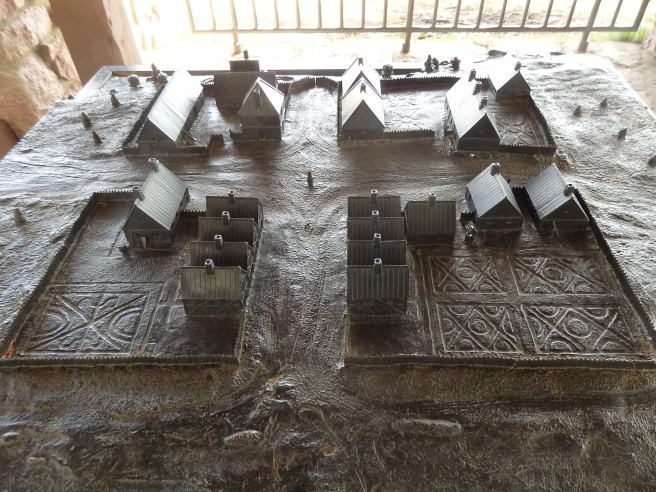
Here’s how the settlement on the island was designed. I’d say it was quite ambitious, especially compared to the small settlement that resulted in Dover, New Hampshire.The enterprise required many skills.Many of the workers were mere boys.
And then they settled in for the winter, ill prepared for harsh conditions that buried their compound under three feet of snow and iced in the river, cutting them off from fresh water and game.
The lack of fresh water, especially, was a fatal flaw in their plan.
By the time spring arrived, 35 of the French expedition’s 79 men and boys had died, many from scurvy. The remainder survived largely because the thawing river allowed Native Passamaquoddy to arrive and trade nutritious food in exchange for any remaining bread and other goods.
After the colonists’ health improved and ships brought new supplies and more men from France, they abandoned the island and relocated to what would become Port-Royal, Nova Scotia, soon the center of L’Acadie, or Acadia, a large and contested province of New France.
In 1607 the English then made two attempts of their own in the New World. Their Popham colony at the mouth of the Kennebec River in Maine fared no better, while the Jamestown settlement in Virginia managed to hang on.
In 1608, Samuel de Champlain successfully founded Quebec City along the St. Lawrence River. What we know of the St. Croix Island experience comes largely through his journaling.
Quite simply, we could have been speaking French here, had someone thought about drinking water earlier in the game. Or perhaps simply been listened to and respected.
~*~
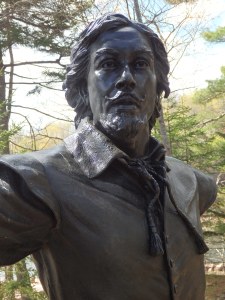
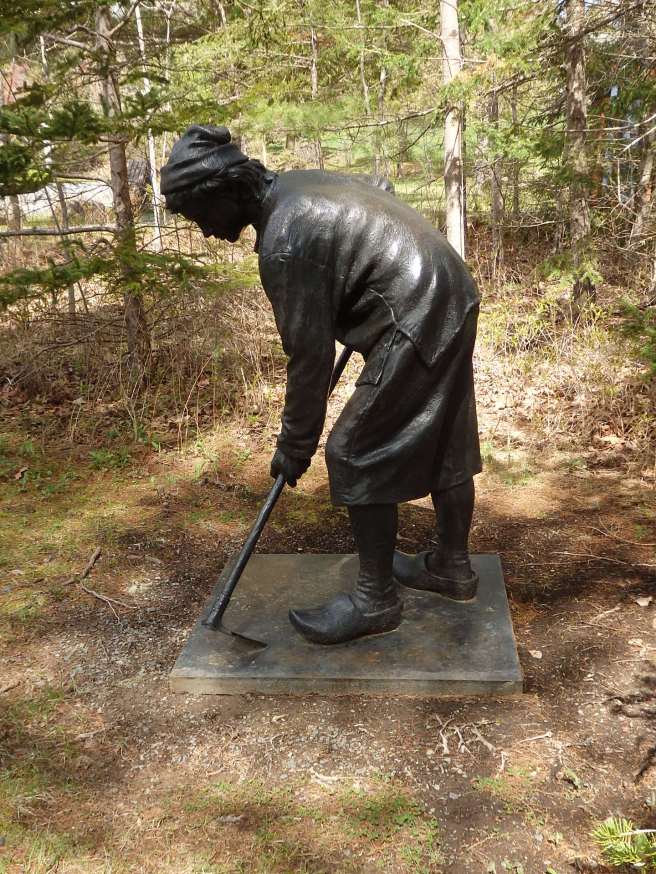
Sculptures at the St. Croix Island International Historic Site, Red Beach in Calais, Maine, are by Ivan Schwartz, Studio EIS.
Through much of its history, the Society of Friends was rooted in families, in contrast to today’s more individualistic lacework.
I use the earlier term, Society of Friends, rather than the more modern version, Religious Society of Friends, because Quaker practice emphasized all facets of one’s life, not just a spiritual component. We can argue about whether Friends worship is mystical or meditative as well as about our understandings of the nature of the Divine, but the faith has led us over our history to closely examine our political, business, educational, community, and family interactions. Often, as we’ve seen, from an intensely practical point of view.
It has been said that there are no Quakers apart from a Meeting, meaning that we need each other to hold ourselves to the path and practice. Families, too, need other families who share a similar vision.
When Friends had large nuclear families, three households could easily fill a small meetinghouse, especially when grandparents and unmarried siblings were included. As Quaker families intermarried over the generations, it became common for children to address everyone in Meeting, except their own parents, grandparents, or siblings, as aunt, uncle, or cousin. We can see how that would easily apply in Dover.
What I hadn’t expected when I began examining the genealogies of Dover’s early Friends was to discover just how intermarried their families had already become in the four decades between the arrival of the Quaker missionaries and the beginning of the Meeting’s surviving minutes. Some families were close even before that, suggesting religious conversions, “convincements,” often came within extended relations or among neighbors more than one by one, individually.
In other cases, some lines of a Dover family were Quaker while others hewed to the Congregational church. Even after a surname line left the Society of Friends, some individuals might later rejoin, and sometimes it is hard to determine precisely when or how. In addition, children of households listed in Dover Friends records might seem to disappear from further consideration when, in reality, their location was one finally set off within a newly recognized Monthly Meeting. In effect, their Meeting moved while they stayed put on the same land. A diligent researcher will need to go to those minutes to continue, if possible.
Compounding this, in terms of this particular history, is the fact that for some of Dover’s Meeting’s families, few or maybe none of the households lived within the current city limits. The Eliot, Maine, role – still officially in the town of Kittery – stands out, as do the Berwicks, in Maine, and Oyster River, now Durham, New Hampshire.
As long as a family was Quaker, we can make some general assumptions about its values and lifestyle.
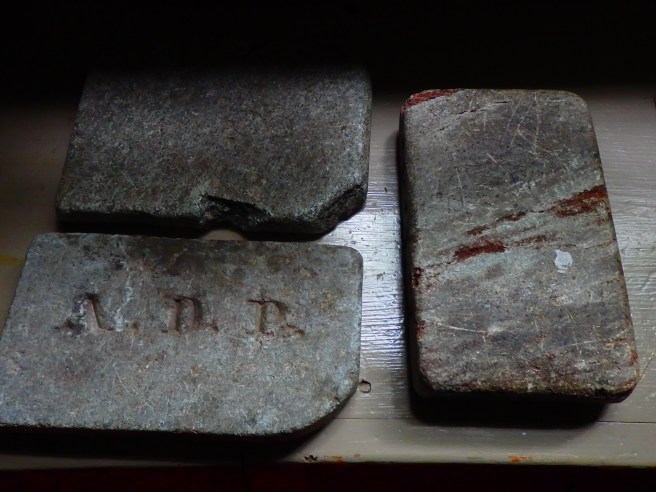
Through much of the history, neither the Congregational nor Quaker meetinghouses had heat in the winter. Instead, members heated soapstone cut like these and carried it in containers from home. I have no idea why they were given to the Meeting, other than a reminder of how tough those characters were.
In some ways, they were like Amish today, with distinctive dress and turns of speech, though choosing to “live behind a protective hedge” rather than separate more totally from the wider world. We’ve seen that Dover Friends were not afraid of speaking out in public and pressing for political redress, unlike the Amish.
Among the values were simplicity, plainness, integrity (honesty, no oathtaking), pacifism and nonviolence, equality of sexes and races. In addition to an avoidance of oathtaking, gambling and gaming, military service, Friends eschewed vain entertainments, including fiction, theater, dance, music, visual art. Science, mathematics, and poetry, however, were valued. There were no headstones until the 1850s. Nor did Friends take other Friends to court – differences were to be settled within Monthly or Quarterly Meeting. Quaker inheritance guidelines sought equal distribution for all the children rather than the bulk of an estate going to the eldest son – over time, raising the overall wealth of a family.
Anger, which commonly leads to violence, was curbed or suppressed – at a hidden price of burying all of one’s emotions.
Yes, the restrictions could be severe, but they also led to some remarkable accomplishments.
As I’ve reviewed Dover Quaker surnames, I find some moved out of the immediate area altogether. Others stayed, but moved completely out of the Society of Friends – still, their accomplishments were part of the larger society.
Even in a small community like Dover Friends Meeting, trying to keep the 41 or so surnames straight over several generations becomes difficult, but is a tight-knitted fabric of individuals and kinships. Sometimes, when I’m sitting in the silence of the meetinghouse, I feel that they’re also sitting with me. It’s a comforting, even strengthening, experience.
~*~
Check out my new book, Quaking Dover, available in an iBook edition at the Apple Store.
so where are the agents at the end of this uphill trial if you meet the test only to pack away crates of hallowed vials and jugs to haul northward for further aging the first time? that truly is such a big butt for such a tiny face



 Jnana's Red Barn