A map is seen much differently from the water

One awareness I’ve gained living in New England is that when you’re out on the water – say in a sailboat, fishing boat, whale watch, or ferry – the geography fits together quite differently than it does on the land.

For example, where I now live in Maine, it’s only four miles or so from our downtown to the one just south of us. That is, if you’re just looking, going by water, or a bird. To drive, though, you have to head north and loop around Cobscook Bay, a distance of 38 miles and about 46 minutes. At least it has no traffic lights.

The water perspective is especially important in understanding the dynamics of early Dover, centered as it was at Hilton Point and Dover Neck between the Piscataqua River and Great Bay. For example, the heart of the town of Kittery was in today’s Eliot, just a mile away by water but 18 miles by land. And today’s Kittery was ten miles downstream or even longer by land.

Hilton Point was just to the left of the “cat” in Piscataqua, while the Shapleigh Kittery House was just to the cat’s right. Getting there by land, though, means going all the way up to the Salmon Falls River. Even finding a map like this of the watershed can be a challenge. Usually, it’s divided by the state line that runs up the river.

Oyster River, or today’s Durham, was only four to eight miles to the west, depending whether you were stopping at wharves along the way or going all the way to the Lamprey River’s falls and the landing.

A trip by boat between Eliot/Kittery and Oyster River/Dover was – and still is – no big deal.

In fact, by water they were closer to Hilton Point than was the village at Cochecho Falls, today’s downtown Dover.

For perspective, I’ve read that a man on the Isles of Shoals thought nothing of rowing ten miles – six of them on the open ocean – for an evening in Portsmouth and then ten miles back in the dark.

In comparison, the relocation of families from Eliot/Kittery to Oyster River becomes much more sensible than a land-based movement would suggest, and much less puzzlingly.

Also, the boundary between New Hampshire and Maine largely dissolves. The watershed becomes the defining perspective.

In terms of understanding history, “Piscataqua” can mean not just the original settlement at Hilton Point but also the expansion across both sides up and down the river. That seems to be the case when Portsmouth, Kittery, and New Castle all claim a 1623 founding.

You might even say it muddies the water.

~*~

Welcome to Dover’s upcoming 400th anniversary.
 

Ways American democracy is increasingly at risk

Spoiler alert. This is a rant. Here are some of the places I see us as American society being in deep doodah.

  1. Out-and-out lies, delusions, and false expectations “Making America great again” has done the exact opposite. And ideological preconceptions block any reality of what needs to be done. It’s a great sales pitch, but if you’re promising to fix something, you better master the details. Think about making your car or computer or anything else run better and who you’d trust doing the job.
  2. The center is coming apart, along with the breakdown of face-to-face community. Who belongs to a lodge or bowling league or even a church anymore? Without those, just how are our opinions tested and refined? It’s part of a decline of civic awareness and participation.
  3. Refusal to give and take, i.e. compromise, to work out solutions for the common good. Health care is a prime example. Any faults with “Obama-care” can be laid at the feet of those opposed to any health insurance for Americans who didn’t have union jobs or the like. And we know who’s opposed those unions.
  4. Disproportionate representation by rural states. Not just the Senate, either, but especially the Electoral College, which was a faulty way of accommodating Southern slaveholders to begin with.
  5. Disenfranchisement of voters, one way or another. Want to talk about “stealing elections”?
  6. PACs and other big-money corruption, leading to the undermining of the middle class. It’s why the rich are getting richer.
  7. An uninformed electorate, along with the economic collapse of responsible journalism coupled with the tainting of “liberal media” by certain self-interests. Where on earth have the left-wing editorial page columnists been in the past half-century, anyway?
  8. Blaming the victims rather than the super-rich. Talk about “entitlement”? Add to that the myth of the “self-made man.”
  9. The collapse of the tax system. I’m no fan of the Internal Revenue Service, but it’s been gutted to let those with the most to get away scot-free.
  10. Without excusing the left for its too-often sanctimonious airs, I’d say the real threats are coming from an increasingly barbarian right-wing. Or should that be “anarchists”? They’re not conservatives or patriots, OK?

Look, unlike many, I’ve read the Federalist Papers closely, the arguments behind the American Constitution. I can say definitively that MAGA is dead-set against its principles.

Your turn to weigh in. Just be polite.


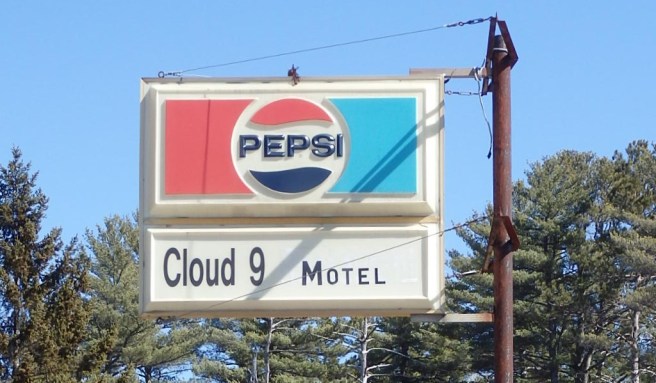
Heavenly rest? The Pepsi sign always raises a chuckle

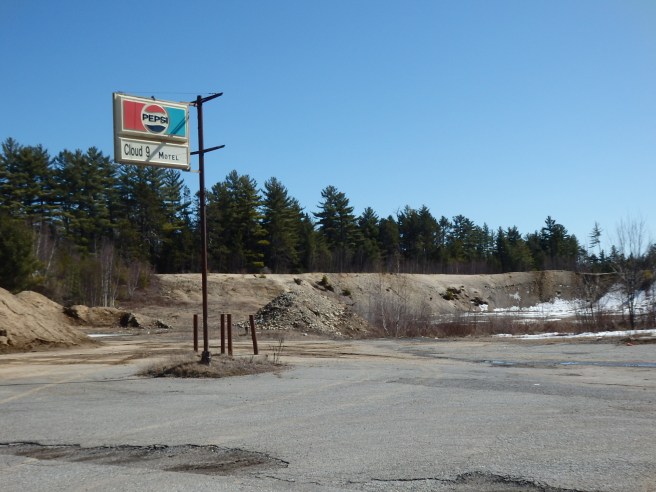
The Cloud 9 Motel sign stands out along State Route 9. Initially, the name seemed to reflect some misplaced hip ’60s jargon. What we encounter is far from a plush, consummate destination. Eventually, I connected the “9” to the highway. Ha-ha.
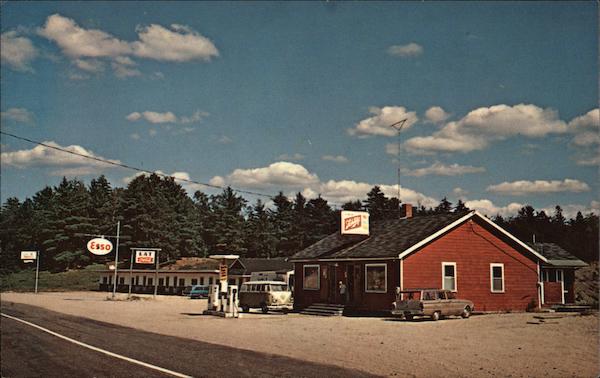
As you can see, there’s no motel, just a sand pit, on Maine Route 9 – the Airline Highway – four miles west of Wesley.
A postcard shows the place in its prime in the ’70s. It had eight heated motel units and sold gasoline, groceries, beer to take out, and light lunches in what it touted as the heart of some of the finest hunting and fishing in Maine. Many of the sportsmen returned annually, but times change. The buildings came down in 2015.

A definite sign of spring

Around here, you know spring has arrived when you see your first boat riding a trailer down the street. An uncovered boat, free of its shrink-wrap or tarp. Behind a battered pickup, of course.

And you can bet yourself that by the end of the day, you’ll have seen a second, if not more.

Who cares if there’s still ice on the lakes?

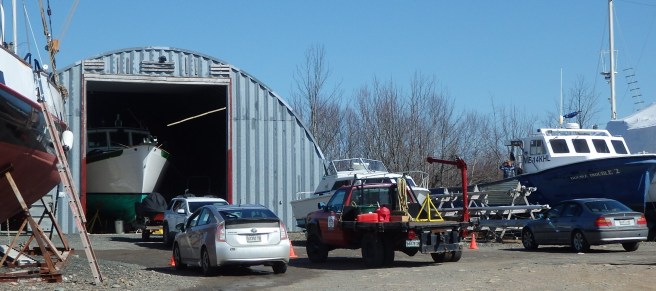
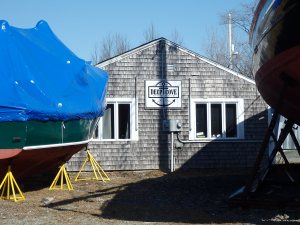
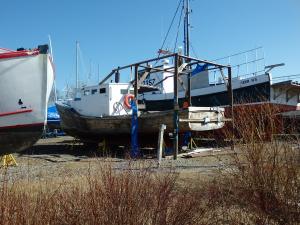
Deep Cove boatyard  

Eastport has the only big boatyard between Halifax and Bar Harbor, and, as they boast, the cheapest one on the East Coast.
Moose Island Marine Inc. operates the sprawling yard out of a modest office.
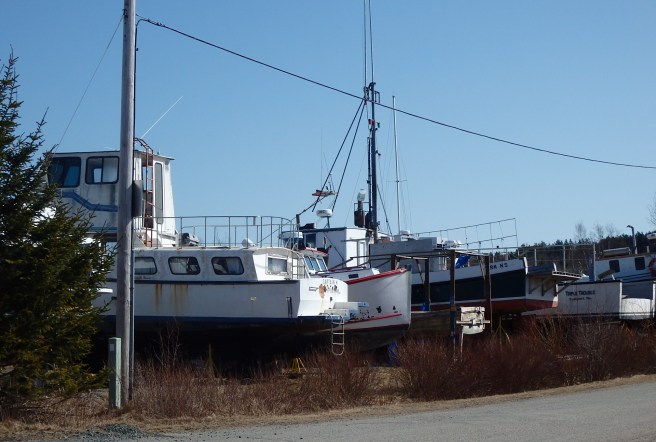
It’s a legacy from earlier days when shipbuilders popped up everywhere along the shoreline.
I do have to learn to identify the various boat styles.


Whazup

after several attempts to figure out how I’d list only what time and last-minute barreling impulses or friendships I wouldn’t want to lose these connections of phone calls and homespun meals in the absence of wild affection I’d lap up even distant lines as in conversation overheard ditto worship to lasso random thoughts and outline a start, so in the mailbox and an income besides to say nothing absolutely nothing about Jesus or just so many wildcards you keep some order re: the recording clerk, both our annual budget and a reminder the dues are due chock full of gossip I’d veer in adoration toward lunacy any day