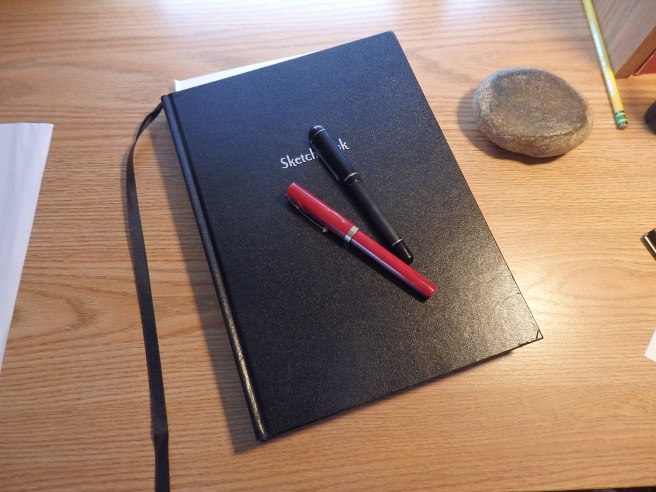
How much interest would there be in my new book?

The literary great Samuel Johnson once quipped, “No man but a blockhead ever wrote except for money,” but he also ascribed to the  pejorative term of “hack writer” for those who set down words as an income. It makes for an impossible bind. After all, he was a stickler for quality literature.

That perspective could generate guilt among some of us who did our best to defend the language in what Johnson would have considered grub work – in my case, daily journalism, with its effort at an anonymous style and universal voice. And yet, for me, at least, there remained an aspiration for something loftier, more lasting, more artistically and intellectually demanding but which, as I’ve found, had no monetary value.

Do I regret the effort? Not when I sit down and reread the published but largely neglected fiction and poetry. Pointedly, it has come at a heavy personal cost in time and foreclosed opportunities, no matter any satisfaction I feel.

CURIOUSLY, I DOUBT that anyone has felt the pain of this dichotomy more than novelist Stephen King, even though I’m certain he’s never heard of me. He has, though, articulated the gap between the writing for wide readership and for critical acclaim better than anyone else. Writing under pseudonyms, he has demonstrated a mastery of the craft, and under his own name, some deep insights into the art of crafting a novel. He deserves great credit for getting a public reading books, against all odds.

MY CURRENT QUANDARY comes in trying to decide which course to take regarding my latest – and likely last – manuscript. I’ve found researching it to be exciting; my findings, provocative and original; and the current voice that’s resulted, lively and entertaining. I get animated just talking about its content, and the listeners catch on. The problem is that it’s still a niche product, as far as marketing goes.

I mean, a history of the Quaker Meeting in Dover, New Hampshire?

Yes, it has the freaky potential to break out, but that’s a gamble.

The book moves novelistically. There are some big villains, a contrarian take on New England itself, a long period of frontier violence, historical surprises, a look at a subculture something like today’s Amish, and political dissent. What a volatile mix!

I’ve approached a couple of regional publishers but heard nothing from one. Not that I’m surprised. They survive by being conservative and cautious. Still, it would relieve me of a lot of effort in production and distribution that I just don’t feel up for. I’m more optimistic, cautiously, about the other. As I posted earlier, I’m ready for a break. Let them keep some of the change.

Plan two would be to issue it as an ebook, like my novels, and via Amazon’s KDP, where it would also be available as a print-on-demand paperback. I’m not sure how to include the maps in those formats, though, and the work wouldn’t be available in bookstores. Much of the sales of the paper edition would be, as they say, from the trunk of my car – after readings and talks, essentially. As for libraries? Marketing of an ebook remains, from my experience, very difficult. People want something physical to examine, even if they buy otherwise.

The third option is through one of several self-publishing programs that distribute to bookstores. (The stores won’t touch the Amazon editions, since they would have to sell at a higher price to cover their added costs.) For reviewers, it’s more respectable than Amazon. You might even pick up some book clubs. The bigger problem is that this route would require me to invest some big bucks. At this time, I have no way of knowing whether the investment would be offset by sales in bookstores, mostly in New England. Or, put another way, I’m feeling way out of my league or field of expertise. Yes, I would have a product I could feel proud of. But could I make the numbers add up? My wife advises me to consider it like joining a country club. Hmm. One involves dropping balls into holes.

A fourth alternative is to shelve it altogether, maybe even taking the money I would have spent and finally traveling off to Europe. Let myself be content with the overview I’m presenting in weekly installments here at the Barn.

One thing I’m not doing here, contrary to Johnson, is being mercenary.

What course would you suggest pursuing?
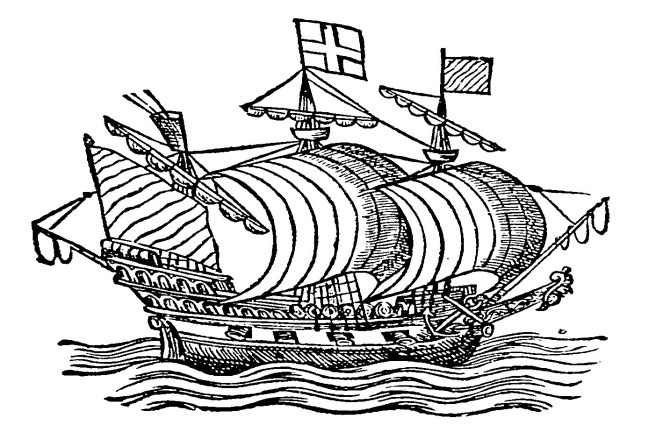
I would love to know more of the ways Devonshire influenced the settlement  

One of my key insights into Dover’s early character came after noticing that the majority of its early residents came from Devonshire – or Devon – rather than the East Anglia shires of Norfolk, Suffolk, Essex, and Cambridge that dominated New England’s Puritan migration, construction, and social order.

And that holds for even the Puritans who take over Dover in 1633 (or so).

In his groundbreaking Albion’s Seed: Four British Folkways in America (Oxford University Press, 1989), David Hackett Fischer elaborates on what he calls the various folkways of four distinctly different regions of Britain, which in turn gave Colonial Massachusetts, Virginia, the Delaware Valley, and the Backcountry their unique natures – divergences that continue, to various degrees, today.

I had already observed that Dover and, for that matter, New Hampshire’s only other towns of the first 70 years – Hampton, Exeter, and Portsmouth – weren’t built around a definitive town square with its church, town hall, and common, as were typical towns in Massachusetts. It’s a hint that the differences run much deeper.

While Fischer goes into great detail on East Anglia’s impact on Massachusetts, he does not in turn examine Devon. At most, he touches on it as he turns to a larger and vaguer area that provided the Cavalier migration into Virginia, one with a center more in South England rather than the South West of Devon. And much of his presentation focuses on the ways they evolved in Virginia, contrasting life in Massachusetts.

Still, he points to differences that go back into antiquity. The language and laws of Devon and its neighboring shires for example, were shaped by West Saxons to the east and Celts to the north and west. In contrast, East Anglia’s are rooted in its Danish occupation.

From the little I’ve been able to glean thus far comes statements that Devon was regarded as backward by many, a repository of the “old England” of superstition and legend. It was a place of seafaring, with Plymouth as a principal port and Bristol just to the north, and of large manors with their landed gentry.

The merchants of Devon sent ships far on the sea. It was in their blood.

There are also suggestions of crucial ways its social manners and religious affinities deviated, affecting how Dover residents interacted with the itinerant Quakers.

No, the English weren’t all alike, not by a long shot. Often, they couldn’t even understand the dialect from another part of Britain.

I would love to see a comprehensive study of those Devon folkways along the lines of Fischer’s earlier work. It would no doubt give us a much more detailed picture of life along the Piscataqua in those seminal decades of settlement. How they cooked and dressed, for instance, or raised their children or treated illnesses or buried their dead, as starters.

Still, my upcoming book shares what I’ve found so far.

So much for preserving footprints in the sand

After 50 years of keeping a journal, though more often of a weekly than daily regularity, I’ve passed the 200-volume mark. By now, most are hardbound, while others, especially early on, were of spiral-bound notebook nature or smaller size.

A few people in my past who admitted to trespassing into their contents were all disappointed. Guess they were expecting juicy details, though one was quite angry and accusatory. Look, mental health requires someplace to spew forth, and if a journal isn’t safe, corking up will only mean the feelings will fester.

Except that few of my entries articulate my emotions, feelings, or sensations. Yes, there were way too many of the hippie-era wow variety, but mine soon became a matter of tracking my ongoing activity. Just trying to remember what I did, who I met, what I saw filled the pages, when I could get to them.

Even so, they remain prompts into so much that happened at the time. And without them? There are no photos. Could that be why everybody is shooting like crazy with their cell phones?

The first newspaper editor who hired me, Glenn Thompson, urged me to keep a journal, though I didn’t get around to the practice until three years later, shortly after graduating from college. Still, I am everlastingly grateful. For the record, I was trying to puzzle together my “problem,” at least as it applied to the lack of a love life. Instead, it began noting the highs, even in the absence of a lover. And then began going from there.

Yes, I wish I had started earlier, there are so many details of my life I’ve forgotten and a trail from there would be deeply helpful in seeing how I eventually landed where I have.

Still, looking back, maybe mine aren’t journals, after all, but maps of my time, movements, and interests.

How do you keep track of where you’ve been?

Ten things about the leading lady in my life

Quite simply, she’s the coolest woman I’ve ever known. Warts and all. Now for some details.

  1. She’s an idealist while having no tolerance for b.s.
  2. Witty, even caustic, but never cruel. The truth, however, can sting.
  3. Much smarter than me, and better read, though knowing everything can be a problem. In other words, she remembers everything, especially what I’ve done wrong.
  4. I love watching her, the way she moves, the twinkle in her eye, the perplexed twist of her lips while solving a problem. Oh, yes, and her long, long hair.
  5. Has an artsy, natural style that leans toward earth-tones, folk sources, and simplicity.
  6. She’s frugal but generous.
  7. Has never been remunerated in just compensation to her societal contributions. If she were, we’d be living in high style.
  8. Is one of the world’s great cooks. And that extends to the garden, though she rarely has time for the weeding. The problem is, neither do I.
  9. Is gifted in spades with empathy. Only she can’t understand why the rest of us can be so lacking in it.
  10. Should have been an astronaut.